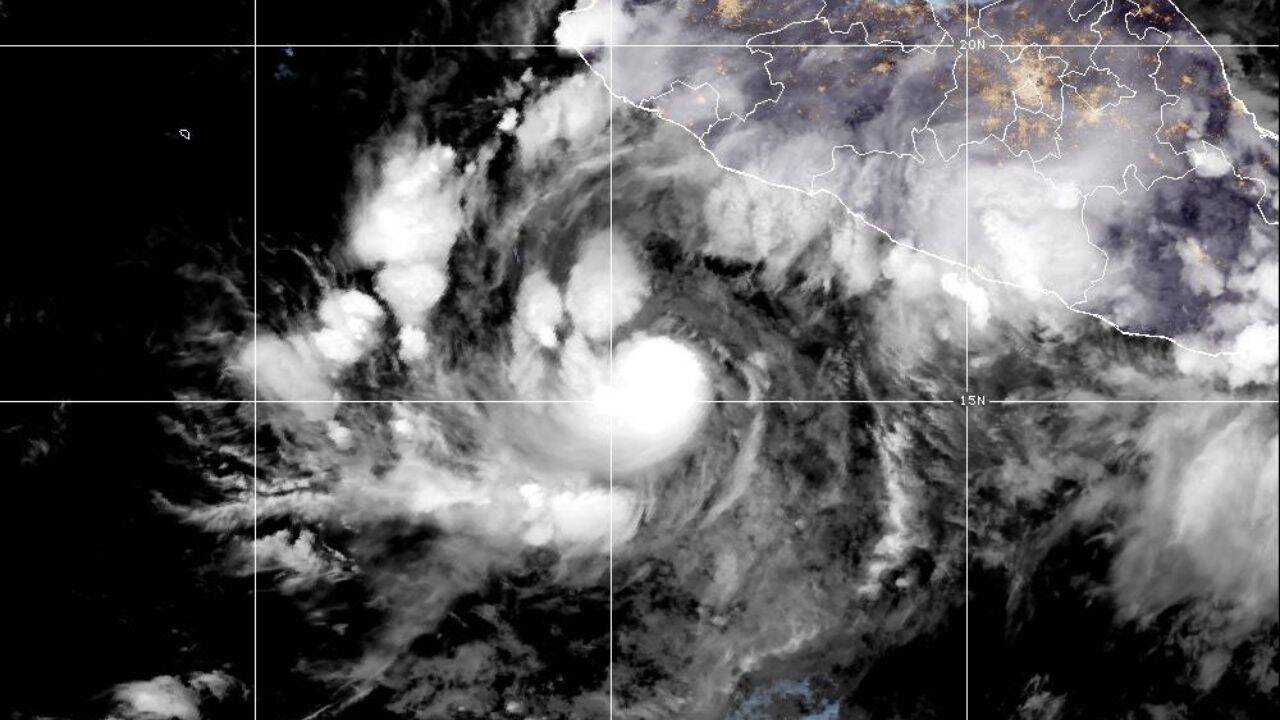
Severe tropical cyclone formation relies on an unforgiving thermodynamic feedback loop, operating as an atmospheric heat engine where energy conversion rates dictate the trajectory from a disorganized cluster of thunderstorms into a catastrophic powerhouse. When Hurricane Simon traversed the Eastern Pacific, its trajectory exposed the exact operational failure points of standard meteorological predictive models. Understanding how a tropical system scales from modest sustained winds into a major classification within hours requires isolating the environmental inputs, ocean thermal capacity, and structural wind shear dynamics that govern oceanic kinetic energy conversion.
The primary driver behind the sudden intensification of systems like Simon is upper-ocean heat content coupled with a low-shear atmospheric column. Tropical cyclones do not merely draw energy from surface sea temperatures; they rely on an integrated column of warm water extending dozens of meters below the surface. When a storm tracks over a pool of high ocean heat content, surface mixing normally causes upwelling, bringing cooler deep water to the surface and choking the storm's fuel supply. Simon encountered a localized regime where vertical mixing failed to mitigate surface thermal inputs, maintaining high boundary-layer enthalpy. This constant thermal flux allows incoming moisture to evaporate at maximum potential, fueling the inner core convection without interruption.
At the core of this thermodynamic engine lies the efficiency of latent heat release. As warm, moist air spirals inward toward the low-pressure center, it ascends rapidly within the eyewall. The condensation of water vapor releases latent heat into the column, warming the core relative to its environment. This temperature differential decreases surface pressure further, drawing in more air at a higher velocity in a self-reinforcing loop known as potential intensity. Simon bypassed standard intensification caps because its inner-core moisture distribution minimized dry-air entrainment. Dry air intrusion typically acts as an operational brake on intensifying cyclones by causing evaporative cooling in the mid-troposphere, which shuts down updrafts. By maintaining high relative humidity across the surrounding troposphere, Simon protected its convective plumes from degradation.
Evaluating the structural response of the vortex reveals why forecasting these transitions remains an ongoing analytical challenge. Traditional numerical weather prediction models often underpredict the rate of pressure falls during rapid intensification phases due to grid-resolution limitations. These models frequently fail to capture the scale-interaction between mesoscale convective bursts and the broader vortex circulation. When a system undergoes eyewall contraction, the radius of maximum winds shrinks, spinning up the inner core through conservation of angular momentum. Simon executed this structural tightening rapidly, concentrating its kinetic energy into a tighter spatial footprint. This concentrated wind field increases surface friction over water, which ironically enhances moisture flux into the core, accelerating the intensification cycle until an eyewall replacement cycle introduces structural instability.
Anticipating the downstream operational impact of such rapid shifts requires moving past static categorization systems toward continuous risk profiling. Emergency management frameworks must abandon linear evacuation timelines, incorporating real-time boundary-layer sensor data that tracks inner-core thermodynamic efficiency rather than relying solely on legacy wind-speed metrics. Systems possessing compact structures like Simon exhibit extreme localized destructiveness that broad-scale tracking models fail to isolate accurately. Infrastructure resilience strategies must therefore account for sudden, non-linear surges in kinetic energy density, designing fail-safes for electrical grids and coastal defenses that can withstand abrupt localized pressure differentials rather than generalized seasonal averages.


