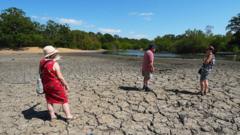
Climate data released by the Met Office indicates that the summer of 2026 in the United Kingdom is tracking toward unprecedented temperature thresholds, exposing systemic vulnerabilities across national infrastructure, supply chain logistics, and public health systems. When ambient temperatures breach historical baseline deviations, the failure modes shift from localized discomfort to macro-level economic contraction. Evaluating this seasonal anomaly requires moving past sensationalized weather reporting and examining the underlying physical mechanisms, cascading failure vectors, and financial friction points generated by prolonged extreme heat.
The Thermodynamic Drivers of the 2026 Anomaly
The meteorological setup driving the current summer temperature profile involves persistent high-pressure blocking patterns stationed over Western Europe. These atmospheric ridges act as thermal domes, compressing lower-level air masses, suppressing cloud formation, and maximizing solar insolation over the British Isles.
Unlike maritime temperate climates historically buffered by oceanic heat sinks, the UK geography is increasingly susceptible to continental advection. When prevailing winds draw air masses from North Africa and Southern Europe across the English Channel, the thermal energy is largely conserved.
The Heat Retention Multiplier
The primary factor accelerating the 2026 temperature metrics is not merely daytime solar input, but the compounding effect of nocturnal minimum temperatures. Urban and suburban environments exhibit high thermal mass due to construction materials like asphalt and concrete. These surfaces absorb shortwave radiation during peak daylight hours and release longwave radiation throughout the night.
When nighttime cooling fails to drop below critical thresholds, human physiology and urban infrastructure experience continuous thermal loading. This lack of recovery time accelerates cumulative fatigue in biological and mechanical systems alike, driving up peak energy demand for cooling while degrading grid efficiency.
Infrastructure Vulnerability and Systemic Failure Points
National infrastructure in the United Kingdom was engineered for a temperate baseline. The structural integrity of transit networks, power distribution grids, and water management facilities assumes an operational envelope that rarely exceeds specific thermal ceilings. Sustained temperatures projected for the summer of 2026 challenge these legacy engineering parameters.
Rail and Road Network Degradation
Steel rail systems expand under high direct solar radiation. When rail steel temperatures exceed ambient air temperatures by significant margins, lateral track buckling becomes a severe operational risk. Speed restrictions are deployed as a mitigation strategy, but these restrictions disrupt freight and passenger throughput, cascading delays across integrated logistics networks.
Road surfaces face parallel degradation. Asphalt binder softens under prolonged high radiant heat, leading to rutting and structural deformation under heavy commercial freight loads. This accelerates capital expenditure requirements for emergency highway maintenance while increasing transit friction for supply chains.
Power Grid Load Inefficiencies
The energy sector confronts a dual-vector challenge during extreme heat events. First, consumer and commercial demand spikes due to the deployment of mechanical cooling units, air conditioning, and refrigeration systems operating at maximum capacity. Second, the efficiency of power transmission lines and transformers degrades as ambient temperatures rise. Higher resistance in transmission lines results in greater resistive line losses, reducing overall grid throughput precisely when demand hits structural peaks.
Furthermore, thermoelectric power plants rely on nearby rivers and coastal waters for cooling cycles. When intake water temperatures rise, the thermodynamic efficiency of power generation drops, and environmental regulations may force plant curtailments to prevent thermal pollution in local aquatic ecosystems.
Public Health Economics and Workforce Productivity
Human capital efficiency declines predictably as ambient wet-bulb and dry-bulb temperatures exceed optimal thermal comfort zones. The economic cost of the 2026 temperature surge manifests primarily through diminished labor productivity, increased healthcare system utilization, and elevated mortality rates among vulnerable demographics.
Cognitive and Physical Labor Impairment
Occupational physiology research demonstrates that cognitive function, decision-making accuracy, and manual dexterity drop sharply in unconditioned environments when ambient temperatures cross baseline thresholds. Construction, logistics, and manufacturing sectors face productivity losses as mandatory rest breaks increase and work rates slow down to mitigate heat-stress illnesses.
Organizations lacking robust climate adaptation protocols experience absenteeism and increased error rates. The economic drag compounds across supply chains that rely on manual sorting, warehousing, and outdoor operations.
Healthcare System Resource Allocation
Hospitals and primary care facilities face surges in admissions driven by heat exhaustion, dehydration, and the exacerbation of pre-existing cardiovascular and respiratory conditions. The challenge for healthcare administrators is managing fixed-capacity facilities during acute demand spikes without compromising standard care pathways. Emergency response times lengthen as ambulance services process higher call volumes related to heat-induced medical emergencies.
Supply Chain Friction and Agricultural Yield Compression
Agricultural output and supply chain integrity are inextricably linked to regional water balances and thermal stress boundaries. The 2026 summer heat trajectory amplifies evapotranspiration rates across arable land, accelerating soil moisture depletion.
Crop Stress and Yield Volatility
Staple crops experience physiological shock when exposed to prolonged heatwaves during critical flowering and grain-filling stages. Livestock production similarly suffers from heat stress, which reduces feed conversion efficiency, dairy yield, and animal weight gain. The resulting contraction in domestic agricultural output places upward pressure on food input costs, altering consumer price indices across retail grocery sectors.
Cold Chain Logistics Integrity
Transporting temperature-sensitive goods—including pharmaceuticals, fresh produce, and dairy—becomes significantly more complex during extreme weather events. Refrigerated transport units must work harder against high ambient thermal gradients. Fleet operators face higher rates of mechanical failure in refrigeration compressors, increasing spoilage rates and financial loss across the cold chain distribution network.
Strategic Operational Mitigation for Enterprises
Organizations operating within the UK market must transition from reactive crisis management to structured resilience planning. Relying on historical weather baselines is no longer a viable risk management strategy.
Conduct a comprehensive asset audit to identify thermal bottlenecks across physical facilities, IT server rooms, and supply chain dependencies. Implement dynamic scheduling for outdoor and logistics workforces, shifting heavy labor hours to cooler early-morning windows. Modernize building envelopes with passive cooling interventions, reflective exterior coatings, and improved internal ventilation to reduce mechanical cooling loads. Diversify supplier networks to hedge against regional agricultural and manufacturing disruptions caused by localized weather extremes. Establish clear threshold triggers for operational scaling, ensuring business continuity protocols activate automatically when temperature metrics breach defined parameters.