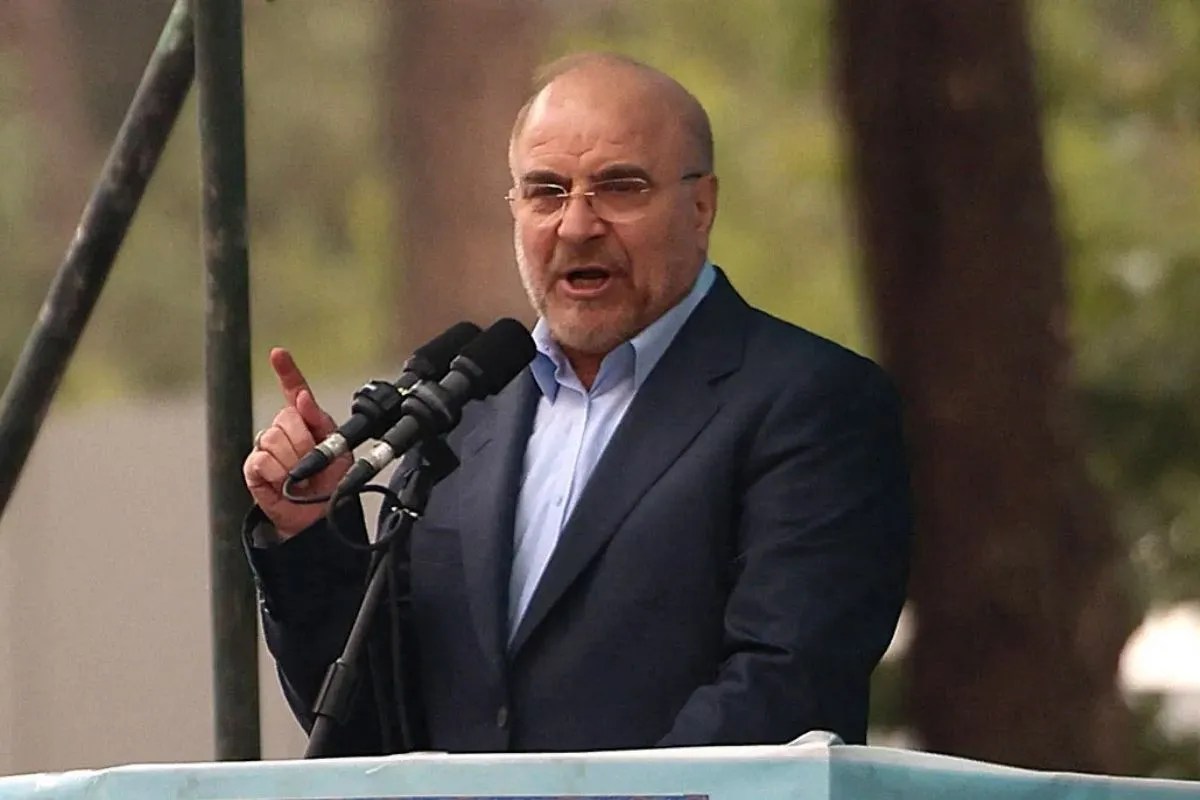
The recent pronouncement by Mohammad Bagher Ghalibaf, Speaker of the Iranian Parliament, asserting that stability in Lebanon is an existential priority for Tehran, signals a shift from ideological rhetoric toward a formalized doctrine of regional security interdependence. This stance implies that the Iranian state no longer views Lebanese stability as a peripheral objective, but as a core component of its own domestic security architecture. To understand the mechanics of this shift, one must examine the operational, economic, and diplomatic feedback loops between Tehran and Beirut.
The Doctrine of Strategic Depth and Border Equivalence
Tehran’s security logic operates on the principle of strategic depth, which suggests that Iranian national security is defended at the borders of its allies rather than its own frontiers. Ghalibaf’s statement codifies a "Border Equivalence" framework. Under this framework, a security breach in Southern Lebanon or a collapse of the Lebanese state apparatus is viewed by the Iranian Supreme National Security Council as a direct breach of Iranian sovereignty.
This interdependence is driven by three primary variables:
- The Deterrence Multiplier: Lebanon, specifically through Hezbollah’s capabilities, serves as a primary deterrent against external strikes on Iranian nuclear or military infrastructure. If Lebanon is destabilized, the cost-benefit analysis for adversaries considering a strike on Iran shifts toward intervention.
- The Logistics of the Land Bridge: Lebanon represents the Mediterranean terminus of a logistical corridor spanning Iraq and Syria. Instability in Lebanon creates a bottleneck that renders the entire corridor high-risk and low-utility.
- Institutional Legitimacy: The Iranian "Revolutionary Export" model relies on the perceived success of its regional partners. A failure in the Lebanese theater would signal a systemic failure of the Iranian external security model.
The Cost Function of Lebanese Instability
When Ghalibaf equates Lebanese peace with Iranian peace, he is acknowledging the escalating economic and military costs of maintaining a "frozen conflict." For Iran, the cost function of Lebanese instability is calculated through resource diversion and diplomatic friction.
The financial burden of supporting an ally in a state of perpetual crisis or active warfare is significant. Iran’s economy, currently navigating internal structural pressures and international sanctions, faces a diminishing marginal utility in funding reconstruction or prolonged military engagements. By prioritizing a "peace" or "stability" mandate, Tehran is signaling a desire to transition from a high-intensity conflict posture to a sustainable influence model. This transition requires a stable Lebanese state capable of maintaining basic infrastructure, which in turn reduces the direct financial burden on Tehran.
The Diplomatic Triangulation of the Speaker’s Statement
Ghalibaf’s background as a former commander in the Islamic Revolutionary Guard Corps (IRGC) and his current role in the legislative branch gives his words a specific dual-authority. He is not merely speaking as a politician but as a strategist. His focus on peace is a tactical deployment of "Realpolitik" designed to achieve three diplomatic objectives:
- Regional De-escalation: Signaling to Gulf neighbors that Iran is interested in a stable Levant, potentially easing the path for broader regional normalization agreements.
- Pressure on Western Negotiators: Positioning Iran as a necessary stakeholder in any Lebanese peace process. This forces international actors to acknowledge that no durable solution in Beirut can be achieved without Tehran’s consent.
- Domestic Posturing: Communicating to a domestic Iranian audience that the government is focused on ending regional tensions, which are often cited by the Iranian public as a drain on national resources.
Structural Constraints and the Risk of Miscalculation
While the rhetoric emphasizes peace, the structural reality of the "Axis of Resistance" presents a friction point. The primary limitation of Ghalibaf’s "stability equals security" thesis is the inherent volatility of the Lebanese political landscape.
Lebanon’s confessional system of government is prone to paralysis. If Iran seeks stability to protect its own interests, it must manage the internal Lebanese contradictions that its own presence often exacerbates. This creates a paradox: Tehran requires a strong, stable Lebanese state to act as a buffer, yet the presence of a powerful, autonomous non-state actor (Hezbollah) inherently complicates the centralization of Lebanese state power.
Furthermore, the mechanism of "Strategic Interdependence" means that Iran is now more vulnerable to Lebanese domestic shocks. A localized conflict in the Bekaa Valley or a total economic meltdown in Beirut now has a direct, quantifiable impact on Iran’s diplomatic leverage in Vienna or Geneva.
The Pivot from Asymmetric Warfare to Managed Stability
The shift in language from "resistance" to "peace and stability" suggests that the Iranian leadership has reached a saturation point regarding regional expansion. The goal is no longer the acquisition of new influence, but the protection and management of existing assets.
The "Peace as a Strategic Asset" model implies:
- Enhanced Intelligence Sharing: A shift toward formalizing security cooperation between the Lebanese Armed Forces and Iranian-aligned elements to prevent internal collapse.
- Economic Integration: Using Lebanon as a secondary market for Iranian goods and energy, provided the Lebanese state can maintain enough stability to facilitate trade.
- Controlled Conflict Tensions: Ensuring that military engagements remain within "red lines" that do not trigger a total regional war, which would be catastrophic for the current Iranian economic trajectory.
This is not a pacifist turn. It is a refinement of power projection. Iran is betting that a stable Lebanon, under its influence, is a more effective shield than a chaotic Lebanon in a state of total war. The risk remains that the actors involved may misinterpret "peace" as a sign of weakness, leading to aggressive maneuvers that force Tehran back into a high-cost conflict cycle it is clearly attempting to avoid.
The strategic play for regional actors moving forward is to test the limits of this "Peace Doctrine." If Tehran truly views Lebanese stability as equivalent to its own, it will be forced to make significant concessions in Lebanon to prevent escalation—a vulnerability that may be exploited by competing regional powers. Conversely, if Tehran can successfully manage a "stable" Lebanon, it will have successfully institutionalized its influence in the Mediterranean for the next decade.
The immediate requirement for Iranian policy is the stabilization of the Lebanese presidency and the implementation of a financial framework that prevents total economic disintegration. Failure to secure these two pillars will render Ghalibaf’s statement a hollow aspiration, leaving Iran exposed to the very regional volatility it seeks to mitigate.