Belgium’s 4-1 victory over the United States in the FIFA World Cup 2026 Round of 16 at Seattle Stadium provides a textbook study in tactical asymmetry. While mainstream media narratives focused heavily on the pre-match geopolitical and administrative friction surrounding Folarin Balogun’s rescinded suspension, the technical reality of the match was determined by three distinct tactical vectors: Belgium's calculated squad rotation, structural flaws in the United States low-block defensive shape, and catastrophic individual processing errors under high-pressing triggers.
By analyzing the mechanics of Rudi Garcia’s selection gambit and the structural breakdowns within Mauricio Pochettino’s defensive apparatus, we can isolate exactly why the final co-host fell in the first knockout stage.
The Strategic Gambit: Inverted Selection Architecture
Rudi Garcia’s decision to bench premier creative engine Kevin De Bruyne and dynamic winger Jeremy Doku was widely interpreted as an extreme risk. In execution, it operated as a highly deliberate load-management and tactical isolation strategy designed to exploit the specific structural vulnerabilities of the United States.
The rationale behind this rotation relies on two primary mechanisms:
- Forced Defensive Reorientation: The absence of De Bruyne altered Belgium's progression model. Instead of relying on centralized vertical zone progression, Belgium shifted to wide overloads driven by Leandro Trossard and Nicolas Raskin. This forced the American backline to continuously stretch laterally, creating massive pockets in the half-spaces.
- Physical Sustainability: By preserving elite transition assets for the upcoming quarter-final against Spain, Garcia gambling on the analytical premise that Belgium's second-line depth possessed a high enough tactical floor to break an uncoordinated American press.
The primary beneficiary of this system was Charles De Ketelaere, who operated not as a traditional focal point, but as an advanced space-interpreter. His opening goal in the ninth minute demonstrated the exact mechanical breakdown Garcia anticipated. Trossard’s delivery forced the US central defenders into a recovery retreat, breaking their vertical alignment. Raskin's subsequent low cross exploited the blind-side gap behind the recovering defenders, leaving De Ketelaere an unimpeded tap-in.
Defensive Volatility and the Breakdown of the American Low-Block
The United States temporary equalization via Malik Tillman’s 31st-minute free-kick masked severe underlying structural deficiencies. Tillman’s strike—a deflected effort that wrong-footed Thibaut Courtois—was a low-probability event that did not reflect sustainable offensive generation. The structural fragility of the United States defensive shape was exposed just 116 seconds later.
The sequence leading to De Ketelaere’s second goal exposes the lack of horizontal compactness in Pochettino's defensive block:
- Failure to Delay Wide Progression: The US right-back failed to apply immediate pressure on Trossard on the left flank, allowing the winger time to measure his crossing trajectory.
- Loss of Spatial Awareness in the Box: The US central defenders dropped too deep into their own six-yard box, failing to check the runs of oncoming attackers.
- Aerial Mismatch Isolation: De Ketelaere read the flight of the ball while maintaining forward momentum, easily outjumping a static American backline to convert his header.
This immediate regression to a defensive deficit highlights a psychological and tactical brittleness. The inability to manage transition phases immediately after scoring points to an unrefined phase-shifting mechanism within the team's tactical framework.
[US Low-Block Failure Mechanics]
Wide Progress -> Uncontested Cross -> Backline Drops Too Deep -> Spatial Void in 18-Yard Box -> Headed Goal
Systematic Catastrophe: The Cost Function of High-Risk Goalkeeping
If the first half exposed structural errors in positioning, the second half illustrated a failure in risk mitigation. Hans Vanaken’s 57th-minute goal, which effectively ended the United States' competitive viability, resulted from a breakdown in situational processing by goalkeeper Matt Freese.
The mechanics of the error present a clear warning regarding aggressive sweeping actions without proper recovery tracking:
Freese Rushes Out of Box -> Fails to Meet Ball -> De Ketelaere Steals Possession -> Vanaken Long-Range Execution
Freese’s decision to leave his penalty area to clear a long ball lacked the requisite spatial margin. By missing the ball entirely, he removed the final line of defensive coverage. The subsequent attempt by veteran defender Tim Ream to block Vanaken’s long-range shot failed because the structural positioning of the entire defensive unit had already dissolved into emergency recovery mode.
In elite international football, the probability of an opposing midfielder converting an open shot from distance into an empty net approaches certainty. This error altered the game's state, forcing the US into high-variance, low-efficiency offensive shapes that left them highly vulnerable to counter-attacks.
The Balogun Paradox: Administrative Interventions vs. On-Pitch Suffocation
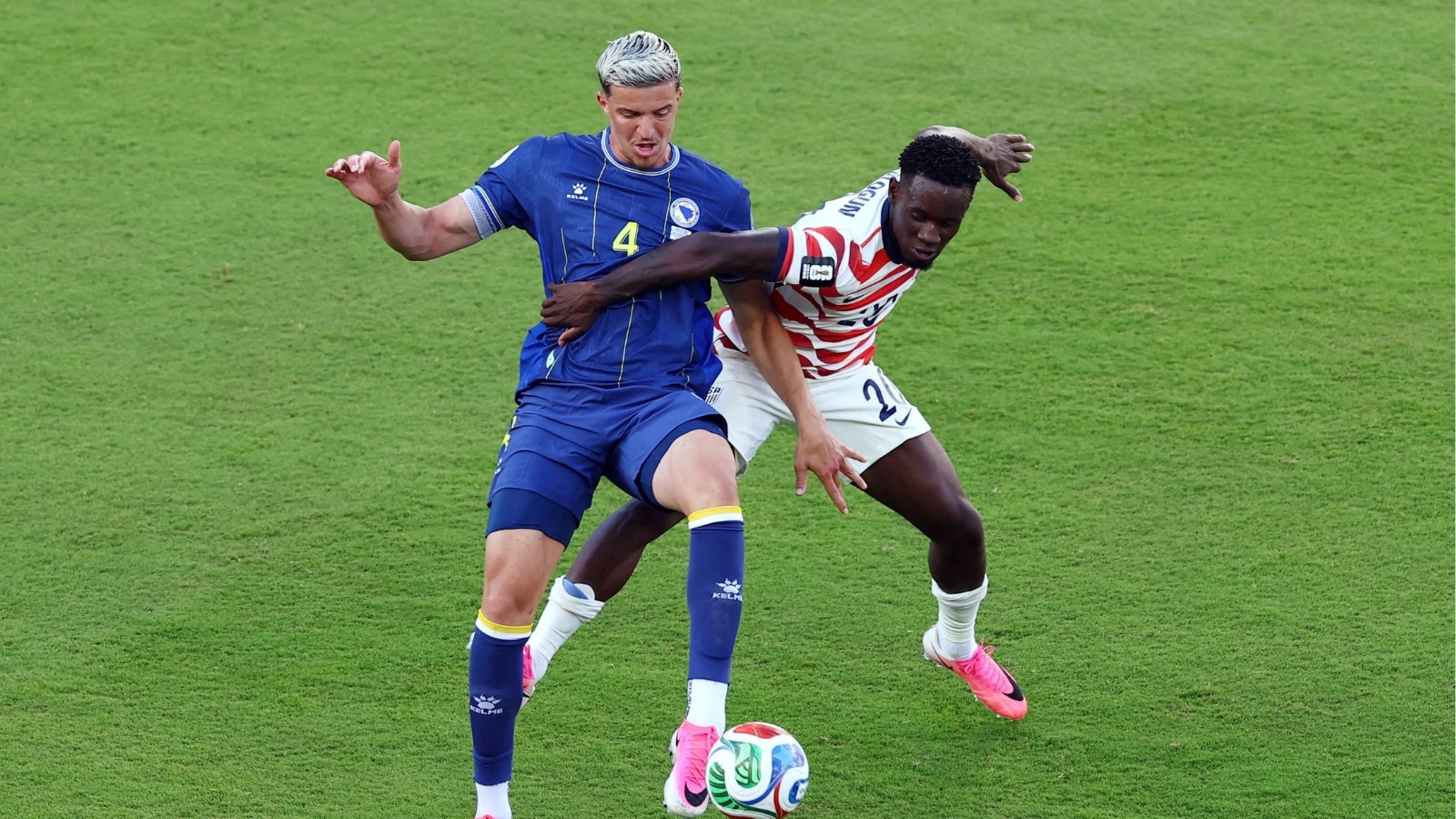
The administrative intervention that allowed Folarin Balogun to start despite a prior red-card offense served as a case study in inefficient asset optimization. FIFA's reversal of the suspension gave the US its premier attacking threat, yet Pochettino's tactical setup failed to create the conditions necessary for Balogun to influence the match.
Belgium neutralized Balogun through a rigid defensive constriction framework:
- Vertical Suffocation: Real Madrid goalkeeper Thibaut Courtois and his central defensive pairing denied Balogun any service into depth. By maintaining a disciplined, mid-to-low block when out of possession, Belgium eliminated the space behind their defensive line, rendering Balogun's elite acceleration useless.
- Passing Lane Disruption: The Belgian midfield pivot aggressively choked the half-spaces, preventing Tillman and the American wingers from executing clean progressive passes into Balogun’s feet.
When Balogun did manage to break loose in the closing stages, Courtois demonstrated world-class shot-stopping mechanics, denying two late opportunities. Romelu Lukaku’s stoppage-time goal (90+3') was the mathematical consequence of an over-extended American side operating with zero defensive structural integrity in search of an improbable comeback.
Strategic Play: Preparing for Spain's Possession Monopoly
Belgium’s victory secures a quarter-final match against Spain at SoFi Stadium on July 10. While a 4-1 scoreline suggests dominant form, Garcia faces an entirely different tactical problem against Luis de la Fuente’s squad, which advanced after a structurally flawless 1-0 clean-sheet victory over Portugal.
To survive the quarter-final, Belgium must address distinct operational limitations exposed during their round of 16 victory:
- Midfield Retention Thresholds: While Vanaken and Tielemans controlled the tempo against an uncoordinated American press, Spain’s counter-pressing efficiency is elite. Garcia cannot afford to bench De Bruyne or Doku against a Spanish midfield that excels at positional suffocation.
- Transition Vulnerability: The brief periods of defensive disorganization that allowed Tillman to win a dangerous free-kick will be decisively punished by Spain’s quick vertical combinations.
The strategic imperative for Belgium rests on their ability to transition from the expansive, wide-overload model used against the United States to a highly compact, counter-punching system designed to break Spain's possession cycles. Relying on individual defensive errors from an opponent will no longer be a viable path to the semi-finals. Garcia must reintroduce his elite creative assets to anchor a low-variance, high-efficiency transition plan.