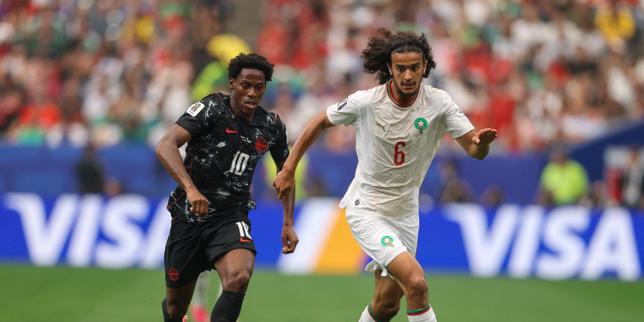
The 2026 World Cup quarter-final fixture between France and Morocco presents a stark confrontation between two fundamentally opposed game models: elite positional possession versus low-block defensive elasticity. This match-up cannot be evaluated through the lens of individual star power or historical prestige. Instead, the outcome depends on measurable spatial mechanics, structural transition efficiency, and how each manager mitigates the specific bottlenecks inherent in their tactical systems.
To understand how this quarter-final will be won or lost, we must deconstruct the pitch into functional zones and analyze the mechanical friction generated when France’s asymmetric attacking shape collides with Morocco’s highly disciplined defensive block.
The Geometry of the Moroccan Low Block
Morocco’s progression to the quarter-finals relies on a defensive architecture designed to minimize space between the lines and force opponents into low-value crossing situations. Operating primarily in a 4-1-4-1 or a compact 4-5-1 mid-to-low block, the Moroccan defensive strategy is governed by strict structural principles.
Horizontal and Vertical Compactness
The primary objective of the Moroccan defensive block is the restriction of vertical passing lanes into Zone 14—the crucial central area just outside the penalty box. Morocco maintains an average distance of fewer than 15 meters between their defensive and midfield lines. This compression denies opposing central attacking midfielders the space required to turn and scan options.
Horizontally, the team shifts as a cohesive unit relative to the position of the ball. When the ball is on the flank, the far-side winger tucks inward to occupy the half-space, effectively transforming the midfield line into a narrow bank of five. This mechanical shifting forces opponents to circulate the ball laterally across the backline, increasing the time the ball spends in transit and allowing Morocco to reset their defensive positioning.
Touchline As an Extra Defender
Morocco deliberately concedes wide areas in their own half, treating the touchline as a structural boundary to trap opposing wingers. Rather than engaging high up the pitch, the Moroccan full-backs delay engagement until the opponent enters the final third.
Once the ball enters the wide channels, the nearest central midfielder and the tracking winger form a defensive triangle with the full-back. This creates a local numerical overload (a 3v2 or 3v1 advantage), neutralizing the opponent's ability to combine effectively or cut inside. The objective is to force a hurried, low-probability cross into a penalty area heavily populated by aerially dominant center-backs.
France’s Asymmetric Overload Engine
France counters defensive compactness through a highly fluid, asymmetric attacking system that relies on isolating elite isolated talents on the flanks while overloading the opposite half-space to unbalance the opponent's defensive structure.
The Left-Sided Overload Mechanics
The French attacking model heavily favors the left channel. The structural mechanism involves three distinct movements occurring simultaneously:
- The left winger maintains maximum width, pinning the opposing right-back to the touchline.
- The left-sided central midfielder advances into the half-space, dragging an opposing central midfielder with him and creating a passing lane.
- The starting left-back occupies an inverted position or underlaps, acting as an auxiliary playmaker or an immediate counter-pressing presence.
This deliberate crowding of the left side forces the opposing defensive unit to slide over aggressively. Once the defensive block has fully committed its weight to that flank, France utilizes rapid, diagonal switches of play to the isolated right winger, who then enjoys a 1v1 isolation scenario against a shifting, unanchored left-back.
The Rest-Defense Bottleneck
The primary vulnerability of France's heavy commitment to advanced attacking positions is the structural integrity of their rest-defense (Restverteidigung). When attacking, France frequently transitions into a 2-3-5 or 3-2-5 shape. If the two central defenders and the holding midfielder fail to position themselves optimally relative to the opponent’s highest outlets, the team becomes highly susceptible to direct, vertical counter-attacks.
A failure to lock down the central corridor immediately upon losing possession allows the opponent to bypass the counter-press with a single progressive pass, exposing the backline to high-velocity transitions.
Transition Dynamics and Choke Points
The match will ultimately be decided during the transitional phases—the volatile seconds immediately following a turnover when neither team is settled into its defensive or offensive shape.
Morocco’s Vertical Transition Function
Morocco does not seek prolonged possession when winning the ball deep in their own territory. Their transition model is optimized for maximum vertical velocity. The mechanics of a Moroccan counter-attack follow a strict sequence:
- The First Pass: The intercepting player immediately looks for a direct vertical pass to escape the immediate counter-pressing zone, targeting the center-forward who acts as a physical hold-up outlet.
- The Third-Man Run: As the ball travels to the center-forward, the opposite-side winger initiates a diagonal blind-side run behind the advancing French full-backs.
- The Second-Ball Collection: The central midfielders sprint forward to capture any knock-downs or loose balls resulting from the initial aerial or physical duel.
If France fails to disrupt the first vertical pass, they will be forced to drop their entire defensive line while running toward their own goal, an operational state that maximizes the probability of defensive errors or tactical fouls.
France’s Counter-Pressing Countermeasures
To neutralize Morocco's transition speed, France employs an aggressive counter-press regulated by proximity. The players closest to the ball loss do not drop; instead, they execute an intense sprint to pressure the ball-carrier within the first three seconds of a turnover. The goal is not necessarily to win the ball back immediately, but to delay the forward pass, thereby allowing the advanced full-backs and midfielders to recover their defensive positions.
France Loss of Possession
       │
       ▼
[Immediate 3-Second Counter-Press]
       │
       ├─► Success: Ball Regained / Forced Turnover
       │
       └─► Failure: Pass Escapes Press
                   │
                   ▼
       [Morocco Vertical Direct Pass] ──► Target: Center-Forward
                   │
                   ▼
       [French Rest-Defense Engagement] ──► Delay / Operational Foul
The efficacy of this counter-press is heavily dependent on the physical conditioning of the French forward line. If the advanced attackers fail to track back or apply pressure, the burden falls entirely on the structural security of the holding midfielders, creating a structural fracture that Morocco can exploit.
Quantifiable Tactical Vulnerabilities
An objective assessment of both teams reveals distinct structural limitations that can be exploited through deliberate tactical adjustments.
Morocco's Depth Management and Fatigue Curves
The low-block system is highly demanding both cognitively and physically. Players must constantly compute spatial distances, shift laterally, and engage in high-intensity collisions. Data from extended tournaments indicates that teams relying on low-block defensive models experience a significant degradation in defensive compactness after the 70th minute.
As physical fatigue accelerates, the distances between the defensive and midfield lines inevitably widen from 15 meters to 25 meters or more. This expansion creates gaps in the half-spaces that elite playmakers can exploit. Furthermore, Morocco's reliance on a settled defensive unit means that injuries or yellow card suspensions to key central defenders drastically reduce the structural integrity of the entire system, as the replacement players often lack the hyper-coordinated spatial awareness required by this model.
France's Vulnerability to Asymmetric Stiffening
Because France commits so heavily to their left-sided attacking dynamics, their offensive output can become predictable. If an opponent manages to neutralize the left flank through defensive doubling and physical imposition, France can struggle to adapt.
The right side of the French attack often lacks the same level of fluid positional rotations. If the diagonal switches of play are intercepted or delayed by a disciplined mid-block, France's possession can degenerate into sterile lateral circulation around the penalty box, generating high possession statistics but low expected goals (xG) metrics.
Strategic Execution Plan
For either side to secure a position in the semi-finals, the managers must execute precise tactical interventions that optimize their strengths while exposing the opponent's structural flaws.
The Tactical Imperative for France
France must avoid the temptation to flood the box with early crosses. Instead, the tactical directive must focus on sustained, patient circulation designed to stretch Morocco’s horizontal lines. France should utilize underlapping runs from the central midfielders to drag Morocco's central defensive block out of position, creating passing lanes for low, cut-back passes from the goal line into the edge of the penalty area. Additionally, the French rest-defense must remain highly conservative, with at least four players consistently staying behind the ball line to prevent Morocco from launching direct vertical counter-attacks upon turnovers.
The Tactical Imperative for Morocco
Morocco's path to victory requires absolute discipline in maintaining vertical compactness. The midfield line must not be enticed to press high up the pitch, as doing so opens the space between the lines where France is most lethal. When in possession, Morocco must bypass the French counter-press by using targeted direct balls to the wide channels rather than through the center, exploiting the vacated spaces left by the advancing French full-backs. Maximizing set-piece efficiency will also be critical; given the expected scarcity of open-play chances, converting a dead-ball scenario represents Morocco’s highest-probability route to breaking the deadlock.
The team that dictates the spatial parameters of this match—whether it is played in the wide, open spaces required by France or within the compressed central corridors protected by Morocco—will determine the outcome of this quarter-final encounter.