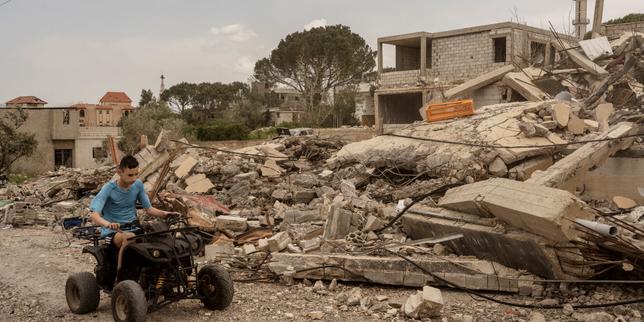
The smoke isn't clearing in South Lebanon. It's thickening. What we’re seeing right now isn't just the collateral damage of a standard military skirmish. It’s the calculated, block-by-block erasing of entire communities. When UN officials recently sounded the alarm about "systematic demolitions," they weren't being hyperbolic. They were describing a reality where villages like Mhaibib or Ramyeh are being wiped off the map with controlled explosions that leave nothing but grey dust and broken rebar.
You’ve probably seen the videos circulating on social media. They usually follow a hauntingly similar pattern. A group of soldiers stands in the foreground, sometimes cheering, as a series of detonations ripple through a residential neighborhood. Seconds later, a dozen homes collapse simultaneously. This isn't a stray missile hitting a target. This is civil engineering used as a weapon of war. The UN has been blunt about this, stating there is no military justification for this level of destruction. Recently making news lately: Structural Integrity and State Fragility Assessing the Claims of Iranian Collapse.
The scale of the disappearing border
Let’s look at the numbers because they tell a story that rhetoric can't hide. Since October 2023, and accelerating sharply in late 2024 and early 2025, over 30 villages along the "Blue Line" have seen significant structural leveling. We aren't talking about a few holes in roofs. In some towns, satellite imagery confirms that 80% of the built environment is gone.
Why does this matter? Because a house isn't just a building. In South Lebanon, these are multi-generational ancestral lands. When you demolish the olive presses, the schools, and the village squares, you’re making the area uninhabitable for decades. The UN Interim Force in Lebanon (UNIFIL) has documented these "clearing" operations and found that they often occur in areas where active combat has already subsided. That’s the red flag. If the fighting is over, why are the houses still falling? Further insights regarding the matter are detailed by USA Today.
Breaking down the military necessity argument
Israel's defense is usually built on the concept of "terror infrastructure." They argue that Hezbollah uses these civilian homes to hide rocket launchers, tunnel entrances, and weapons caches. While it's a documented fact that Hezbollah operates within civilian areas, the legal jump from "there’s a tunnel under this street" to "we must level every house in a three-mile radius" is a massive leap that international law doesn't support.
International humanitarian law, specifically the Geneva Conventions, is pretty clear about this. You can only destroy property if it's "imperatively demanded by the necessities of war." Levelling an entire village to create a "buffer zone" or a "securitized perimeter" usually doesn't meet that high bar. It looks less like defense and more like collective punishment. When you destroy a village’s water tower and its only bakery, you’re not fighting a militia. You’re fighting the possibility of people ever coming back.
The UN response and why it feels like shouting into a void
UN High Commissioner for Human Rights Volker Türk has been vocal, calling these actions a potential war crime. But honestly, the UN’s power in this situation feels more symbolic than anything else. UNIFIL troops, who are supposed to monitor the border, have themselves been caught in the crossfire. They’ve seen their watchtowers hit and their perimeter fences bulldozed.
The frustration among humanitarian circles is palpable. They see a pattern where the "rules of engagement" are being rewritten in real-time. If the international community accepts the demolition of Mhaibib as "standard procedure," it sets a terrifying precedent for every other conflict on the planet. It says that if you don’t like who lives next door, you can just remove the door, the walls, and the foundation.
A ghost map of the south
If you look at the map of South Lebanon today, there are "ghost zones." These are places where the GPS might say there’s a town, but the drone footage shows a lunar landscape.
- Mhaibib: A historic village with a shrine that stood for centuries. Now? It's a pile of rubble.
- Aita al-Shaab: Once a bustling border town, now a skeleton of scorched concrete.
- Meiss el-Jabal: Entire residential blocks have been pancaked in single afternoons.
The psychological impact on the displaced population is massive. There are over 800,000 people displaced in Lebanon right now. Many of them are watching their homes disappear on TikTok. They aren't just wondering when the war will end; they're wondering what they’re even going back to. You can't "return" to a crater.
The buffer zone trap
The strategic goal seems to be the creation of a "no-man's land." By making the south unlivable, the aim is to ensure no one can launch an attack from there. But history shows this usually backfires. Hard.
Creating a wasteland doesn't bring security; it brings resentment. It creates a vacuum. When you take away someone’s home and their livelihood, you aren't leaving them with many options. The UN's warnings aren't just about legalities; they’re about the long-term stability of the region. A scorched-earth policy might provide a temporary tactical advantage, but it’s a strategic nightmare.
The financial cost of rebuilding a memory
Economists are already trying to tally the damage, and it’s staggering. We’re looking at billions of dollars just for housing. That doesn't include the infrastructure—the electrical grids, the sewage systems, and the roads that have been chewed up by armored bulldozers. Lebanon was already in a state of total economic collapse before this started.
Who pays for the reconstruction? Historically, Gulf nations or international donors stepped in. But with the scale of this destruction, and the political mess surrounding it, those funds aren't guaranteed this time. People are staring at the very real possibility that South Lebanon will remain a ruins-scape for a generation.
What happens when the cameras turn away
The real danger is that we get used to it. We see a video of a building blowing up and we swipe to the next thing. The UN is trying to prevent that desensitization. They’re documenting every single demolition because, eventually, there will be a day of reckoning in an international court. Whether that leads to actual accountability is anyone's guess, but the paper trail is being built right now.
The systematic nature of these demolitions suggests a policy, not a series of individual command decisions. That’s what makes it so chilling. It's an administrative approach to destruction.
If you want to understand the gravity of the situation, stop looking at the political talking points and start looking at the satellite maps. The grey patches are growing. Every grey patch is a village that survived world wars, civil wars, and occupations, only to be turned into dust in 2025.
Monitor the reports coming out of the UN Human Rights Office and the daily briefings from UNIFIL. Don't just look at the headlines about "clashes." Look for the words "controlled explosion" and "civilian infrastructure." That’s where the real story of South Lebanon’s future is being written. Support organizations like the Lebanese Red Cross or international NGOs that are providing immediate shelter, but stay informed on the land rights issues that will inevitably follow this destruction. The fight for the South won't just be fought with guns; it'll be fought over who has the right to rebuild on the land where their house used to stand.