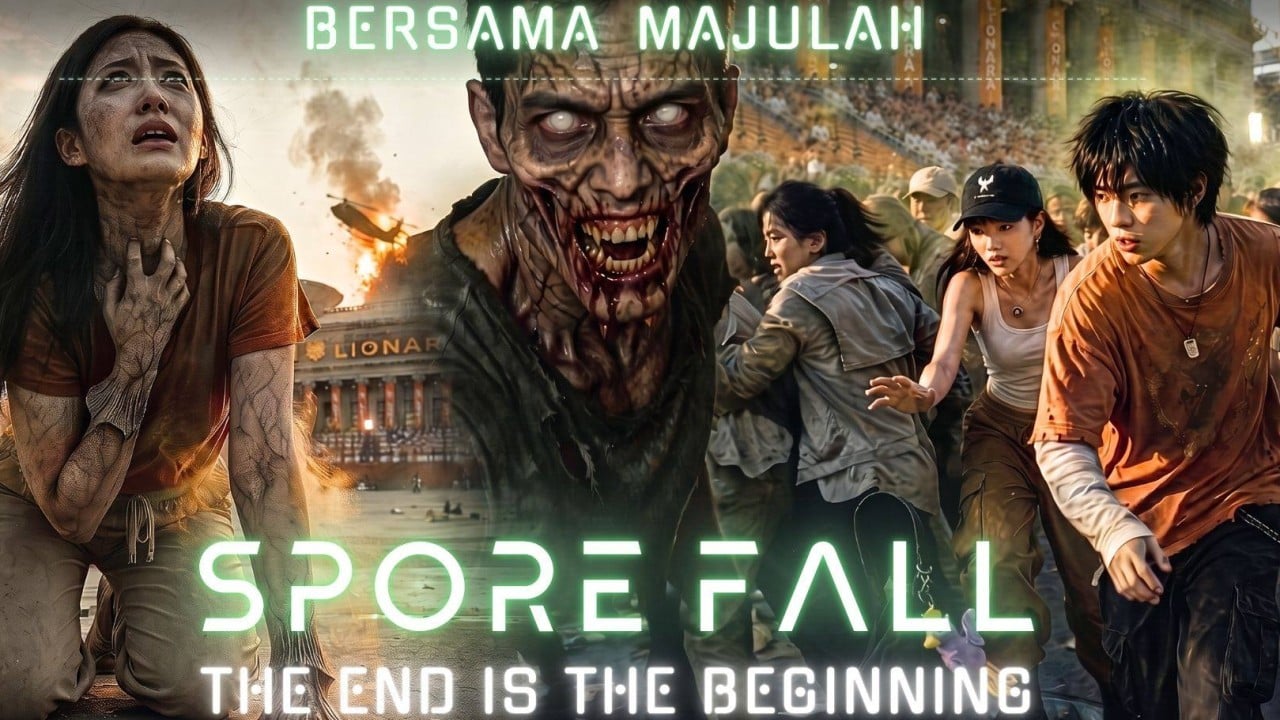
The viral circulation of an artificial intelligence generated zombie video depicting Singapore during National Day exposes a fundamental shift in media production economics. When a localized piece of synthetic media commands mass public attention, it signals a structural collapse in the traditional capital expenditure required for high-fidelity visual effects.
Media production has historically operated under a strict tripartite constraint involving time, capital, and labor. Traditional filmmaking relies on physical crews, location permits, staging infrastructure, and linear post-production pipelines. Generative video architectures bypass these physical bottlenecks entirely, replacing them with compute-time and prompt engineering. The Singapore zombie clip demonstrates that audiences do not evaluate cultural resonance through the lens of production pedigree; rather, cultural traction is now a direct function of topical relevance combined with visual novelty.
The mechanism driving this disruption centers on marginal cost reduction. In legacy visual effects workflows, creating a horde of digital entities requires rigging, texturing, animation, and iterative rendering passes managed by specialized artists. Each additional frame demands human hours. Generative diffusion models treat the generation of a complex crowd scene and a static interior shot with near-identical marginal costs. This decoupling of complexity from expenditure alters the competitive dynamics of video content creation, lowering the barrier to entry from millions of dollars in studio overhead to subscription-based API access.
To understand how synthetic video alters the media ecosystem, we must examine the operational components that separate legacy pipelines from generative workflows.
The Production Cost Function
Traditional media economics are defined by high fixed costs and linear variable costs. Securing permits to shut down a metropolitan area for filming incurs municipal fees, insurance bonds, and security detail expenses. Building a believable post-apocalyptic aesthetic via traditional computer-generated imagery requires rendering farms running proprietary software licenses, supervised by armies of compositors.
Generative video shifts this expenditure curve. The primary inputs transition from human labor pools to server compute cycles and model optimization strategies. Creators utilizing foundational video models operate within a cost structure where the creation of a hyper-realistic municipal disaster costs pennies per generation run rather than thousands of dollars per second of finalized footage.
However, this cost reduction introduces a new operational bottleneck: quality control and consistency. While legacy pipelines guarantee temporal coherence and asset persistence across shots, current generative models struggle with structural continuity. Characters morph, lighting shifts arbitrarily, and physical laws break down across cuts. The economic trade-off has shifted from capital-intensive labor execution to intensive curation and prompt iteration. Creators spend time selecting the optimal outputs from stochastic generation runs rather than manually painting individual frames.
The Attention Capture Mechanism
The viral trajectory of the Singapore zombie clip highlights changing audience heuristics regarding digital artifacts. Historically, the uncanny valley effect—the psychological revulsion triggered by near-human digital replicas—served as an immediate deterrent to viewer engagement. Audiences rejected synthetic elements that failed to achieve photorealistic perfection.
The threshold for audience tolerance has shifted due to platform-native aesthetics. Short-form video platforms prioritize rapid narrative delivery, high visual contrast, and immediate emotional provocation over optical perfection. The deliberate blending of familiar civic landmarks with apocalyptic fiction creates cognitive dissonance that captures attention within the critical first three seconds of exposure.
This dynamic redefines cultural relevance. Regional contexts that previously lacked the localized budget to produce high-end speculative fiction can now bypass traditional gatekeepers. National identity, local landmarks, and localized folklore can be integrated into high-impact visual formats without securing multi-million-dollar grants from state media development authorities or multinational studios.
The Legal and Narrative Vulnerabilities
Despite the democratization of visual effects, relying on generative video introduces severe systemic risks that strategic creators must navigate.
Intellectual property rights regarding training datasets remain contested. Foundational models ingest vast quantities of copyrighted visual material, creating legal ambiguity for commercial distribution. Furthermore, depicting recognizable sovereign infrastructure undergoing catastrophic destruction crosses into sensitive territory regarding public safety regulations and misinformation laws. In jurisdictions with strict governance on digital manipulation, synthetic media depicting real-world locations must clear high compliance hurdles to avoid state intervention or public panic.
Narrative control represents another structural vulnerability. Stochastic systems inherently resist precise direction. While a human director can orchestrate micro-expressions and precise framing, prompt-based generation relies on probability distributions. Creators surrender deterministic control in exchange for speed and scale. This lack of deterministic control makes long-form narrative consistency nearly impossible using current text-to-video architectures alone. Long-form success requires hybrid pipelines where traditional editing frameworks stitch together isolated generative vignettes.
Strategic Operational Playbook
Media organizations and independent creators attempting to integrate synthetic video workflows must restructure their operational frameworks to account for stochastic outputs and rapid depreciation of visual novelties.
Establish strict post-generation curation pipelines. Because generative models produce high volumes of unusable artifacts, human intervention must shift from creation to curation. Build automated screening protocols combined with rapid manual selection to filter out temporal anomalies before distribution.
Adopt hybrid production architectures. Do not rely entirely on pure text-to-video generation for narrative projects. Instead, use generative tools for background plate generation, rapid concept visualization, and texture mapping while maintaining traditional control over character rigging and core editorial timing.
Monitor regulatory compliance proactively. Anticipate stricter verification standards for media depicting real-world geographic locations. Implement cryptographic watermarking and transparent labeling protocols to protect distributed assets against platform suppression or legal liability regarding synthetic impersonation and unauthorized alterations of public infrastructure.
Scale content velocity over perfectionism. In an ecosystem saturated with infinite visual options, production polish yields diminishing returns compared to contextual timeliness and cultural agility. Organizations that build rapid-response synthetic video loops will capture audience attention share from legacy studios bound by multi-year production cycles.


