The fluorescent lights of a hospital unit at three in the morning do something strange to human skin. They strip away the warmth, leaving everyone looking a little ghostly, a little hollowed out by exhaustion. In the cardiovascular intensive care unit at Riverside Methodist Hospital in Columbus, Ohio, that sterile glow reflects off linoleum floors that have seen every iteration of human grief and recovery.
But recently, the night shift began to notice a different kind of change. It started with the quiet rustle of snack wrappers hidden behind charts. Then came the sudden, collective aversion to the smell of the cafeteria’s morning coffee.
One by one, the stethoscopes resting against scrub tops started moving outward, pushed by the unmistakable, slow-growing curve of new life.
Seventeen.
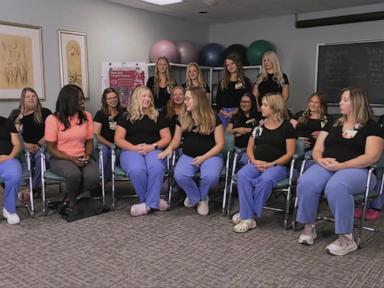
That is not a typo. It is not a statistical anomaly easily dismissed by a rounding error. Seventeen nurses, all working within the walls of the exact same Ohio medical center, found themselves expecting babies at the exact same time. To an outsider, it looks like a bizarre glitch in the matrix of probability. To the women walking those long, quiet hallways in compression socks, it felt like something else entirely. It felt like a shared lifeline.
Hospital floors run on a rhythm that civilians rarely understand. It is a world measured in milligrams, heart rates, and the sharp, sudden beep of an alarm that sends adrenaline spiking through your chest. To survive it, nurses develop a kind of unspoken telepathy. They know who needs a glass of water without asking. They know when a colleague is holding back tears after losing a patient they spent twelve hours trying to save.
Now, imagine carrying that weight while your own body is busy building a nervous system, a spine, a set of tiny lungs.
Consider a hypothetical nurse named Sarah. She represents a composite of the very real women who lived this boom. Sarah is twenty-eight, thirty weeks pregnant, and her lower back feels like it is being compressed by a hydraulic press. She has been on her feet since six o’clock yesterday morning. Her patient in room 412 is unstable, requiring constant monitoring. Her own heart is racing, not just from the stress of the shift, but because her blood volume has literally doubled to support the child kicking against her ribs.
She steps out of the room, leaning her forehead against the cool glass of the nurse's station. She thinks she might vomit. She thinks she cannot possibly finish the remaining four hours of her shift.
Then she looks up.
Across the desk, another nurse is eating pickles directly from a jar, her own belly pressing against the edge of the counter. Three feet away, a third nurse is adjusting her maternity scrubs, groaning softly as she sits down to chart. They exchange a look. No words are spoken. None are needed. A hand is extended with a pack of crackers. A chair is rolled over.
The isolation that so often accompanies pregnancy—the feeling that you are a solitary vessel navigating a terrifying physical transformation—evaporates when your entire workplace is sharing the same symptom list.
Statisticians will tell you that clustering happens. If you throw enough darts at a board, eventually a few will land in the exact same square. They call it the law of truly large numbers. When you employ hundreds of nurses, many of whom fall into the same demographic window of early adulthood and family planning, paths will inevitably cross.
But mathematics fails to capture the emotional reality of the breakroom.
We live in an era where the medical profession is stretched to its absolute limit. Burnout is not just a buzzword; it is a chronic condition threatening the bedrock of healthcare. Nurses are leaving the bedside in droves, exhausted by the administrative grind and the moral injury of a system that often feels like an assembly line. Against that backdrop, a hospital unit can become a place of profound emotional scarcity.
Yet, inside this particular Ohio hospital, something entirely counter-intuitive occurred. The impending arrival of seventeen babies transformed a high-stress workplace into an ad hoc community of fierce, protective solidarity.
They began tracking their due dates on a massive dry-erase board, a colorful timeline of hope pinned against a wall usually reserved for patient tracking and surgical schedules. The babies were lined up like planes on a runway, scheduled to arrive month after month, a steady drumbeat of new beginnings.
The logistics, of course, were a nightmare for management.
How do you cover the maternity leave of seventeen highly trained clinical staff members without collapsing the infrastructure of the unit? It requires a complex dance of traveling nurses, shifted schedules, and a massive amount of goodwill from the colleagues who aren’t expecting. It is a puzzle that requires military precision to solve.
But the nurses themselves were focused on a different kind of survival. They became each other’s keepers. If a patient became combative or required an X-ray that involved radiation exposure, the pregnant nurses were quietly shielded by their peers. The staff without bellies stepped into the line of fire, taking on the heavy lifting and the hazardous exposures, while the expectant mothers took over the sedentary charting and the non-hazardous tasks.
It was an organic ecosystem of care, a living demonstration of the very empathy these women dispense to strangers every single day.
There is a unique vulnerability in being a pregnant healer. You spend your days assessing the vital signs of others while harboring a deep, quiet anxiety about your own. You know too much. Every nurse knows the statistics on preeclampsia, gestational diabetes, and preterm labor. They have seen the worst-case scenarios play out in the very rooms where they clock in for work. Having sixteen other women to talk you down from the ledge of medical paranoia is a form of therapy that money cannot buy.
The trend caught the attention of local news, then national broadcasts. Videos of the women lined up in their blue and gray scrubs, laughing as they compared the sizes of their bumps, went viral. People loved the story because it felt wholesome, a rare piece of joyful news in a media cycle dominated by friction and crisis.
But the superficial charm of a viral video misses the deeper truth of what happened in Columbus.
This wasn’t just a cute coincidence. It was a manifestation of shared humanity in a place that desperately needed it. Hospitals are places where life is constantly ending and beginning, but the beginning part is usually confined to the labor and delivery wing. To have that energy spill over into the rest of the building, into the intensive care units and the cardiac floors, changed the atmosphere. Patients noticed it. Families caught a glimpse of the dry-erase board and smiled. It reminded everyone who walked through those double doors that life, despite everything, insists on continuing.
The summer months brought the first waves of deliveries. The dry-erase board began to fill up with birth weights, times, and names. The collective belly bump photos transitioned into group texts filled with pictures of newborns wrapped in hospital blankets.
The nurses who had waddled through the hallways together were now navigating the blurry, sleepless haze of early motherhood together. The bond didn’t dissolve when they punched out for maternity leave; it merely shifted to living rooms filled with diapers and breast pumps.
On a quiet afternoon in the fall, several of the mothers returned to the unit to show off their babies to the staff members who had covered their shifts. The babies were passed from person to person, cradled by hands that just hours prior had been adjusting IV lines and administering life-saving drugs.
The unit was noisy, chaotic, and entirely alive.
One of the infants, a tiny girl with a shock of dark hair, fell asleep while resting against the scrub top of a nurse who was just starting her twelve-hour shift. The steady, rhythmic beep of the cardiac monitors in the hallway continued, but for a moment, it was drowned out by the soft, cyclical breathing of a child whose journey began in the very heart of the chaos.