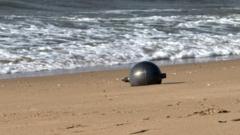
In mid-October 2024, thousands of mysterious black, golf-ball-sized spheres washed ashore across Coogee Beach and several neighboring coastal stretches in Sydney, Australia. Initial public alarm sparked wild theories ranging from space debris to alien eggs. Local authorities swiftly shut down the beaches, donning protective gear to scoop up the debris. Within weeks, rigorous chemical testing unmasked the true culprit. These were not fragments of a fallen satellite, but highly complex, toxic "tar balls" composed of human feces, diesel fuel, cooking oil, and illicit drugs. While the immediate cleanup finished quickly, the incident exposed a much larger, systemic failure in maritime surveillance and coastal environmental protection that still remains unresolved.
The Chemistry of Modern Urban Pollution
The assumption that washed-up beach debris must come from the sky points to a broader collective blindness regarding what actually floats in our oceans. When the analysis from the University of New South Wales emerged, the results read like a grim inventory of modern metropolitan waste.
These spheres were formed through a process called saponification. When fats, oils, and grease mix with domestic sewage in a highly turbulent environment—like a churning ocean outfall or a ship’s bilge tank—they undergo a chemical reaction. The calcium and sodium in saltwater act as binding agents, turning liquid grease into solid, soapy masses.
This was not a simple oil spill. The presence of epicoprostanol, a chemical marker definitive of human waste, alongside traces of hair medication, methamphetamine, and veterinary pharmaceuticals, proved the material originated directly from a human source. The spheres functioned as sticky traps, accumulating heavy metals and polycyclic aromatic hydrocarbons from the surrounding water as they drifted.
The Tracking Blindspot in Coastal Waters
A primary question remains unanswered. Where exactly did thousands of these spheres originate?
Sydney's coastline is flanked by major deepwater ocean outfalls managed by Sydney Water. These systems pump treated effluent kilometers out to sea, relying on deep ocean currents to disperse the waste. When functioning correctly, the system keeps waste away from the shoreline. However, during periods of torrential rain, urban stormwater systems and sewage networks become overwhelmed, leading to system bypasses.
Maritime investigators also focused heavily on commercial shipping lanes. Large vessels frequently clean their fuel tanks and bilges at sea. While international maritime regulations strictly forbid the dumping of oily waste within specific coastal zones, enforcement relies on self-reporting and sporadic satellite tracking. A ship discharging a mixture of contaminated bilge water and galley grease just outside territorial waters could easily generate the exact chemical fingerprint found on Coogee Beach.
The difficulty in pinpointing the source highlights a severe gap in real-time maritime monitoring.
Typical Composition of the Sydney Tar Balls:
+---------------------------------+---------------------------------+
| Component Category              | Specific Substances Detected    |
+---------------------------------+---------------------------------+
| Organic Waste Binder            | Cooking oils, lard, fatty acids |
| Human Identifiers               | Feces markers, human hair       |
| Chemical Contaminants           | Diesel fuel, industrial solvents|
| Pharmaceutical Residues         | Blood pressure meds, stimulants |
+---------------------------------+---------------------------------+
Current satellite tracking systems, such as the Automatic Identification System used for vessel tracking, tell us where ships are, but not what they are dropping into the water. Synthetic Aperture Radar can detect massive, slick oil spills from orbit, but it completely misses scattered, emulsified grease balls drifting just beneath the surface.
The Failure of Current Regulatory Frameworks
When an environmental incident occurs in coastal waters, bureaucratic friction frequently stalls the investigation. In New South Wales, jurisdiction is split among several entities, including the Environment Protection Authority, beach watch programs, local municipal councils, and port authorities.
During the initial days of the Coogee incident, this fragmentation was on full display. Conflicting messages regarding whether the material was highly carcinogenic or merely unpleasant caused unnecessary panic.
Furthermore, the legal penalties for maritime dumping fail to act as an effective deterrent for international shipping conglomerates. The cost of properly disposing of contaminated bilge water at a port facility often exceeds the token fines levied by regulatory bodies, assuming the offending vessel is even caught. For a commercial operator, treating the ocean as a free waste bin remains a calculated, economically viable risk.
Upgrading the Defensive Infrastructure
Relying on beach inspectors to visually spot pollution after it coats the sand is an archaic approach to environmental management. Preventing the next contamination event requires integrating autonomous technology into coastal defense networks.
Autonomous Underwater Vehicles
Deploying fleets of small, long-endurance autonomous underwater vehicles along high-risk shipping corridors would allow for early detection. These drones can be equipped with fluorometers capable of detecting microscopic traces of hydrocarbons and synthetic fats long before they coagulate into physical masses.
Predictive Ocean Modeling
Current hydrodynamic models used by coastal authorities rely heavily on surface wind data, which frequently miscalculates the movement of semi-submerged debris. Integrating real-time sub-surface current data from regional buoy networks would allow investigators to reverse-engineer the path of a pollution plume, tracing it back to a specific coordinate and time window to match against vessel transits.
The Sydney tar ball incident was a warning shot. The ocean did not spit back space debris; it simply returned a concentrated sample of the waste pumped into it daily. Until maritime monitoring technology catches up with the scale of commercial shipping and urban expansion, our beaches will remain the default destination for the secrets we flush away.