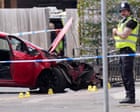
The transition of a vehicle from a transport utility to a kinetic weapon represents a failure of public space security and an instantaneous shift in local emergency resource allocation. In the Nottinghamshire town of Sutton-in-Ashfield, the collision involving five pedestrians and a single driver provides a data point for analyzing the physics of impact, the triage bottleneck in semi-rural environments, and the procedural friction of post-incident containment. Understanding this event requires moving past the surface-level reporting of "accidents" and examining the specific variables that dictate survival rates and legal culpability in high-density pedestrian zones.
The Kinematics of Pedestrian Impact
The severity of a vehicular incident is governed by the transfer of kinetic energy, defined by the formula:
$$E_k = \frac{1}{2}mv^2$$
In this specific scenario, the velocity ($v$) of the vehicle at the moment of impact is the primary determinant of injury severity. Because velocity is squared, even marginal increases in speed result in exponential increases in the energy absorbed by the human frame. When five individuals are struck, the vehicle undergoes a series of rapid energy transfers rather than a single terminal deceleration.
Impact dynamics generally follow a three-phase sequence:
- Primary Impact: The vehicle bumper makes contact with the lower extremities, often causing "bumper fractures" (tibia/fibula) and initiating the "wrap-around" effect where the pedestrian’s torso rotates toward the hood.
- Secondary Impact: The pedestrian’s head or thorax strikes the windshield or A-pillar. This is where life-threatening traumatic brain injuries (TBI) typically occur.
- Tertiary Impact: The individual is ejected from the vehicle and strikes the ground. The friction and deceleration of the pavement introduce a new set of variables, including "road rash" and secondary spinal fractures.
In a multi-person collision, the initial victims may act as physical buffers, inadvertently altering the trajectory and remaining kinetic energy available for subsequent impacts. This creates a high-variance casualty profile where injuries range from minor lacerations to critical internal hemorrhaging within the same event.
Tactical Response and the Triage Bottleneck
A five-casualty event in a town like Sutton-in-Ashfield triggers an immediate "Major Incident" protocol, which shifts the medical objective from individual-centered care to the greatest good for the greatest number. The operational efficiency of this response is dictated by the METHANE framework:
- Major Incident declared.
- Exact location.
- Type of incident.
- Hazards present (fuel leaks, unstable structures, or a volatile crowd).
- Access routes for emergency services.
- Number and severity of casualties.
- Emergency services required.
The bottleneck in these scenarios is rarely the number of ambulances, but rather the "clearance rate" of the nearest Level 1 Trauma Center. If the local facility lacks the surgical capacity to handle five simultaneous polytrauma patients, the triage officer must make high-stakes decisions regarding air-lifting patients to regional hubs like the Queen’s Medical Centre in Nottingham. Delay in this decision-making phase increases the risk of "preventable death" from non-compressible hemorrhaging.
Categorization of Forensic Evidence
The arrest of a suspect following such an event initiates a transition from medical crisis management to forensic data preservation. Investigators focus on three distinct evidence streams to reconstruct the intent and mechanics of the crash.
Mechanical Diagnostics
The vehicle’s Event Data Recorder (EDR), often referred to as the "black box," provides a granular telemetry log. This includes throttle position, braking force, steering input, and speed at 0.1-second intervals leading up to the impact. This data is the only objective way to determine if the incident resulted from mechanical failure (unintended acceleration) or human input.
Environmental Mapping
CCTV and dashcam footage serve as the primary source for establishing the pre-impact "threat trajectory." Analysts look for "pre-collision braking," which indicates an attempt to avoid the impact, versus "sustained acceleration," which suggests intentionality or severe impairment. The absence of skid marks on the pavement further corroborates a lack of evasive maneuvers.
Toxicological and Psychological Profiling
Upon arrest, the suspect undergoes immediate testing for ethanol and controlled substances. However, the psychological state of the driver—specifically the distinction between "diminished responsibility" due to a medical episode (e.g., a hypoglycemic shock or seizure) and "criminal negligence"—requires a longer-term psychiatric evaluation. The legal threshold for "dangerous driving" versus "attempted murder" hinges entirely on the proven intent to use the vehicle as a weapon.
The Logic of Urban Vulnerability
The Nottinghamshire incident exposes the inherent fragility of pedestrian zones that lack physical "hardened" infrastructure. Most high-street environments rely on "soft security," which assumes driver compliance with traffic laws and social norms.
The vulnerability of these spaces can be quantified by the Permeability Index. High-permeability areas have few physical barriers (bollards, raised curbs, or planters) separating high-velocity vehicle lanes from high-density pedestrian foot traffic. When a vehicle leaves its designated path, the "Time to Impact" (TTI) for a pedestrian is often less than 1.5 seconds—below the average human reaction time for a flight response.
Urban planning must shift toward Passive Defense mechanisms. This does not require unsightly concrete walls but rather "Integrated Security Furniture." Planters, reinforced benches, and strategic street curvature can effectively decelerate a vehicle or prevent it from entering a pedestrianized area entirely without disrupting the aesthetic flow of the town center.
Legal and Societal Recalibration
The prosecution of vehicular crimes in the UK is currently undergoing a shift in severity. Under the Police, Crime, Sentencing and Courts Act 2022, the maximum penalty for causing death by dangerous driving was increased to life imprisonment. While this incident involves injuries rather than confirmed fatalities at the time of reporting, the "attempt" and the "risk of life" are evaluated under the same rigorous standard of public endangerment.
The challenge for the legal system is the "Motive Gap." Unlike a firearm or a knife, a car is a legal, ubiquitous tool. Proving that a driver consciously repurposed this tool for harm requires a high burden of proof. The investigation in Sutton-in-Ashfield will likely center on the driver’s behavior in the 30 minutes prior to the event—looking for "triggers" or "patterns of escalation" that suggest the impact was the culmination of a deliberate act rather than a momentary lapse in attention.
Strategic Priority for Public Safety Entities
Local authorities must move beyond reactive policing and adopt a "Kinetic Risk Mapping" strategy for town centers.
- Identify High-Risk Nodes: Map intersections where pedestrian density and vehicle speed exceed safety thresholds.
- Deploy Modular Barriers: Implement removable, high-impact bollards during peak hours or community events to create a physical "buffer zone."
- Optimize Emergency Comms: Ensure that local CCTV operators have a direct, low-latency link to emergency dispatchers to provide "Live Situational Awareness" during the first 120 seconds of an incident.
The Nottinghamshire impact is a reminder that the safety of a public space is only as strong as its weakest physical barrier. The focus must remain on hardening the environment to ensure that even if a driver loses control—or chooses to cause harm—the infrastructure absorbs the energy, not the citizens.