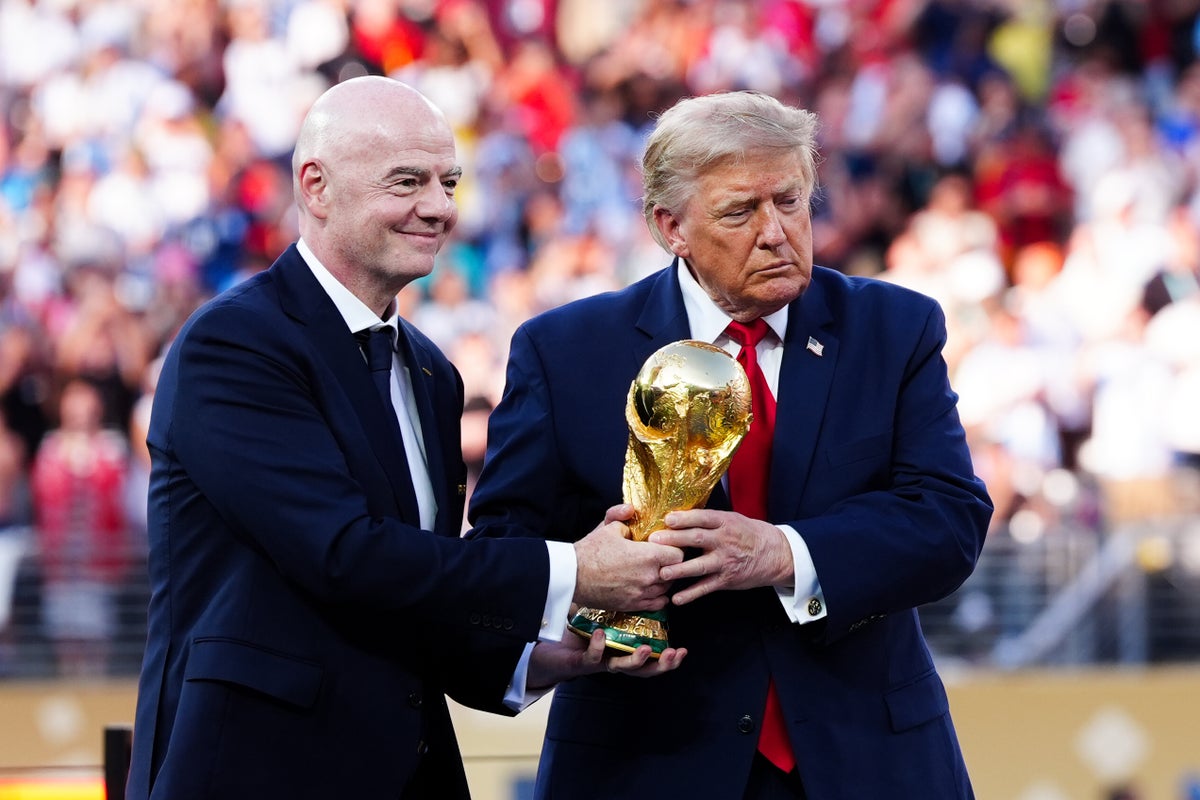
Modern sports governance operates on a simple financial imperative: extract maximum yield from a finite calendar. Under the leadership of Gianni Infantino, FIFA has transitioned from a traditional regulatory body into an aggressive commercial enterprise. Critics frequently frame this shift as a moral failure, characterizing expanded tournament formats and corporate partnerships as selling the soul of football. That framing misses the point. The ongoing transformation of global soccer is not a betrayal of institutional values; it is the predictable optimization of a monopoly facing declining organic growth in traditional domestic markets and explosive demand in emerging economic corridors.
To understand the trajectory of international football administration, one must deconstruct the financial mechanics driving FIFA, the structural vulnerabilities of the existing club-versus-country calendar, and the long-term sustainability of constant expansion. You might also find this similar coverage interesting: Stop Mourning Peak Chasers and Admit Commercial Mountaineering is Broken.
The Revenue Architecture of Global Football Governance
FIFA functions as a private association under Swiss law holding a de facto monopoly over the global regulatory apparatus of association football. Its revenue model depends almost entirely on the men's World Cup quadrennial cycle. Historical dependency on a single four-week tournament created extreme revenue volatility, leaving the organization exposed to macroeconomic shocks, broadcast fee stagnation in core European territories, and operational interruptions.
The strategic response to this volatility involves two primary mechanisms: event multiplication and asset commodification. As highlighted in latest reports by FOX Sports, the implications are significant.
The Diversification of Tournaments
By scaling the FIFA Club World Cup into a 32-team quadrennial tournament and expanding the national team World Cup to 48 teams, the organization flattens its cash flow cycle. Instead of relying on a financial spike every four years, revenue generation becomes continuous.
The Monetization of Unexploited Geographies
Traditional European club dominance concentrated capital within a small cartel of elite teams. Infantino’s strategy deliberately shifts the center of gravity outward, capturing commercial interest, sovereign wealth investment, and broadcast rights from North America, the Middle East, and Asia.
The critique that this erodes the prestige of the sport fails to account for capital requirements. Elite European clubs generate immense revenues through domestic leagues and the UEFA Champions League, leaving national associations outside the Western European core starved of development capital. FIFA's expansionist policies serve as a redistribution mechanism, though the primary beneficiary remains the governing body itself, which extracts a management and regulatory toll from every transaction.
The Congestion Calculus and the Fatigue Function
The friction between FIFA and major stakeholders—specifically European clubs, domestic leagues, and player unions—is fundamentally a dispute over resource allocation and physiological limits.
The football calendar operates under a zero-sum constraint. There are 365 days in a year, and players require mandatory recovery periods, pre-season training, and travel downtime. Every additional match introduced by FIFA or continental confederations increases the cumulative workload on elite athletes.
[Total Available Days]
       │
       ├─► [Domestic League & Cup Requirements]
       ├─► [Continental Club Competitions (UEFA/AFC/etc.)]
       ├─► [International Windows & Qualifiers]
       └─► [Expanded FIFA Tournaments (New Club World Cup / 48-Team World Cup)]
              └─► RESULT: Physiological Bottleneck & Injury Vector
When supply expands beyond physiological carrying capacity, systemic degradation occurs. The cost function of this congestion manifests in three distinct ways:
- Injury Incidence Rates: High-intensity sprinting volumes scale linearly with fixture density. Soft-tissue injuries spike when recovery windows drop below seventy-two hours between high-output matches.
- Product Dilution: When elite players are rested during group stages or perform below peak capacity due to chronic fatigue, the entertainment value of the broadcast product declines.
- Talent Hoarding: Elite clubs respond to fixture inflation by expanding squad depths, further widening the financial chasm between wealthy contenders and mid-tier competitors who cannot afford two starting-caliber XIs.
FIFA argues that squad rotation mitigates individual burnout. However, this argument ignores the economic reality of modern broadcasting. Broadcasters pay premium rates for elite starting assets, not developmental replacements. When the physical toll of an overstaturated calendar diminishes the presence of top-tier talent, the projected commercial value of expanded tournaments faces an invisible ceiling.
Governance, Rent-Seeking, and the Monopoly Dilemma
Monopolies in sports governance possess unique structural properties. Unlike traditional corporate monopolies subject to antitrust dissolution by consumer protection agencies, sports regulators enjoy recognized sovereignty over their respective disciplines. FIFA sets the Laws of the Game, dictates the international match calendar, and retains ultimate disciplinary authority.
This absolute structural control creates an environment ripe for rent-seeking behavior. Rent-seeking occurs when an entity maximizes economic value without contributing productive output, instead leveraging its regulatory position to capture a larger share of existing wealth.
Infantino’s tenure has accelerated this dynamic by weaponizing commercial partnerships to cement political alignment. By distributing development funds through targeted programs across member associations—particularly within the Confederation of African Football (CAF) and the Asian Football Confederation (AFC)—FIFA secures voting blocs essential for maintaining leadership continuity.
Critics focus on the moral hazard of aligning with controversial commercial sponsors or sovereign entities. From an institutional perspective, this is a rational risk-management strategy. European traditionalists command historical cultural capital, but emerging markets command demographic and financial momentum. Infantino’s strategy trades European institutional approval for global financial diversification.
The Downstream Market Impacts of 48-Team Tournaments
The expansion of the men's World Cup from 32 to 48 teams fundamentally alters qualification mathematics and group-stage dynamics.
In a 32-team format, qualification acted as an elite filter. Traditional football nations faced genuine elimination risk, which generated high-stakes broadcast drama during qualifying windows. The 48-team model dilutes this friction. By lowering the barrier to entry, FIFA accomplishes two strategic objectives:
- Guaranteed Participation of Growth Markets: Key geopolitical and economic zones—such as North America, India, and Southeast Asia—benefit from higher probabilities of qualification. Inclusion drives domestic broadcast consumption, merchandise sales, and government-backed infrastructure investment.
- Mitigation of Revenue Volatility for Member Associations: Smaller federations receive increased financial payouts through FIFA’s Forward program, securing their political loyalty and insulating domestic football economies from local macroeconomic downturns.
The structural trade-off is clear. Group-stage matches in expanded tournaments frequently feature asymmetrical matchups where elite squads dominate under-resourced opponents. This creates early-round match inventory with low competitive balance, testing consumer patience during the opening weeks of the tournament. The financial upside of capturing new regional markets outweighs the marginal loss of early-round competitive integrity on a global balance sheet.
Strategic Capital Allocation and the Future of Club Independence
The tension between FIFA and elite clubs is not merely ideological; it is a battle for balance-sheet dominance. For decades, UEFA and the European Club Association (ECA) held effective hegemony over elite club revenues. The proposed European Super League, though temporarily stalled by regulatory and fan pushback, was a direct response to this financial imbalance—an attempt by elite clubs to bypass governing bodies and capture 100% of the broadcast yield.
FIFA’s 32-team Club World Cup is a direct counter-offensive. By institutionalizing a global club tournament under its own regulatory umbrella, FIFA inserts itself as an indispensable commercial intermediary between elite clubs and global capital.
When clubs participate in FIFA-sanctioned global events, they surrender a portion of their commercial autonomy in exchange for guaranteed participation fees. This dynamic creates a financial dependency loop. If elite clubs rely on FIFA's new tournament architecture to meet their debt service obligations and comply with financial sustainability regulations, their appetite to launch breakaway leagues diminishes.
The Structural Limits of Expansion
Every monetization strategy encounters diminishing marginal returns. FIFA’s current growth trajectory relies on the assumption that global demand for football is infinitely elastic. Empirical data from domestic media rights negotiations in core European markets suggests otherwise.
Broadcast inflation has flattened. Domestic rights fees for major leagues have either stabilized or contracted when adjusted for inflation. The marginal fan cannot consume unlimited hours of live content, and subscription fatigue across multiple streaming services is real.
If broadcast values for saturated fixtures begin to correct downward, FIFA’s revenue model will face severe compression. At that juncture, the organization will have little room to maneuver without alienating the core player labor pool upon which its entire product depends. The long-term risk is not that football loses its soul, but that it exhausts its physical infrastructure.
To secure institutional survival against these structural headwinds, the strategic play moving forward requires shifting focus from raw fixture multiplication to yield optimization per match. This means leveraging digital engagement platforms, direct-to-consumer data harvesting, and localized micro-rights to extract value without adding further physical strain to an already overloaded global calendar.