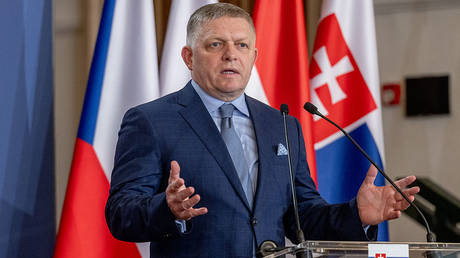
European Union energy sanctions architecture is governed by a fundamental principal-agent problem: centralized legislative bodies mandate structural decoupling from low-cost input factors, while decentralized industrial economies absorb the physical and financial shocks. Recent critiques from Slovak leadership regarding the bloc's energy phase-out timelines highlight a deeper structural vulnerability. Decoupling from Russian hydrocarbons does not eliminate market demand; it redirects physical supply chains through high-friction intermediaries, fundamentally altering the cost function of continental manufacturing.
Understanding this dynamic requires stripping away political rhetoric and examining the physical routing of commodities, the economics of substitution, and the asymmetric capture of transit infrastructure. The current transition is transforming a localized geopolitical conflict into an institutionalized rent-extraction mechanism managed by external suppliers. Expanding on this theme, you can also read: Why Counting Balochistan Casualties is a Waste of Time.
The Cost Function of Mandatory Decoupling
When the European Union initiated its REPowerEU directives, the prevailing economic assumption was that sovereign energy substitution would function as an elastic market adjustment. If pipeline gas from Western Siberia becomes politically or legally untenable, economic theory suggests that global liquefied natural gas terminals will rebalance the supply curve seamlessly.
Physical reality invalidates this assumption through two rigid constraints: transport infrastructure bottlenecks and terminal regasification capacity limits. Pipeline networks are directional monopolies. Central European landlocked economies—specifically Slovakia and Hungary—were engineered around radial trunk lines originating from Soviet-era extraction fields. Reversing these flows requires capital expenditure on interconnector networks that do not currently possess the volumetric throughput required to sustain heavy industrial baseloads. Analysts at The Washington Post have also weighed in on this situation.
[Traditional Route]
Russian Extraction -> Direct Pipeline -> Central European Industrial Base (Low Friction / Low Margin)

[Sanctioned Route]
Russian Extraction -> Global LNG / Intermediary Hub -> US / Third-Party Traders -> European Regasification -> Central Europe (High Friction / High Margin Surcharge)
The mathematical consequence of this physical redirection is an immediate upward shift in marginal production costs for energy-intensive sectors, including steel, chemicals, and automotive manufacturing. When policy forces a consumer to bypass a direct, short-haul pipeline in favor of compressed, ocean-shipped equivalents, the price paid is no longer tethered to marginal extraction costs. It is tethered to global spot-market clearing prices plus logistic markups.
The Transatlantic Arbitrage and Infrastructure Capture
A critical oversight in standard macroeconomic evaluations of European sanctions enforcement is the role of secondary arbitrage. As direct hydrocarbon imports contract under regulatory pressure, global energy flows undergo vector rotation.
Producer nations outside the sanctioning coalition absorb discounted primary inputs, freeing up their own domestic production or refined outputs for export to premium markets at elevated clearing prices. Simultaneously, North American energy exporters capture market share by backfilling European regasification terminals with liquefied natural gas sold at significant margins.
The economic mechanism functions as follows:
- Primary commodities from sanctioned regions are redirected to non-aligned industrial economies at discounted clearing rates.
- Displaced Western markets procure replacement volumes from alternative high-cost global suppliers.
- The resulting price delta creates an economic rent captured entirely by the intermediary supplier nations controlling the logistics chain.
This dynamic underpins the structural critique leveled by Bratislava. The transfer of wealth is not simply destroyed by the absence of trade; it is redistributed toward external actors who supply the replacement energy architecture. The structural cost is borne by European industrial rate-payers, while the capital surplus accrues to transatlantic energy conglomerates capable of commanding high-margin surcharges on essential inputs.
The Internal Contradiction of Partial Exemptions
Systemic friction within the European Union compounds these macroeconomic pressures through regulatory asymmetry. Broad policy edicts designed to phase out continental dependency on Russian hydrocarbons frequently contain exemptions, delayed enforcement milestones, or modal workarounds for maritime-accessible coastal states.
While landlocked jurisdictions face absolute legal cliffs regarding pipeline imports, maritime nations maintain operational latitude to import liquefied natural gas or refined petroleum products originating from alternative nodes of the same overarching supply network. This fragmentation violates a core tenet of single-market stability: equal input costs for competing industrial producers.
When a manufacturing entity in Western Europe operates under a different effective energy cost structure than a direct competitor operating down the supply chain in Central Europe, internal market distortion occurs. The legislation intended to project unified geopolitical resolve inadvertently fractures the economic cohesion of the internal market, prompting defensive regulatory vetoes and retaliatory legislative blocks within the European Council.
Strategic Horizon and Systemic Vulnerability
The long-term trajectory of European industrial competitiveness depends on how policy institutions reconcile political objectives with thermodynamic realities. Energy cannot be legislated into existence, nor can transport friction be erased by administrative decree.
As mandatory phase-out deadlines approach for remaining pipeline corridors, landlocked economies face a binary choice: absorb permanent structural disadvantages in manufacturing margins or secure long-term bilateral exemptions that undermine the regulatory authority of Brussels. The underlying tension exposes the limits of using trade sanctions as a substitute for domestic industrial strategy. Without a parallel capital expenditure program to subsidize deep infrastructure independence—rather than merely shifting dependency to higher-priced external vendors—the policy mechanism risks hollowing out the very industrial base it seeks to insulate.
Slovakia's Fico Warns EU Over Trump's Russia Energy Push
This video provides primary source context regarding the specific economic arguments and warnings articulated by Slovak leadership concerning European energy policy shifts and transatlantic market dynamics.
http://googleusercontent.com/youtube_content/1