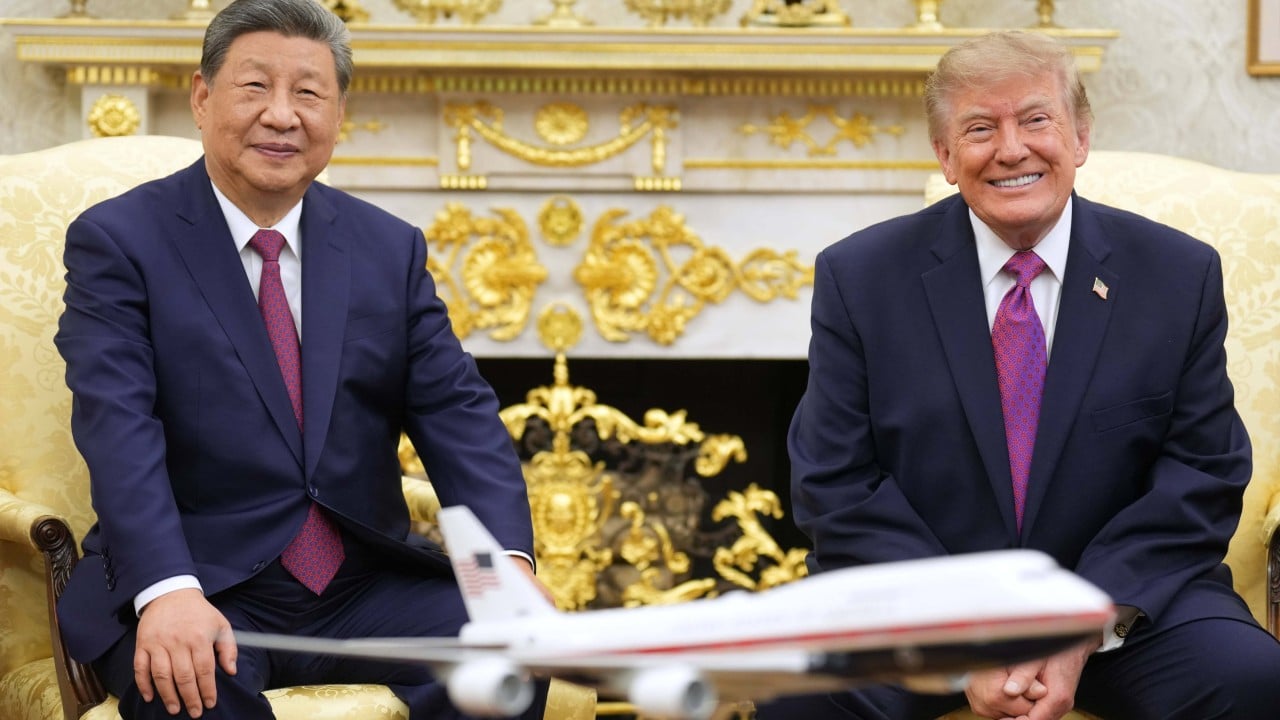
High-stakes bilateral diplomacy between economic superpowers functions less as a forum for idealistic accord and more as a high-frequency negotiation over structural asymmetries. When state visits occur against a backdrop of prolonged trade friction, protocol and pageantry serve primarily to mask deep-seated institutional divergence. The recent Washington summit between the leaders of the United States and China provided a clinical case study in this dynamic. Beneath the surface of airport welcomes, military reviews, and formal banquets lay a web of unresolved structural contradictions, temporary regulatory pauses, and stark asymmetries in commercial integration.
To evaluate the true output of this high-level engagement requires stripping away the diplomatic rhetoric and examining the underlying economic mechanisms, the cost functions of temporary trade agreements, and the divergent operational strategies governing industrial policy in both nations. Statecraft in the modern era cannot be measured by joint communiques alone; it must be quantified through the lens of market access, supply chain security, and the credibility of enforcement mechanisms.
The Asymmetry of Commercial Integration
A striking indicator of underlying bilateral strain during the Washington summit was the composition of the business delegations. When the American presidential delegation traveled months prior, corporate titans from technology, manufacturing, and finance participated visibly in Beijing, integrating commercial representation directly into the diplomatic choreography. This arrangement reflected a traditional model where multinational capital acts as an institutional bridge between political systems.
In contrast, the Washington state dinner exhibited a pronounced structural imbalance. While prominent American executives attended in force, the anticipated mirror image—an official, coordinated delegation of Chinese corporate leaders representing strategic sectors such as electric vehicles, advanced batteries, and semiconductor supply chains—failed to materialize in an official capacity. While individual executives traveled independently, the absence of an institutionalized business delegation highlighted the hardening barriers around state-directed commerce.
This divergence points to a fundamental shift in how both capitals conceptualize economic security. Washington approaches commercial exchange through a lens of national security risk containment, filtering prospective delegations through stringent screening regarding military ties and technological transfer. Beijing views commercial access not merely as a transactional market opportunity, but as an instrument of industrial policy that requires reciprocal concessions on export controls and tariff barriers. When these two opposing optimization functions collide, the resulting equilibrium is not integration, but managed friction.
The lack of a balanced commercial counterpart at the highest level of state dinners serves as an empirical metric for trade stagnation. Without reciprocal corporate representation, bilateral summits lose a critical constituency for stability. Multinational corporations historically functioned as stabilizing lobbies, applying internal political pressure within their respective capitals to prevent escalation. As state security mandates override commercial incentives, this stabilizing feedback loop weakens significantly.
The Economic Mechanics of the Busan Agreement Extension
Diplomatic announcements frequently rely on temporal extensions to manufacture momentum without resolving core disputes. The decision to extend the trade framework originating from Busan provides a clear illustration of this mechanism. By pushing the expiration date forward, both administrations avoided immediate tariff escalation, buying time for bureaucratic machinery to manage market expectations.
However, a temporary trade truce operates under diminishing marginal utility. Each extension alters the planning horizons of multinational supply chain managers. Uncertainty regarding tariff rates creates a persistent cost penalty, forcing firms to maintain higher buffer inventories, duplicate manufacturing footprints, and absorb higher insurance premiums against sudden regulatory shifts.
The economic cost function of these recurring truces can be modeled through capital expenditure decisions. When tariff stability is guaranteed only for narrow, short-term windows, long-term capital allocation shifts away from cross-border infrastructural investments toward defensive hedging strategies. Firms do not optimize for cost efficiency; they optimize for regulatory resilience. Consequently, trade volumes may stabilize on paper, but the underlying structural efficiency of global supply chains degrades continuously.
Furthermore, the extension of the trade truce failed to address the foundational drivers of bilateral imbalance. Structural grievances—including intellectual property protection, state subsidies for domestic manufacturing champions, and market access restrictions in service sectors—remain untouched by temporary tariff freezes. Treating symptoms through rolling extensions does not cure the underlying pathology of trade friction; it merely defers the fiscal and political reckoning.
Technology Controls and the Sovereign Tech Stack
The most intractable division between the two superpowers centers on advanced technology, particularly semiconductors, artificial intelligence, and quantum computing. The strategic calculus in Washington is governed by the doctrine of maintaining a decisive technological lead in critical nodes of the supply chain. This involves strict export controls, entity list expansions, and multilateral pressure to restrict foreign foundry access for advanced logic chips.
Conversely, Beijing's strategic objective is technological self-reliance combined with sustained access to global semiconductor manufacturing equipment. The divergence between these positions creates an absolute zero-sum constraint. No diplomatic compromise is mathematically viable when one nation's national security depends on denying advanced capabilities to the other.
During the summit, proposals for communication channels regarding artificial intelligence risks were floated as a mechanism for crisis prevention. While establishing technical coordination protocols for algorithmic safety is a prudent risk-mitigation step, it must be distinguished from economic policy harmonization. A communication hotline regarding technological risk does not alter the competitive race for computational supremacy.
The bifurcation of the technological stack proceeds unabated. Software ecosystems, hardware standards, and data governance frameworks are fragmenting into distinct regional blocs. Firms operating in this environment face mounting compliance overhead as they navigate conflicting regulatory requirements across jurisdictions. The economic toll of this fragmentation manifests as duplicated research and development expenditures, reduced economies of scale, and slower global innovation diffusion.
Macroeconomic Divergence and Monetary Policy Spillover
Beyond direct trade and technology metrics, the macroeconomic posture of both nations creates ongoing structural friction. Structural imbalances in domestic savings rates, domestic consumption patterns, and industrial overcapacity continue to exert pressure on external trade balances.
China's economic model remains heavily weighted toward supply-side investment and manufacturing output, driven by state-directed credit allocation. When domestic consumption fails to absorb domestic production, excess capacity must find an outlet in global export markets. This structural surplus inevitably triggers protectionist responses from advanced economies facing industrial hollowing out in key manufacturing sectors.
In response, importing nations deploy tariff barriers, anti-dumping duties, and domestic subsidy programs to protect domestic industrial bases. The diplomatic summits do not resolve this structural mismatch because neither capital is willing to alter its core macroeconomic growth model. Washington cannot easily engineer a rapid increase in domestic household savings, and Beijing cannot instantly pivot its entire economic engine away from manufacturing-led investment toward consumer-driven services without risking severe short-term growth deceleration.
This macroeconomic reality dictates that trade friction is a structural condition rather than a temporary policy aberration. Negotiators can manage the symptoms through managed truces and high-level visits, but the underlying pressure gradient remains constant.
Strategic Realignment and Supply Chain Resiliency
As traditional globalization recedes, multinational enterprises are forced to redesign their operational architectures. The prevailing strategy has evolved from pure cost minimization to regionalized redundancy, frequently described as friend-shoring or near-shoring.
This transition imposes a permanent upward shift on cost curves. The deflationary impulse that characterized global trade for decades—driven by unhindered access to low-cost manufacturing centers and optimized logistics networks—has been systematically dismantled. Every component sourced, every assembly plant relocated, and every compliance audit conducted adds friction to the global economic engine.
The diplomatic outcomes of leadership summits accelerate this structural realignment. When businesses observe that high-level political engagement yields no breakthrough on core trade barriers or market access restrictions, corporate strategy hardens around the assumption of permanent bifurcation. Investment capital flows reflect this strategic pessimism, prioritizing resilience over efficiency.
The Strategic Outlook for Bilateral Capital Flows
Analyzing the trajectory of great power competition requires evaluating the limits of executive diplomacy. Leadership summits can successfully alter tactical timelines, prevent catastrophic escalation, and establish communication channels for crisis management. They cannot, however, reconcile fundamentally incompatible economic models or bridge irreconcilable national security doctrines.
The evolving relationship is characterized by managed competition—an architecture where economic interdependence is systematically pruned in strategic sectors while maintaining transactional engagement in non-sensitive domains. For corporate strategists and policy analysts, the imperative is clear: discard assumptions of a return to unconstrained globalization. Operational planning must account for permanent regulatory friction, escalating compliance costs, and the absolute primacy of national security over market efficiency. The structural reality defined at the summit is not an anomaly to be weathered, but the baseline environment of twenty-first-century global commerce.



