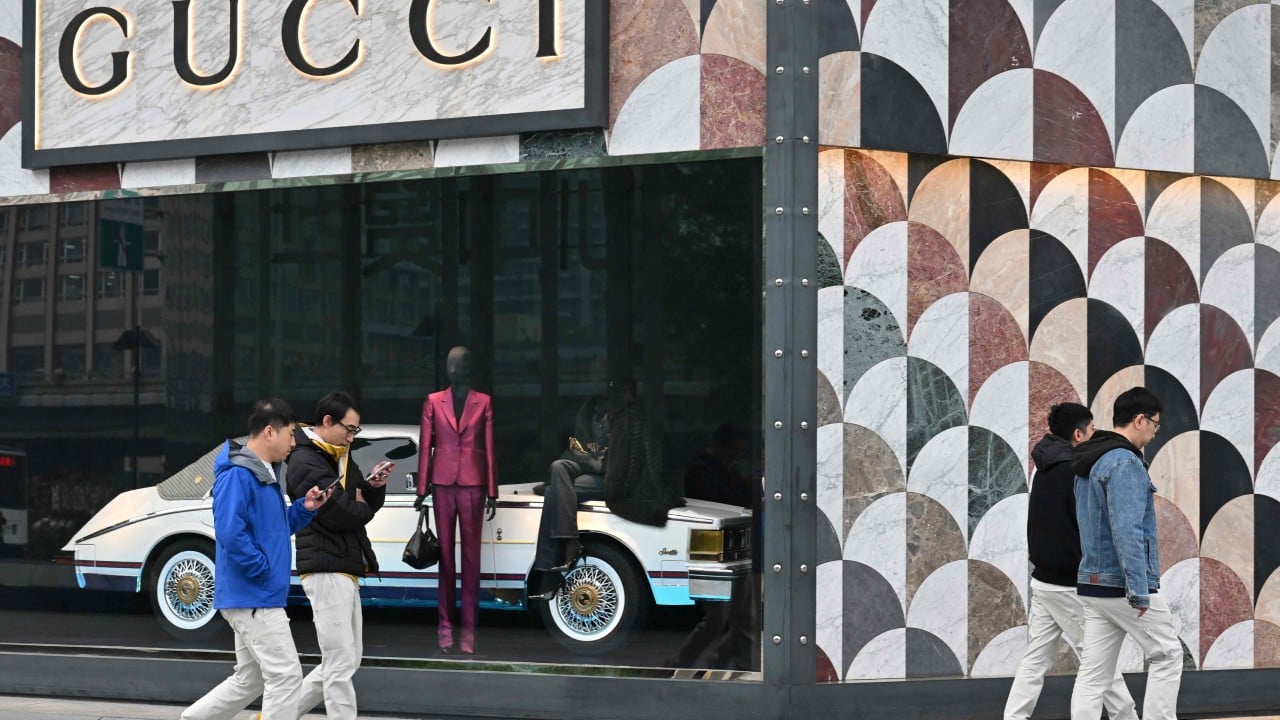
Tactical cost-cutting cannot cure a brand equity crisis. When a heritage luxury house responds to a regional demand contraction with retail footprint reductions and wholesale discounting, it triggers a self-reinforcing downward spiral in perceived scarcity and pricing power. For Gucci—and its parent conglomerate Kering—attempting to stabilize operating margins in mainland China through store closures and promotional markdowns addresses the symptoms of bloated fixed overhead while actively accelerating the erosion of the brand’s core intangible asset: desirability.
To understand why conventional retail restructuring fails in the high-end sector, analysts must separate operational efficiency from brand mechanics. In standard consumer packaged goods or mid-tier apparel, closing underperforming doors and clearing excess inventory through off-price channels restores return on invested capital (ROIC) and frees up working capital. In ultra-high-margin luxury, the economic engine operates on Veblen principles, where price elasticity is inverted and consumer utility is derived from exclusivity, social signaling, and aesthetic authority. Applying mass-market turnaround levers to a distressed luxury asset destroys the exact premium that justifies its gross margins.
The Structural Anatomy of the Luxury Turnaround Trap
Kering’s reliance on Gucci—historically accounting for over half of group revenue and roughly two-thirds of recurring operating profit—creates an acute institutional impatience. When top-line growth stalls in a primary engine like China, capital markets demand immediate margin defense. Management inevitably reaches for controllable P&L levers: rationalizing the physical store network and liquidating slow-moving stock. Both actions introduce severe second-order friction.
1. The Signaling Cost of Footprint Contraction
Physical retail in Tier-1 and Tier-2 Chinese cities functions primarily as brand theater and customer acquisition infrastructure rather than mere points of distribution. Flagship stores in Shanghai’s Plaza 66 or Beijing’s SKP serve as physical manifestations of cultural dominance.
When a brand shutters peripheral boutiques or scales back its physical presence, three market signals propagate instantly:
- Perceived Retreat: Affluent Chinese consumers exhibit high sensitivity to brand momentum. Store closures broadcast declining cultural relevance, prompting status-conscious buyers to rotate capital toward houses projecting unbroken expansion, such as Hermès or Louis Vuitton.
- Loss of Clienteling Touchpoints: High-net-worth individuals (HNWIs) purchase through dedicated sales associates (SAs) who cultivate long-term relationships. Closing a store severs localized SA networks, driving top-tier spenders directly into the arms of competing houses occupying the same luxury malls.
- Landlord Leverage Inversion: Luxury real estate in mainland China is heavily concentrated among a few dominant developers (e.g., Hang Lung Properties, Swire Properties). Reducing door counts weakens a conglomerate’s bargaining power for prime corner locations and favorable lease renewals across its entire brand portfolio, including Saint Laurent, Bottega Veneta, and Balenciaga.
2. The Markdown Ratchet and Reference Price Destruction
Excess inventory is the silent killer of luxury balance sheets. When seasonal collections fail to clear at full price, brands face a binary choice: destroy or recycle the goods at a total write-off, or route them through outlet malls, private sales, and grey-market daigou networks.
Discounting violates the foundational contract of luxury pricing. Once a consumer observes a handbag retailing at a 30% to 50% reduction in an outlet village or via cross-border e-commerce platforms, the brand’s internal reference price collapses. Rational buyers delay full-price purchases, anticipating future markdowns. More damagingly, grey-market arbitrageurs exploit regional price differentials and wholesale liquidation to flood Chinese digital platforms (such as Dewu or Tmall luxury channels) with discounted stock. This undercuts official flagship pricing, alienates full-price VIP clients who feel penalized for their loyalty, and forces the brand into a perpetual promotional cycle that compresses gross margins permanently.
Macroeconomic Reality Versus Brand-Specific Decay
A critical analytical error in evaluating Gucci’s China performance is conflating cyclical macroeconomic headwinds with secular brand fatigue. While China’s post-pandemic recovery has been weighed down by a protracted property sector slump, youth unemployment, and subdued consumer confidence, the luxury slowdown is markedly asymmetric.
The Chinese luxury market has bifurcated along strict lines of perceived value preservation:
- Hard Luxury and Absolute Scarcity: Ultra-high-end players—specifically Hermès, Chanel, and top-tier Swiss watchmakers—have demonstrated structural resilience. Their products function as alternative stores of value with strong secondary market liquidity.
- Aspirational and Trend-Driven Luxury: Brands heavily reliant on entry-level leather goods, overt logo-mania, and rapid aesthetic turnover bear the brunt of middle-class belt-tightening.
Gucci’s explosive growth between 2015 and 2021 under former creative director Alessandro Michele was built on maximalist aesthetics and massive recruitment of aspirational, younger consumers. That cohort is precisely the demographic most exposed to China’s economic deceleration. Simultaneously, as Chinese luxury consumers matured, aesthetic preferences shifted decisively toward "quiet luxury"—understated, logo-free craftsmanship emphasizing heritage and timelessness.
Sabato De Sarno’s appointment as creative director and the subsequent pivot toward minimalist, classic silhouettes (epitomized by the Rosso Ancora palette and streamlined tailoring) represent a direct attempt to reposition Gucci upmarket. Yet an aesthetic reset requires a multi-year gestation period. Closing stores and discounting legacy maximalist inventory while simultaneously trying to convince consumers that Gucci is now an understated, ultra-premium house creates acute cognitive dissonance. You cannot elevate brand equity while running a clearance sale.
The Three Pillars of Luxury Brand Equity Erosion
To quantify why operational triage fails without a corresponding shift in brand architecture, consider the three interdependent mechanisms governing luxury brand health.
The Exclusivity-Accessibility Paradox
Luxury brands must balance revenue scale against perceived rarity. During boom cycles, brands expand distribution, broaden SKU counts into accessible categories (belts, sneakers, small leather goods), and raise prices aggressively to capture margin. Gucci executed aggressive price hikes between 2020 and 2023 without a commensurate elevation in product craftsmanship or scarcity. When macroeconomic conditions tightened, consumers rejected the price-to-value ratio. Cutting stores now does not restore exclusivity; it merely shrinks volume while leaving bloated price tags exposed to scrutiny.
Creative Transition Lag
In fashion-driven luxury, product is the ultimate marketing vehicle. However, the timeline between a runway debut, showroom buying, supply chain manufacturing, and retail floor delivery spans six to nine months. Brand perception lags product delivery by another twelve to eighteen months. During this transition trough, legacy inventory accumulates. If management prioritizes short-term cash conversion over strict channel discipline during this window, the discounted old aesthetic cannibalizes the launch of the new creative vision. Consumers continue to associate the brand with its clearance-bin past rather than its elevated future.
The VIP Concentration Metric
Healthy luxury houses generate upwards of 30% to 40% of revenue from the top 2% to 5% of their client base—VICs (Very Important Clients). These buyers are largely insulated from macroeconomic downturns; their purchasing behavior is driven by access to limited editions, bespoke experiences, and social prestige. Gucci’s historical over-indexing on aspirational shoppers left it structurally underweight in VICs. Operational restructuring—cutting store payroll and reducing retail footprints—directly degrades the high-touch service environment required to recruit and retain VICs. Without an aggressive reallocation of capital toward private salons, haute horlogerie, and high-jewelry clienteling, store closures simply lock in a lower-tier customer mix.
Operational Mechanics of a True Luxury Reset
Escaping this trap requires abandoning retail triage in favor of radical supply discipline and capital reallocation. History within the sector—most notably Louis Vuitton in the early 2010s and Bottega Veneta following Daniel Lee’s arrival—demonstrates that recovering lost luxury equity requires absorbing short-term P&L pain to protect long-term pricing integrity.
First, wholesale and outlet exposure must be severed unilaterally, regardless of the immediate revenue hit. Brands must absorb the balance sheet write-down of unsold seasonal inventory rather than allowing a single unit to enter secondary off-price channels in Asia. Destroying or repurposing dead stock into raw materials protects the primary retail price integrity far more effectively than recovering twenty cents on the dollar through outlet liquidation.
Second, physical retail optimization must be framed as elevation rather than contraction. Instead of quiet closures that signal distress, capital expenditure must shift toward consolidating smaller, underperforming boutiques into fewer, vastly superior flagship destinations equipped with dedicated VIC apartments. Reducing total door count while increasing square footage per remaining door signals confidence, concentrates top sales talent, and elevates the experiential barrier to entry.
Third, marketing spend must pivot away from broad-reach digital performance advertising and toward high-friction cultural capital. Mass celebrity endorsements in China yield diminishing returns and reinforce an aspirational, mass-market image. Rebuilding authority requires investment in localized architectural exhibitions, museum sponsorships, and private trunk shows that anchor the brand in permanence and artisanal craft rather than transient seasonal trends.
The Strategic Play for Kering and Gucci
Management must explicitly guide financial markets to accept a multi-year margin trough rather than attempting to engineer an artificial earnings floor through store closures and inventory liquidation.
The immediate strategic directive is to halt all promotional clearance in mainland China and accelerate the exit from third-party wholesale and outlet distribution, absorbing the resulting inventory write-offs in the current fiscal cycle. Concurrently, capital saved from closing peripheral Tier-2 and Tier-3 doors must not be returned to the bottom line to pad short-term operating margins; it must be redeployed immediately into upgrading flagship VIC infrastructure in Shanghai, Beijing, Chengdu, and Shenzhen, alongside direct investment in leather goods craftsmanship to justify post-2020 price tiers. Until Gucci demonstrates the discipline to sacrifice volume for absolute price integrity, every closed store and discounted handbag will simply fund the market share gains of its rivals.