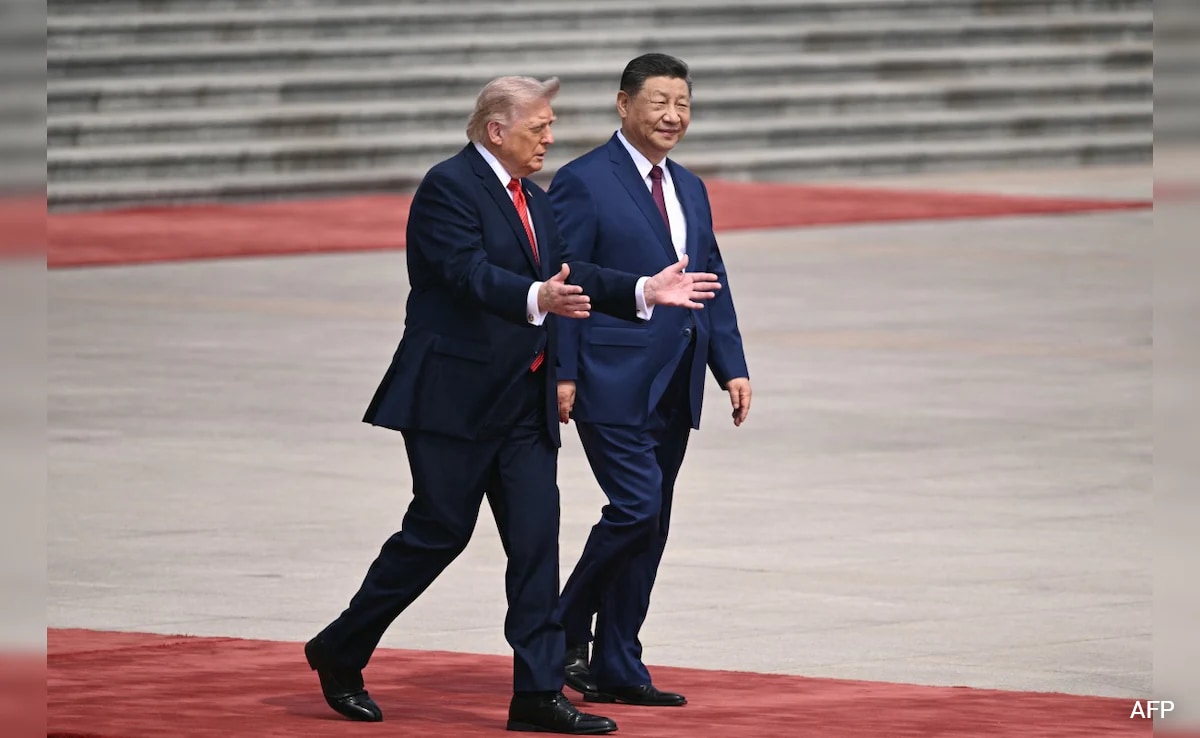
The recent high-level dialogue between the United States and China signals a fundamental shift from ideological confrontation toward a transactional "Tariff Truce" model. While geopolitical flashpoints like Tehran and Taiwan remain latent risks, they have been relegated to secondary status in the current negotiating cycle. The primary objective is the management of a bilateral trade deficit that has become politically unsustainable for the U.S. executive branch. This strategic pivot suggests that both nations are moving away from the pursuit of a comprehensive "grand bargain" and are instead focusing on a series of modular, sector-specific agreements designed to prevent immediate economic contagion.
The Triad of Economic Leverage
The current negotiations operate within three distinct pillars of influence that dictate the boundaries of any potential truce. Understanding these pillars is essential for interpreting why certain concessions are made while others are withheld.
- The Manufacturing Subsidy Barrier: China’s industrial policy, characterized by state-directed credit and energy subsidies, creates a structural price advantage that tariffs are designed to neutralize. From a U.S. perspective, tariffs function not as a revenue tool, but as a corrective tax on state-capitalist distortions.
- The Technology Containment Envelope: Export controls and investment restrictions on high-end semiconductors and artificial intelligence serve as a hard ceiling. This "small yard, high fence" strategy ensures that even if trade flows for consumer goods normalize, the strategic decoupling of frontier technologies remains intact.
- The Domestic Political Constraint: Both leaderships face internal pressures that limit their room for maneuver. For the U.S., any perceived weakness in trade enforcement carries a high electoral cost in the industrial "Rust Belt." For China, maintaining export volumes is critical for social stability and the transition toward a "high-quality growth" model.
The Cost Function of the Tariff Truce
A truce is not a return to free trade; it is the institutionalization of managed trade. The logic of the current standoff follows a specific cost function where the "Price of Stability" ($P_s$) is calculated by the sum of deadweight loss and the administrative costs of compliance.
$P_s = DWL + C_{admin} + I_{risk}$
In this equation:
- DWL (Deadweight Loss) represents the lost economic efficiency as supply chains reroute through more expensive third-party nations like Vietnam or Mexico.
- C_admin (Administrative Costs) covers the bureaucratic overhead of managing exclusion lists and origin-of-country certifications.
- I_risk (Inflationary Risk) accounts for the upward pressure on consumer prices as importers pass tariff costs to the end-user.
The truce persists only as long as $P_s$ remains lower than the projected cost of a full-scale trade war, which would involve the total blockage of critical inputs such as rare earth elements or advanced manufacturing equipment.
Structural Bottlenecks in Supply Chain Realignment
The assumption that tariffs alone will drive manufacturing back to the U.S. ignores the complexity of modern industrial clusters. Analysis of the "Friend-shoring" trend reveals significant friction points:
- Skilled Labor Scarcity: The U.S. lacks the vocational training infrastructure required to match the sheer volume of technicians available in Chinese coastal provinces.
- Tier 2 and Tier 3 Suppliers: While a "Tier 1" factory (e.g., an EV assembly plant) might move to North America, its sub-component suppliers often remain in the Yangtze River Delta, meaning the "decoupled" product still possesses high Chinese value-add content.
- Infrastructure Lead Times: Building out the energy and logistics capacity to support large-scale reshoring requires a decade-long investment horizon, which exceeds the four-year political cycle governing trade policy.
This creates a "circularity trap" where tariffs increase the cost of the very components needed to build a domestic manufacturing base.
The Mechanism of Currency as a Shadow Tariff
One of the most significant yet under-discussed aspects of the Trump-Xi talks is the relationship between the Yuan (CNY) and the effectiveness of U.S. trade barriers. When the U.S. applies a 25% tariff, a 10% depreciation in the CNY relative to the USD effectively absorbs nearly half of that tariff's impact for the American importer.
China utilizes a "managed float" currency regime to maintain export competitiveness. Any truce that does not include specific, enforceable provisions regarding currency transparency is inherently fragile. If China allows the Yuan to slide to 7.3 or 7.5 against the dollar, the "teeth" of U.S. trade policy are blunted without a single shot being fired in the trade war.
The Bifurcation of Global Standards
We are witnessing the emergence of two distinct techno-economic spheres. The truce provides a temporary ceiling on friction, but it does not stop the underlying divergence in:
- Data Sovereignty: China’s Data Security Law creates a firewall that prevents the seamless flow of industrial data, forcing multinational corporations to maintain "Twin IT" stacks—one for China and one for the rest of the world.
- Financial Rail Systems: The expansion of the Cross-Border Interbank Payment System (CIPS) as an alternative to SWIFT is a direct response to the risk of financial sanctions. This reduces the efficacy of the U.S. dollar as a geopolitical lever.
- Standard Essential Patents (SEPs): In sectors like 6G and green energy, China is aggressively pursuing leadership in international standards bodies to ensure that future global infrastructure is built on Chinese IP, regardless of U.S. tariff levels.
Strategic Divergence in Agricultural Trade
Agriculture serves as the "vent" for trade pressure. For the U.S., soybean and corn exports are high-value political chips. For China, food security is a national security priority. However, China’s strategy is shifting from dependence on the U.S. Midwest to a diversified sourcing model involving Brazil and Argentina.
This diversification reduces the U.S.’s primary point of leverage. If China can secure its caloric intake from the Global South, it can afford to be more recalcitrant in negotiations over intellectual property or market access for services. The U.S. agricultural sector faces a long-term risk of becoming a "swing producer" rather than a primary partner.
The Limits of Transactionalism
The current "tit-for-tat" negotiation style has inherent limitations. Transactionalism focuses on the quantity of trade (e.g., "China will buy $200 billion more in goods") rather than the quality of the institutional environment. This leads to several systemic failures:
- Verification Gaps: Monitoring whether China has actually met purchase quotas is notoriously difficult, as commodity prices fluctuate and private companies—not the state—are often the end buyers.
- Crowding Out: Forced purchase agreements often displace trade from other U.S. allies, creating friction within the Western security bloc.
- Static Solutions for Dynamic Problems: A trade deal signed today does not account for the rapid evolution of digital services or the emergence of the "Green Trade" conflict, where carbon border adjustment taxes will soon replace traditional tariffs as the primary tool of protectionism.
Critical Metals and the Asymmetric Threat
While the U.S. holds the lead in "Logic" (semiconductors), China holds the lead in "Materials" (processing of lithium, cobalt, and rare earths). The trade talks must be viewed through this lens of mutual vulnerability.
The U.S. cannot build a domestic battery supply chain without Chinese processing technology, and China cannot advance its AI capabilities without Western lithography equipment. This "Mutual Assured Economic Destruction" (MAED) is the underlying force keeping both parties at the table. The truce is an acknowledgement that neither side is ready to trigger a total break.
Operational Realignment for Global Enterprises
Businesses must move away from a "Just-in-Time" efficiency model toward a "Just-in-Case" resilience model. This involves three specific actions:
- Supply Chain Balkanization: Establishing "China for China" and "West for West" manufacturing hubs. This eliminates the risk of cross-border tariff exposure but doubles capital expenditure requirements.
- Tariff Engineering: Redesigning products to change their Harmonized System (HS) codes or moving final assembly to "Rule of Origin" friendly jurisdictions to minimize duty exposure.
- Geopolitical Stress Testing: Incorporating "worst-case" scenario planning where trade is restricted not just by tariffs, but by physical blockades or financial asset freezes.
The truce between Trump and Xi is a tactical pause, not a strategic peace. It buys time for both nations to further insulate themselves from the shocks of a potential future rupture. The true metric of success for this dialogue is not a reduction in trade deficits, but the prevention of a hard decoupling that would trigger a global depression.
The immediate play for market participants is to capitalize on this window of relative stability to diversify production away from the most sensitive "dual-use" sectors while securing long-term contracts for raw materials that sit outside the primary zone of conflict. Expect volatility to remain localized in high-tech sectors while consumer goods see a temporary easing of pressure. The "Tariff Truce" is a management framework for a long-term decline in bilateral trust, not a roadmap for its restoration.