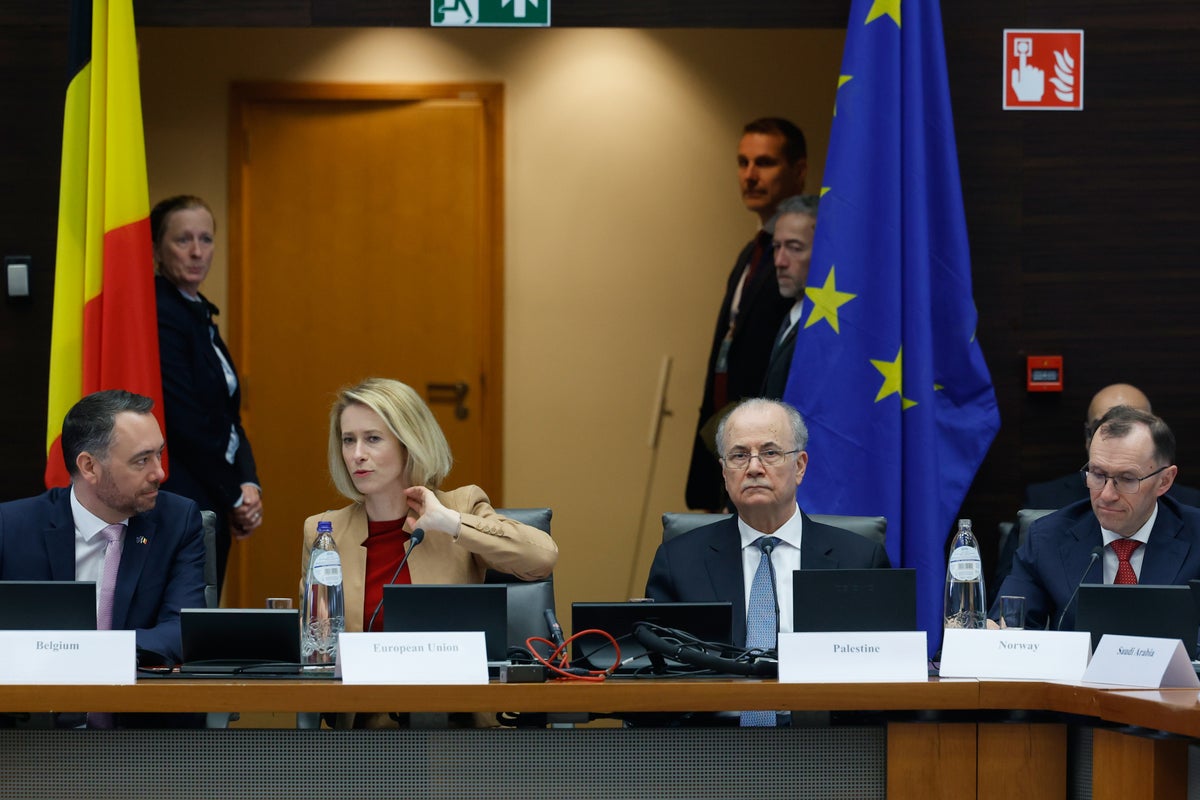
The recent diplomatic assembly in Brussels involving European Union leadership and Palestinian representatives operates on a central, unstated assumption: that international legitimacy can substitute for internal institutional capacity. While high-level summits serve the function of maintaining diplomatic channels, they often obscure the underlying variables that determine stability in Gaza and the West Bank. Stability in these territories is not a result of diplomatic consensus; it is a derivative function of administrative functionality, security architecture integration, and fiscal sustainability.
The Tripartite Framework of Institutional Fragility
The primary obstacle to effective governance in the Palestinian territories is the fragmentation of authority. This fragmentation creates a divergence between nominal political leadership and the actual provision of services. To understand why previous peace efforts have stalled, one must evaluate three core operational pillars:
1. The Fiscal Dependency Ratio
The Palestinian Authority (PA) operates under a severe structural deficit. Tax revenues collected on its behalf by external actors—specifically Israel under the Paris Protocol—are frequently subject to holdbacks due to security disputes. This creates a liquidity trap where the PA cannot meet its payroll obligations, which constitute the majority of public spending. Without a reliable, autonomous revenue stream, the government loses its ability to enforce social contracts. Stability requires transitioning from a model of international aid dependence to one of tax base expansion and predictable revenue transfer mechanisms.
2. The Security-Administrative Gap
In the West Bank, the security apparatus is bifurcated, existing partially as a law enforcement entity and partially as a political instrument. In Gaza, the governance structure remains disconnected from the formal internationally recognized Palestinian leadership. A stable security environment requires a unified command structure that differentiates between civil policing and border security. The failure to integrate these functions results in localized instability where criminal networks and militant factions fill the power vacuum left by ineffective state institutions.
3. The Legitimacy Deficit
Political governance relies on the perception of efficacy. When public services such as education, healthcare, and infrastructure maintenance are degraded, the governing body loses the mandate to lead. This is compounded by the lack of electoral processes, which prevents the peaceful transfer of power and prevents the renewal of institutional leadership. Legitimacy is not earned through international recognition in Brussels; it is built through the daily delivery of tangible utility to the citizenry.
Mapping the Failure of External Mediation
International mediation efforts frequently suffer from a misalignment of objectives. While the EU prioritizes the two-state solution as a normative goal, the operational reality on the ground requires a functional state model before a sovereign state can exist.
The mechanism for stabilization involves three specific transitions:
- Financial Decoupling: Moving away from volatile, conditional aid transfers toward transparent, automated revenue clearing systems that bypass political friction points.
- Institutional Auditing: Implementing rigorous, performance-based metrics for the civil service to ensure that international investment is not absorbed by systemic corruption or administrative inefficiency.
- Security Sector Reform: Establishing an independent, professionalized security force with a singular, non-partisan chain of command.
Most diplomatic conferences ignore these mechanisms, preferring to focus on the rhetoric of peace rather than the logistics of statehood. A state, by definition, requires a monopoly on the legitimate use of force and the ability to sustain its own operational budget. Currently, both requirements remain unfulfilled.
Measuring the Impact of Administrative Fragmentation
Data suggests that regions with high levels of institutional fragmentation experience a significant "governance tax." This tax manifests as higher costs for goods, delayed infrastructure projects, and the erosion of private sector investment. When the central government cannot guarantee the rule of law, businesses shift to informal markets. These informal markets are less productive, harder to tax, and prone to volatility.
The intersection of these factors creates a cycle where:
- Low administrative capacity limits tax collection.
- Low tax collection limits public service delivery.
- Poor service delivery reduces public trust.
- Reduced trust limits political cooperation with security forces.
- Security challenges trigger further fiscal holdbacks.
Breaking this cycle necessitates a prioritization of state-building over state-recognition. Diplomatic efforts that emphasize the final status of borders while ignoring the foundational weaknesses of the governing institutions are structurally destined to repeat historical failures.
Strategic Forecast and Implementation Requirements
The immediate path toward regional stability does not lie in further diplomatic summits, but in the implementation of a technocratic administration capable of managing fiscal and security transitions.
The first priority is the creation of an independent fiscal oversight body tasked with managing the collection and distribution of customs revenues, ensuring that public sector salaries are decoupled from diplomatic disputes. This requires a shift in focus from broad-spectrum political dialogue to specific, granular administrative reforms.
The second priority is the professionalization of the security sector, moving it toward a strictly law-enforcement model. This objective is best served by international partners focusing on training, equipment standardization, and the establishment of independent oversight mechanisms that hold security forces accountable for rule-of-law violations.
The final requirement is the phased implementation of municipal-level elections. Building a mandate from the bottom up allows for the identification of effective leaders and creates a mechanism for the peaceful resolution of political conflict. This bottom-up approach to legitimacy is the only credible alternative to the top-down failures of the past decade.
Stability will arrive only when the administrative systems function independently of the diplomatic fluctuations between Israel, the PA, and international stakeholders. Investment should be directed toward the technical systems of governance—tax collection software, court efficiency projects, and civil service training programs—rather than political theater. If the goal is a functioning society, the strategy must shift from diplomatic consensus to the brutal, unglamorous work of institutional engineering.