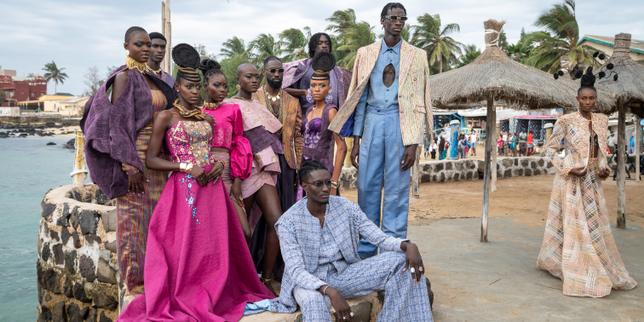
The ambition to achieve complete domestic self-sufficiency in textile production within urban West Africa faces a structural paradox. While consumer markets exhibit high demand for localized sartorial expressions, the underlying supply chain remains tethered to external inputs. Analyzing the shift toward domestic sourcing requires examining raw material dependencies, labor distribution, and the capital constraints governing local manufacturing ecosystems.
The Import Dependency Matrix
Local tailoring traditions and contemporary fashion movements in urban centers rely heavily on imported textiles and second-hand garments. This creates a severe cost-of-production imbalance. Raw fibers, industrial weaving machinery, and chemical dyes are rarely produced at scale domestically. You might also find this related coverage interesting: Why the Houston G20 Energy Talks Completely Missed the Point of the Global Fuel Crisis.
Consequently, independent ateliers must absorb high logistical overhead costs to acquire imported materials before assembly can even begin.
- Raw Materials: The absence of large-scale domestic spinning and weaving mills forces designers to import basic fabrics.
- Capital Equipment: Industrial sewing machines, specialized embroidery units, and finishing tools are sourced internationally, raising startup costs for small enterprises.
- Secondary Markets: The influx of cheap, imported second-hand clothing establishes a distorted baseline consumer price point, undercutting the margins of local artisans.
The Labor and Distribution Bottleneck
The transition from bespoke tailoring to scalable domestic manufacturing exposes structural limitations in workforce training and distribution networks. Tailoring is predominantly artisanal, characterized by fragmented micro-enterprises rather than consolidated industrial production lines. As discussed in detailed articles by Investopedia, the effects are widespread.
[Imported Raw Inputs] ---> [Artisanal Ateliers (Fragmented)] ---> [Informal Distribution] ---> [Domestic Consumer]
          ^                                                                                          |
          |_______________________ High Logistical Friction _________________________________________|
This structural fragmentation prevents economies of scale. Without centralized hubs for cutting, grading, and quality control, production runs remain small, unit costs remain elevated, and regional export scalability is constrained.
Market Mechanisms and Consumer Intent
Consumers driving the local fashion economy are navigating a dual reality. They seek cultural authenticity through garments explicitly tailored or manufactured within the country, yet their purchasing power is bounded by macroeconomic realities.
- Price Sensitivity: The middle-income consumer base demands high craftsmanship but resists prices that fully reflect the true cost of unassisted local production.
- Identity Signaling: Wearing garments produced from local design houses serves as a deliberate economic statement, shifting prestige away from imported luxury brands toward indigenous creators.
- Value Chain Retention: Every stage of production kept within national borders—from pattern drafting to final retail—retains capital that would otherwise leak to foreign fast-fashion exporters.
Strategic Capital Allocation
To bypass the current ceiling on domestic manufacturing growth, capital must be redirected away from purely retail-focused expansion and toward intermediate industrial infrastructure. Establishing regional textile mills, cooperative resource-sharing networks for heavy machinery, and formalized vocational training academies will reduce input costs. Until the upstream supply of raw yarn and fabric is industrialized locally, any pursuit of total independence remains vulnerable to external market shocks.