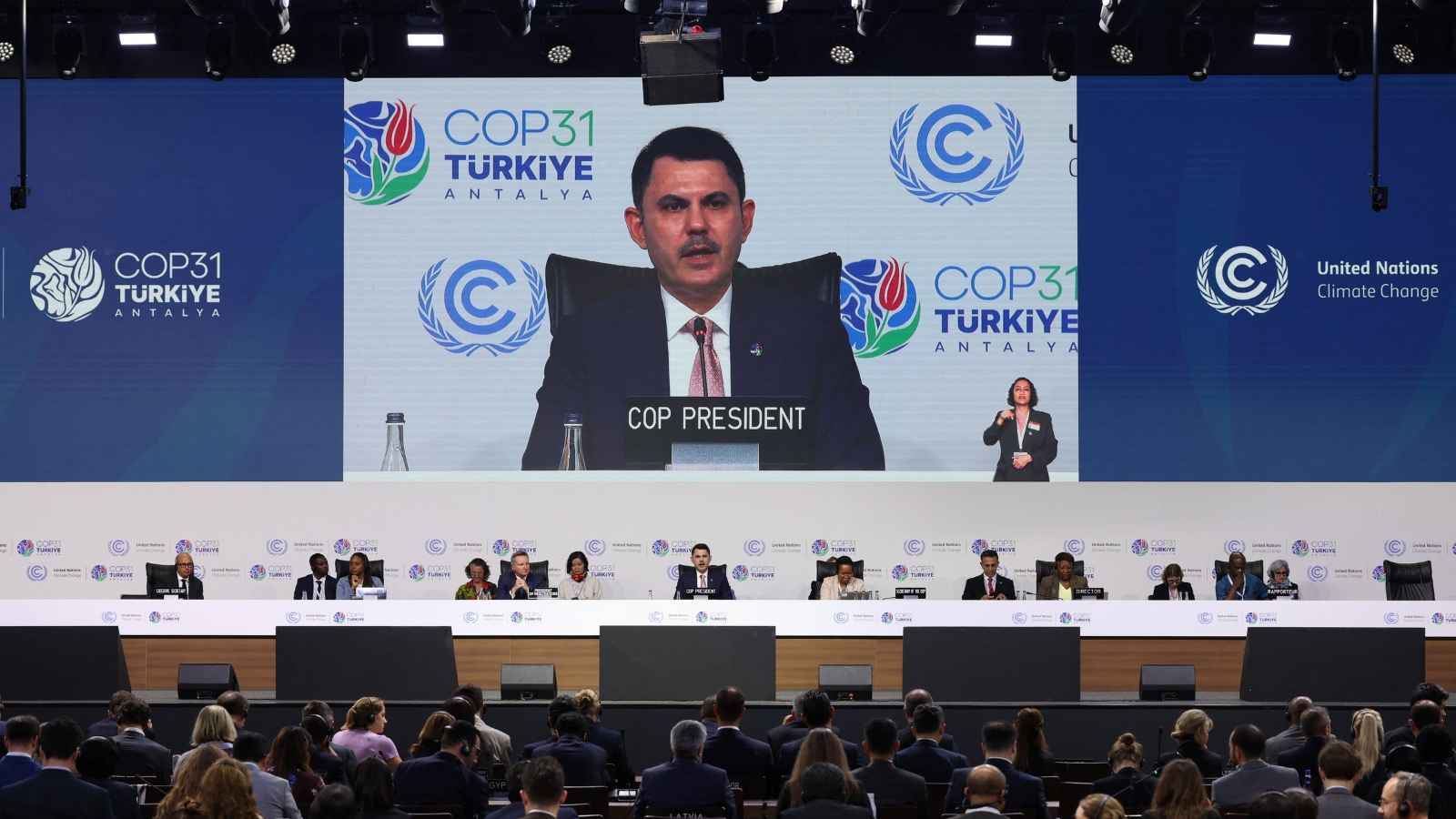
Multilateral climate negotiations do not stall in overtime because diplomats lack urgency; they stall because the consensus architecture of the United Nations Framework Convention on Climate Change (UNFCCC) incentivizes brinkmanship until the final hour of the scheduled window. When COP31 talks extend past their formal deadline, the delay represents a predictable game-theoretic equilibrium rather than a sudden diplomatic breakdown.
Standard news coverage treats overtime at a Conference of the Parties as an unexpected crisis of willpower. That framing misses the operational mechanics of international environmental treaties. Under UNFCCC rules of procedure, decisions require consensus—defined operationally not as unanimity, but as the absence of formal, sustained objection from nearly 200 sovereign delegations. This procedural rule transforms the final 48 hours of any summit into a high-stakes game of chicken where early concessions yield zero strategic advantage.
The Game Theory of the Overtime Equilibrium
To understand why COP31—and virtually every preceding summit from Paris to Dubai and Baku—drifts into extra hours, one must model the payoff matrix facing individual negotiating blocs.
In bilateral trade deals, parties exchange incremental concessions to build momentum. In multilateral climate governance, the text is negotiated across dozens of parallel technical tracks—mitigation, adaptation, climate finance, loss and damage, and Article 6 carbon markets—that remain legally non-binding until bundled into a single "cover decision" at the closing plenary.
This bundling creates three structural incentives that guarantee delay:
- The Holdout Premium: Any delegation that reveals its true bottom line early in week two loses its primary bargaining chip. By withholding agreement on a high-priority text (such as fossil fuel phase-out language or finance quantum targets) until the physical exhaustion of the final night sets in, a bloc maximizes its extractable concessions from host presidencies desperate to avoid a public collapse.
- Issue Linkage and Cross-Track Hostage Taking: Because all tracks converge in the final plenary, progress in one domain is routinely held hostage to secure movement in another. Developing nations may block procedural adoption of technical emissions reporting rules until developed nations yield on grant-based adaptation finance.
- Domestic Political Signaling: Negotiators do not answer solely to the plenary room; they report to domestic constituencies, legislatures, and industrial lobbies. Returning home with a compromise signed on schedule invites criticism that the delegation settled too easily. Returning with a compromise extracted after 36 hours of overtime allows ministers to frame the outcome as the absolute limit of diplomatic endurance.
Overtime is therefore an endogenous feature of the institutional design, not an exogenous shock.
The Four Pillars of the COP31 Deadlock
When COP31 enters extended negotiations, the friction rarely stems from a single ideological disagreement. Instead, the gridlock distributes across four distinct operational axes that govern the global energy transition.
1. The Finance Quantum and Burden-Sharing Asymmetry
At the core of every modern COP is a capital allocation dispute. Developing economies require trillions of dollars annually to decarbonize their grids while adapting to physical climate impacts. Developed economies, constrained by domestic fiscal deficits and high interest rates, resist open-ended sovereign balance-sheet commitments.
The disagreement centers on the structure of capital, not merely the headline figure:
- Public Grants vs. Mobilized Private Finance: Vulnerable nations demand predictable, non-debt-creating public grants. Wealthier nations push for blended finance instruments, guarantees, and private sector mobilization, arguing public treasuries cannot scale to multi-trillion-dollar levels alone.
- Expanding the Contributor Base: Traditional donor blocs (Annex II countries under the 1992 convention) argue that economic realities have shifted over three decades. They demand that high-income emerging economies with substantial sovereign wealth and high cumulative emissions transition from recipients to contributors. Recipient blocs reject this as a violation of the foundational principle of Common but Differentiated Responsibilities and Respective Capabilities (CBDR-RC).
2. Mitigation Ambition and Transition Language
The second axis governs the physical trajectory of global energy systems. Following the precedent set at COP28 regarding transitioning away from fossil fuels, subsequent summits face the harder task of operationalizing that mandate into Nationally Determined Contributions (NDCs).
The deadlock here hinges on textual precision:
- Abated vs. Unabated Fuels: Fossil-fuel-exporting states insist on language permitting "abated" fossil fuels, relying on Carbon Capture, Utilization, and Storage (CCUS) technologies to preserve long-term asset value.
- Sub-sector Timelines: Ambitious coalitions push for explicit phase-out dates for unabated coal and specific ceilings on upstream oil and gas expansion. Because a single sentence in a cover decision can alter sovereign credit ratings and long-term capital expenditure models for national oil companies, every verb—phase out, phase down, transition away—triggers hours of line-by-line legal dispute.
3. Adaptation Metrics and the Loss and Damage Operationalization
While mitigation deals with future atmospheric concentrations, adaptation and loss and damage address immediate physical liabilities. The technical bottleneck lies in quantification and attribution.
Unlike greenhouse gas emissions, which can be standardized into metric tons of carbon dioxide equivalent ($CO_2e$), adaptation resilience lacks a universal unit of account. Establishing the Global Goal on Adaptation requires agreeing on measurable indicators across water security, agricultural yield stability, and infrastructure resilience. Without standardized metrics, capital allocation for adaptation remains arbitrary, stalling agreement on funding disbursement triggers.
4. Carbon Market Integrity Under Article 6
Article 6 of the Paris Agreement governs international cooperation through carbon markets, specifically bilateral transfers (Article 6.2) and a centralized UN-supervised crediting mechanism (Article 6.4).
Disputes in overtime frequently focus on:
- Corresponding Adjustments: Preventing double counting where both the host country selling a carbon credit and the buyer country purchasing it claim the same emissions reduction toward their respective climate targets.
- Additionality and Permanence: Setting strict baseline methodologies to ensure forest conservation or technological removal credits represent genuine atmospheric reductions rather than business-as-usual activity. Loose rules collapse market prices and credibility; overly rigid rules freeze capital flows to developing projects.
The Operational Cost Function of Overtime
When a COP presidency extends the summit past its scheduled Friday close, the diplomatic environment undergoes a rapid, measurable degradation that directly impacts the quality of the final legal text.
[Scheduled Close]
       │
       ▼
[Flight Departures & Hotel Checkouts] ──► [Asymmetric Attrition of Small Delegations]
       │
       ▼
[Presidency "Take-It-or-Leave-It" Text] ──► [Ambiguous Legal Phrasing ("Constructive Ambiguity")]
       │
       ▼
[Closing Plenary Gavel] ──► [Delayed Implementation & Execution Risk]
Asymmetric Delegation Attrition
Wealthy nations and large emerging economies deploy delegations numbering in the hundreds, complete with rotating shifts of international lawyers, sector specialists, and senior ministers. Least Developed Countries (LDCs) and Small Island Developing States (SIDS) often operate with teams of fewer than ten people covering dozens of simultaneous negotiation rooms.
Once the summit enters overtime, flights expire, per diem budgets run dry, and junior technical experts from smaller nations must depart. By Saturday afternoon or Sunday morning, the diplomatic playing field tilts sharply toward well-resourced delegations capable of sustained physical endurance. Small states lose the technical capacity to scrutinize last-minute textual insertions buried in hundred-page annexes.
The Trap of Constructive Ambiguity
To break deadlocks during overtime, COP presidencies rely on "constructive ambiguity"—drafting language vague enough that opposing sides can claim victory to their domestic audiences.
While constructive ambiguity secures the gavel at the closing plenary, it exports the conflict downstream into implementation:
- Regulatory Uncertainty: Private capital markets require clear policy signals to price carbon risk and allocate infrastructure debt. Ambiguous diplomatic phrasing delays final investment decisions (FIDs) for clean energy projects.
- Compliance Drift: When targets lack binding verification mechanisms or clear timelines, national governments defer difficult domestic policy reforms—such as removing fossil fuel subsidies or enacting carbon border adjustments—until the next geopolitical cycle.
- Litigation Exposure: Vague treaty commitments increasingly migrate from diplomatic halls into domestic and international courts, where judicial bodies are forced to interpret what negotiators refused to define.
Limitations of the Multilateral Consensus Model
Recognizing the mechanics of COP31 overtime exposes the inherent ceiling of the UNFCCC process. Critics often call for replacing consensus with majority voting, yet doing so ignores the structural reality of international law.
Under the UN Charter and the Vienna Convention on the Law of Treaties, no sovereign state can be bound to emissions cuts or financial transfers against its explicit consent. If a major emitter or capital provider is outvoted via a two-thirds majority rule, it will simply refuse to ratify the amendment, withdraw from the accord, or ignore the mandate—hollowing out the treaty's real-world emissions coverage.
The consensus rule is not a procedural flaw to be patched; it is the exact price of universal participation. Because climate change is a global commons problem where free-riding undermines collective effort, an imperfect agreement that keeps major emitters inside the tent yields higher marginal utility than a pristine agreement signed only by already-aligned nations.
Strategic Execution Beyond the Plenary Gavel
For institutional investors, corporate strategists, and energy planners watching COP31 drag into overtime, reacting to minute-by-minute diplomatic headlines is a misallocation of analytical bandwidth. The closing text of a COP is a lagging indicator of geopolitical consensus, not a leading indicator of market reality.
Decision-makers should execute three concrete adjustments to navigate multilateral climate gridlock:
- Decouple Capital Allocation from Plenary Text: Base long-term infrastructure and supply-chain investments on hard national legislation, industrial policy incentives, and technological learning curves (such as battery storage cost declines and solar deployment rates) rather than aspirational COP cover decisions.
- Track Minilateral and Sectoral Clubs: Monitor smaller, binding coalitions—such as carbon border adjustment regimes, regional power pool treaties, and maritime fuel standards—where smaller participant counts eliminate the holdout premium and enforce real compliance penalties.
- Price Physical Risk Directly: Treat protracted COP overtime on adaptation and finance as confirmation that sovereign adaptation funding will remain undercapitalized relative to physical climate volatility. Hedge supply chains and fixed assets against localized weather disruptions assuming minimal public-sector bailout capacity.


