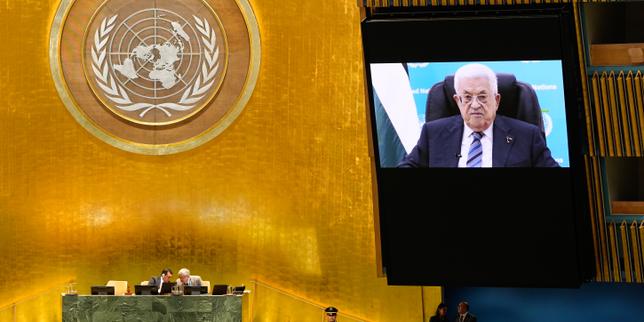
Diplomatic pronouncements delivered at international plenaries are rarely evaluated through their systemic mechanics. When Mahmoud Abbas addressed the United Nations regarding Israeli state policy and its friction with Palestinian existence, international media framed the discourse through standard emotive lenses. This approach obfuscates the underlying structural realities, legal frameworks, and long-term strategic game-theory dynamics governing the conflict. To deconstruct this diplomatic intervention accurately, one must examine the institutional levers, the limits of international jurisprudence, and the systemic cost functions borne by both polities.
The Institutional Lever: International Legitimacy as a Strategic Asset
For stateless or semi-autonomous political entities operating under military occupation, the United Nations General Assembly and Security Council function primarily as legitimacy-generation engines. Lacking conventional hard power, sovereign economic structures, or blue-water military projection capabilities, such actors rely entirely on normative pressure.
The mechanism operates through three distinct vectors:
- Codification of Grievance: Transforming political disputes into codified violations of international humanitarian law shifts the debate from bilateral negotiation—where power asymmetries are absolute—to multilateral compliance.
- Cost-Imposition via Isolation: Diplomatic resolutions, advisory opinions from the International Court of Justice, and formal UN statements accumulate institutional friction for the opposing state, translating into reputational damage, commercial divestment pressures, and potential universal jurisdiction liabilities for military or political leadership.
- Domestic Resilience Signaling: For internal constituencies, securing high-profile international validation serves to reinforce institutional continuity despite physical fragmentation.
The limitation of this vector lies in enforceability. Without Chapter VII enforcement mechanisms from the UN Security Council—routinely constrained by permanent member vetoes—normative victories do not alter physical ground realities. They merely alter the legal and diplomatic baseline from which future negotiations occur, assuming a framework for negotiation remains viable.
The Cost Function of Protracted Statelessness
When evaluating statements concerning the threat to physical existence, analysts must examine the quantitative and qualitative decay curves of institutional and demographic structures under prolonged occupation. The sustainability of a populace depends on capital accumulation, infrastructural integrity, and spatial mobility.
The economic and social cost functions can be modeled across three interdependent domains:
Spatial Fragmentation and Transaction Costs
The imposition of administrative checkpoints, jurisdictional division (such as the West Bank administrative zones), and infrastructural barriers introduces massive transaction costs into daily commerce. When transit times for basic inputs, labor, and medical logistics become unpredictable, capital formation stalls. Businesses cannot achieve economies of scale, and foreign direct investment collapses. This economic erosion directly affects baseline healthcare access, water security, and nutritional stability.
Institutional Atrophy
Sovereign states possess centralized taxation, regulatory oversight, and public goods provisioning systems. Under conditions of fragmented jurisdiction, tax collection is heavily mediated or compromised, and regulatory control over land, resources, and telecommunications is externalized. This creates a structural dependency where internal economic vitality is directly tethered to the economic policies and administrative permissions of the occupying power, eliminating macroeconomic sovereignty.
Demographic Vulnerability
The concept of existential threat, stripped of rhetorical flourish, translates into demographic displacement mechanics, land expropriation rates, and the systematic reduction of viable agricultural and residential space. As population density increases within confined municipal boundaries while available land area for expansion contracts due to zoning restrictions and settlement expansion, the carrying capacity of the local infrastructure is systematically degraded.
The Deterrence Deficit and Legal Asymmetry
A central paradox in high-level diplomatic appeals is the reliance on the international legal order by actors who lack the institutional capacity to enforce judgments. International humanitarian law, specifically the Fourth Geneva Convention, places strict obligations on an occupying power regarding the protection of civilian populations, the prohibition of population transfers, and the preservation of existing institutional frameworks.
However, the international legal architecture suffers from a structural enforcement deficit. When a state actor calculates that the short-term security gains or domestic political dividends of a policy outweigh the long-term, highly attenuated diplomatic penalties, compliance breaks down entirely.
- Asymmetric Accountability: Armed non-state actors or occupied populations are judged by the standards of international criminal law and humanitarian norms, yet formal judicial bodies frequently lack jurisdiction to prosecute state-level violations effectively without political consensus.
- The Veto Bottleneck: The Security Council structure ensures that major geopolitical actors can shield allies or themselves from binding punitive measures, rendering resolutions declarative rather than operational.
- Normalization of Exception: Prolonged occupation breeds normalization. Temporary emergency measures become permanent administrative realities, shifting the baseline of legality over decades until the original legal protections are virtually unrecognizable in practice.
Strategic Trajectory and Systemic Outcomes
Rhetoric concerning existential survival is the ultimate indicator of diplomatic impasse. When political leadership stops negotiating parameters of governance and begins debating physical and national survival, compromise mechanisms fail because the zero-sum nature of existence precludes compromise.
The ongoing trajectory indicates a hardening of positions where institutional engagement at global forums serves less as a bridge to bilateral resolution and more as an institutional defensive maneuver. As long as the structural asymmetry in hard power remains uncorrected by effective international enforcement, diplomatic interventions will function as diagnostic markers of a deteriorating status quo rather than mechanisms for structural reform. The ultimate resolution depends not on verbal declarations at international tribunals, but on a fundamental realignment of the political and economic cost-benefit calculations governing the actions of the primary actors on the ground.