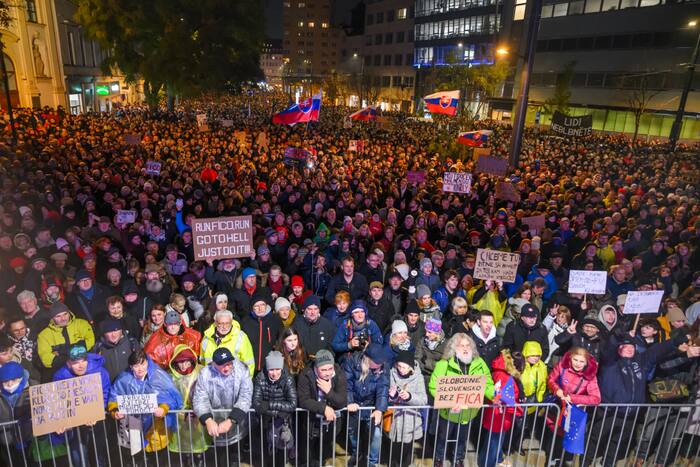
Western media loves a clean, romantic story about Eastern Europe. You know the script. Crowds gather in a historic square on the anniversary of the 1989 Velvet Revolution, wave European Union flags, and chant against a populist leader labeled as a Kremlin sympathizer. Journalists file dispatches framing the event as a decisive awakening of civil society against democratic backsliding.
That narrative is comforting, predictable, and completely detached from how Slovak politics actually operates.
When thousands of demonstrators take to the streets of Bratislava to protest Prime Minister Robert Fico, international observers routinely misread the crowd size as a barometer of impending political collapse. In reality, street protests in Slovakia’s capital rarely threaten Fico’s grip on power. More often, they hand him the exact political ammunition he needs to consolidate his base outside the Bratislava bubble.
The Bratislava Bubble Versus the Slovak Reality
To understand why standard political commentary gets Slovakia wrong, you have to look at the geography of political power in Central Europe. Bratislava is wealthier, younger, and far more culturally aligned with Vienna and Prague than with the industrial towns of central and eastern Slovakia.
When opposition parties like Progressive Slovakia (PS) or Freedom and Solidarity (SaS) mobilize tens of thousands of people in Bratislava’s SNP Square, they are largely preaching to voters they already own. Political analysts in the region have long noted a stark urban-rural divide in Slovak voting behavior. High turnout at a rally in the capital does not translate into flipped parliamentary seats in regions like Trenčín, Žilina, or Prešov, where economic anxieties, pension security, and skepticism toward Western interventionism dominate the conversation.
Every time opposition leaders frame a protest around abstract concepts like "rule of law," "European values," or foreign policy alignment, they inadvertently validate Fico’s core campaign message. Fico’s party, Smer-SD, thrives on portraying the opposition as an out-of-touch urban elite that cares more about Brussels' approval than grocery prices and energy bills in the Slovak countryside.
The Flawed Premise of the "Pro-Russian" Label
Mainstream coverage almost universally reduces Fico to a single, two-word caricature: "pro-Russian." This lazy shorthand obscures the cold, transactional opportunism that actually drives his administration.
Calling Fico an ideological puppet of Moscow misses the mechanics of his political survival. Fico has served as Prime Minister across multiple eras—first in 2006, again in 2012, and returning in 2023. During his earlier tenures, he oversaw Slovakia’s entry into the Eurozone and maintained standard, cooperative relations with NATO and EU institutions whenever it benefited Bratislava financially.
His current rhetoric—halting state military aid to Ukraine, criticizing EU sanctions against Russia, and questioning Western diplomatic consensus—is not rooted in ideological devotion to the Kremlin. It is a calculated domestic electoral strategy. According to polling data from agencies such as GLOBSEC and Focus over recent years, a significant portion of the Slovak electorate holds skeptical views toward NATO and blames Western policies for regional instability and inflation. Fico did not invent this sentiment; he simply monetized it at the ballot box.
Furthermore, look at what Fico actually does in Brussels versus what he says in Bratislava. Despite fiery speeches at home, his government has repeatedly avoided blocking major EU aid packages for Ukraine when push comes to shove, choosing instead to extract concessions or preserve access to EU cohesion funds. Treating his rhetoric as identical to his policy is a rookie analytical error.
Why Velvet Revolution Symbolism Backfires
Staging anti-government rallies on November 17—the anniversary of the 1989 Velvet Revolution that toppled Communist rule in Czechoslovakia—carries immense emotional weight for older liberals and urban intellectuals. Yet as a political weapon against Fico, 1989 nostalgia has severe diminishing returns.
For a substantial segment of Slovak voters, the post-1989 transition is not remembered solely as a triumph of liberty. In regions hit hard by deindustrialization and the privatization waves of the 1990s, the transition meant lost jobs, stagnant wages, and the hollowing out of local communities.
When opposition figures wrap themselves in the mantle of 1989 to attack Fico, they unintentionally trigger historical resentment among voters who associate the post-Communist liberal establishment with economic hardship. Meanwhile, Fico positions himself as the protector of the social welfare state, appealing directly to pensioners and working-class families who feel left behind by rapid market reforms.
The Mechanics of Polarization
Watch how Fico responds whenever a major protest erupts in the capital. He rarely panics, and he almost never retreats. Instead, he uses the protests as a foil to sharpen political polarization.
- Framing the Opposition as Destabilizers: Fico’s communication team consistently characterizes mass demonstrations not as organic civic expression, but as coordinated attempts to overturn the results of a free and fair parliamentary election.
- Weaponizing Media Narratives: By pointing to sympathetic coverage of the protests in mainstream Slovak outlets and international press, Fico reinforces his claim that powerful external forces are working against a sovereign Slovak government.
- Shifting Focus from Governance to Identity: When the public debate revolves around street protests and geopolitical loyalty tests, voters spend less time scrutinizing internal coalition fractures, healthcare bottlenecks, or fiscal deficits.
Imagine a scenario where the Slovak opposition abandoned massive, symbol-heavy rallies in Bratislava for six months. Suppose instead they spent that exact same energy and funding organizing town halls in small eastern municipalities, focusing exclusively on hospital wait times, local infrastructure decay, and cost-of-living pressures. Fico’s primary rhetorical shield—that his critics are arrogant city elites obsessed with foreign agendas—would evaporate overnight.
What Observers Should Actually Watch
If you want to know whether Robert Fico’s coalition is genuinely in trouble, stop counting heads in Bratislava squares on national holidays. Street protests are a lagging indicator of frustration among people who already dislike him.
Look instead at three metrics that actually govern political survival in Slovakia:
- Coalition Arithmetic: Fico governs through a delicate alliance involving Smer-SD, the more moderate Hlas-SD, and the nationalist Slovak National Party (SNS). Friction among these partners over ministry posts, state enterprise appointments, and parliamentary votes poses a far greater threat to the government than any outdoor demonstration.
- EU Funds and Fiscal Reality: Slovakia relies heavily on European Union structural funds for public investment. As long as Fico keeps the money flowing from Brussels while talking tough at home, his balancing act holds. If his domestic judicial or media reforms trigger a genuine freeze in EU funding—similar to what happened in Hungary—economic pressure will hit his core voters directly.
- Hlas-SD’s Voter Retention: Hlas, led by allies of President Peter Pellegrini, occupies the crucial center-left space between Fico’s hardline populism and the liberal opposition. If Hlas voters begin defecting due to dissatisfaction with governance or economic stagnation, the coalition’s parliamentary majority collapses from within.
The Limits of Street Politics
There is a crucial caveat to this analysis. Street protests are not entirely useless. In 2018, following the murder of investigative journalist Ján Kuciak and his fiancée Martina Kušnírová, massive nationwide demonstrations—reaching far beyond Bratislava into dozens of smaller towns—created a moral and political earthquake that forced Fico to resign as Prime Minister.
That is the benchmark that matters. The 2018 protests succeeded because they crossed the urban-rural divide, united disparate social classes around a visceral shock to the national conscience, and cracked the loyalty of Fico’s own coalition partners.
Current protests, driven largely by partisan opposition parties and concentrated heavily in the capital, lack that cross-demographic reach. Treating every rally in Bratislava as a sequel to 2018—or worse, as a replay of 1989—misunderstands the electorate. Until Slovakia’s opposition learns how to speak to the economic and cultural anxieties of the towns outside the capital, filling SNP Square will remain an exercise in preaching to the choir while Robert Fico counts the votes that actually decide elections.