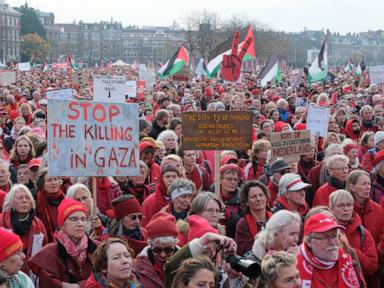
Tens of thousands of protesters marched through Amsterdam, waving flags, chanting slogans, and demanding that the Dutch government fundamentally alter its diplomatic and military stance toward Israel and Gaza. Legacy news outlets covered the event with predictable awe, treating headcount as a direct proxy for political leverage.
They are wrong.
The prevailing consensus in modern journalism equates mass street mobilization with imminent policy shifts. Reporters count bodies in Museumplein, quote a handful of impassioned organizers, and imply that The Hague is now forced to rethink its alliances. In reality, mass demonstrations in Western European democracies rarely dictate foreign policy—especially when those policies are anchored in coalition arithmetic, binding European Union frameworks, and deeply entrenched defense treaties.
If you want to understand why the Dutch cabinet will largely absorb this public pressure without changing course, you have to stop looking at the streets and start looking at the mechanics of parliamentary survival and international law.
The Illusion of the Crowd
In domestic politics, a crowd of fifty thousand people can kill a pension reform bill or force a resignation over housing shortages. Foreign policy operates under entirely different rules.
I have spent years analyzing European parliamentary maneuvering and coalition negotiations in The Hague. The single biggest misconception among activists and casual observers is that politicians view foreign policy demonstrations through the same lens as domestic labor strikes. They do not. When a Dutch prime minister looks at a march in Amsterdam, they are not calculating how many seats they will lose in the next general election over Gaza; they are calculating whether breaking ranks with Washington, Berlin, and Brussels will tank their domestic legislative agenda.
The Netherlands is a trading nation whose security architecture relies entirely on NATO and EU consensus. Unilateral foreign policy shifts are treated by the Dutch Ministry of Foreign Affairs not as moral victories, but as diplomatic liabilities.
Coalition Paralysis and the Polder Model
To understand the Dutch government's inertia, you have to understand the polder model—the consensus-driven decision-making process that defines politics in the Netherlands.
Dutch governments are invariably multi-party coalitions composed of factions with wildly divergent ideological foundations. In recent administrations, right-wing populist parties, center-right liberals, and centrist technocrats have shared cabinet tables while holding fundamentally incompatible views on the Middle East.
When a coalition is fragile, foreign policy becomes the first casualty of internal stability. Rather than adopting a bold new stance demanded by protesters, a divided cabinet defaults to the lowest common denominator: strict adherence to existing EU statements, calls for adherence to international humanitarian law, and incremental adjustments to export licenses only when compelled by domestic courts.
Marching in Amsterdam does not resolve the ideological deadlock inside the Binnenhof. If anything, high-visibility street pressure forces coalition partners to dig into their existing positions to avoid looking weak to their respective voter bases.
The Courtroom Beats the Street Every Time
If street protests are largely theatrical in the context of Dutch foreign policy, what actually moves the needle? Litigation.
While tens of thousands of people were marching in Amsterdam, the most consequential blow to Dutch-Israeli military cooperation had nothing to do with chanting crowds. It happened in a quiet courtroom in The Hague.
In February 2024, the Court of Appeal in The Hague ordered the Dutch government to halt the export of F-35 fighter jet parts to Israel, ruling that there was a "clear risk" that the aircraft were being used to commit serious violations of international humanitarian law. That ruling was not the result of a massive street rally. It was the result of three human rights organizations—Oxfam Novib, PAX, and The Rights Forum—filing a targeted administrative lawsuit based on existing EU Common Position rules and the Arms Trade Treaty.
Let’s compare the actual impact of these two mechanisms:
- Mass Demonstrations: Generate media coverage, validate participants' moral urgency, and signal public discontent. Policy impact: Near zero.
- Targeted Administrative Litigation: Forces the state to prove compliance with its own statutory obligations under threat of judicial injunction. Policy impact: Immediate suspension of military export licenses.
Activists love marches because they feel cathartic. Lawyers love statutes because they are binding. The Dutch state can ignore a hundred thousand people walking down the Damrak, but the Dutch Supreme Court cannot be ignored without triggering a constitutional crisis.
The Strategic Flaw in "Demanding a Shift"
Another lazy assumption in mainstream coverage is that the Dutch government actually possesses the unilateral autonomy to execute what protesters are demanding—such as comprehensive economic sanctions, immediate diplomatic severance, or unilateral arms embargoes.
Under the Treaty on the Functioning of the European Union (TFEU), trade policy is an exclusive competence of the European Union. The Netherlands cannot unilaterally impose trade sanctions on Israel—or any other non-EU nation—without violating EU single-market law. Any substantive economic measure requires unanimity among all 27 EU member states in the European Council.
With countries like Germany, Hungary, and the Czech Republic firmly opposed to punitive economic measures against Israel, the prospect of EU-wide sanctions is dead on arrival.
When journalists report that protesters are "pressing the Dutch government" to enact sweeping economic sanctions, they are reporting on a demand that is legally impossible for The Hague to fulfill on its own. By failing to point out this structural reality, media coverage misleads the public about where actual power resides and sets activists up for inevitable disillusionment.
What People Get Wrong About Public Opinion in the Netherlands
Mainstream reporting frequently frames large protests as proof that "the Dutch public" has decisively turned against government policy. This is a classic sampling error.
Amsterdam is not the Netherlands. It is a progressive, cosmopolitan outlier whose municipal politics routinely diverge sharply from the rest of the country. Outside the Randstad—the urban crescent encompassing Amsterdam, Rotterdam, The Hague, and Utrecht—voter priorities look drastically different.
Polling consistently shows that while a majority of Dutch citizens express deep concern over civilian casualties in Gaza and favor humanitarian aid, there is no consensus on severing ties with Israel or abandoning traditional Western diplomatic alignments. Furthermore, for a massive segment of the Dutch electorate, domestic issues—such as the nitrogen crisis, asylum policy, inflation, and the acute housing shortage—completely overshadow foreign conflicts at the ballot box.
Politicians know how to read disaggregated polling data. They know that the demographic marching in Amsterdam overwhelmingly votes for opposition parties like GroenLinks-PvdA, DENK, or the Party for the Animals—voters the center-right and right-wing parties were never going to win anyway. Until foreign policy dissatisfaction begins bleeding into the suburban and rural constituencies that decide national elections, the political cost of ignoring the marches remains negligible.
The Downside of the Institutional Route
To be clear, abandoning street mobilization entirely in favor of pure legalism and lobbying has its own severe limitations.
Courts can only enforce laws that already exist; they cannot write new foreign policy or invent moral leadership. The F-35 ruling succeeded only because the Netherlands had already ratified the Arms Trade Treaty and integrated EU export criteria into national law. Where no clear statutory violation exists, judges will inevitably defer to the executive branch's prerogative over foreign affairs.
Moreover, without visible public pressure, institutional actors often lack the political cover needed to push for incremental reforms. Large demonstrations serve a secondary function: they shift the Overton window just enough to make previously taboo policy discussions—like reviewing the EU-Israel Association Agreement—palatable in polite diplomatic circles.
The mistake is confusing that background noise for the primary engine of change.
How Real Foreign Policy Leverage Actually Works
If citizens, advocacy groups, and political strategists actually want to alter how a mid-sized European power conducts its foreign policy, marching through a capital city on a Sunday afternoon is the least efficient allocation of resources imaginable.
Real leverage in a system like the Netherlands requires exploiting institutional choke points rather than staging public spectacles:
- Supply Chain and Pension Fund Pressure: The Netherlands manages some of the largest institutional capital pools in the world, including massive public pension funds like ABP. Directing shareholder activism, divestment campaigns, and fiduciary duty challenges at Dutch institutional investors hits corporate and state interests where it actually hurts—balance sheets and credit ratings.
- Municipal Procurement Boycotts: While the national government is bound by EU trade rules, Dutch municipalities have significant autonomy over local procurement contracts and city-to-city partnerships. Targeted pressure on city councils in Amsterdam, Utrecht, and Rotterdam yields concrete, enforceable policy changes far faster than lobbying the Ministry of Foreign Affairs.
- Strategic Parliamentary Interpellation: Instead of generic demands for "action," effective advocacy equips opposition MPs with granular, technical intelligence—such as specific customs codes for dual-use exports or compliance failures under existing bilateral treaties—forcing ministers into recorded parliamentary debates where evasion carries legal consequences.
Legacy journalism will continue to treat every large protest as a potential turning point because crowds make for compelling photography and simple narratives. But power in The Hague is not moved by decibels in the street. It is moved by judicial injunctions, coalition math, and institutional capital. Until activists and reporters alike stop confusing visibility with leverage, the marches will keep happening—and the policies will stay exactly the same.