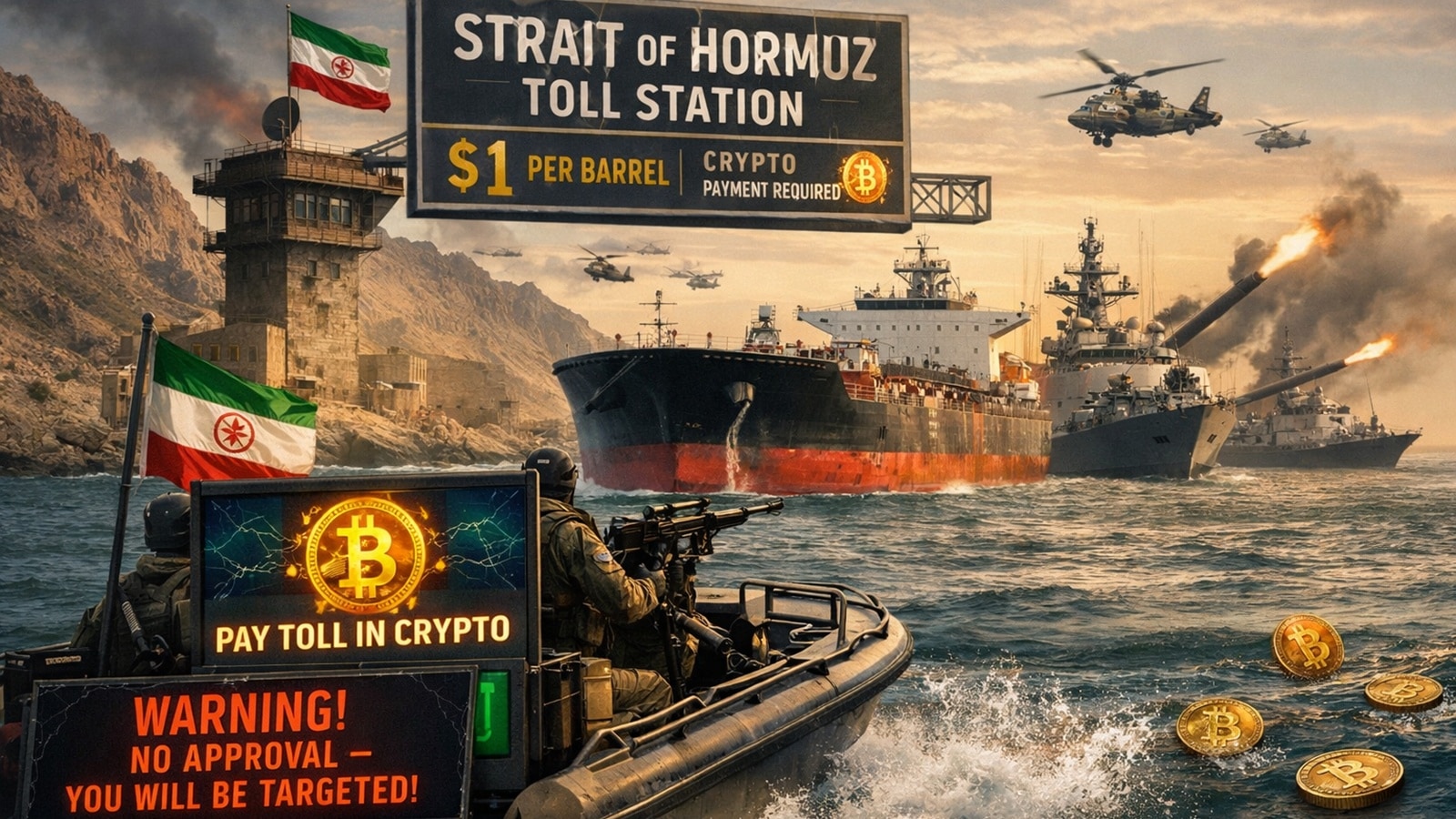
Tehran just sent the world a billion-dollar invoice, and the West is too distracted by the word "ceasefire" to realize they’ve already lost the checkbook. The report that Iran intends to charge a $1 per barrel transit fee for oil passing through the Strait of Hormuz isn't just a "policy shift" or a "regional development." It is a fundamental rewriting of the laws of the sea that turns a global chokepoint into a private toll road.
The lazy consensus among analysts is that this is a desperate cash grab by a sanctioned regime. They are wrong. This is a masterclass in asymmetrical economic warfare. By demanding payment in Bitcoin and Chinese yuan, Iran isn't just collecting a fee; they are building a parallel financial universe that the SWIFT system cannot touch.
The Myth of "Innocent Passage"
Every maritime law textbook will tell you that the Strait of Hormuz is governed by the principle of transit passage. This means ships have the right to move through without interference as long as they are continuous and expeditious. Iran is currently setting those textbooks on fire.
By imposing a $1 per barrel tax, Iran is effectively claiming sovereignty over international waters. For a Very Large Crude Carrier (VLCC) carrying 2 million barrels, that’s a **$2 million entry fee**. If you don’t pay, you don't pass. The IRGC has moved from being a regional militia to becoming the world's most aggressive harbor master.
The legal argument Tehran is using is a clever piece of "lawfare." Since Iran never ratified the 1982 UN Convention on the Law of the Sea (UNCLOS), they argue they are only bound by the 1958 Convention, which allows for more restrictions on "innocent passage." They are framing this toll as a "security service fee"—a protection racket with better branding.
Why the Market is Wrong About Who Pays
Most pundits assume this $1 fee will be passed directly to the consumer at the pump. That’s a fundamental misunderstanding of oil market elasticities.
In reality, the world oil price is set by global supply and demand. A $1 tax on Gulf oil doesn't automatically raise the price of Brent or WTI by a dollar. Instead, it creates a price wedge. The producers—Saudi Arabia, the UAE, and Kuwait—are the ones who will eat the majority of this cost.
- The Producers' Burden: Gulf states account for roughly 20% of world supply. Because they can’t easily move their oil elsewhere, they are forced to absorb the tax to stay competitive with non-Gulf producers.
- The "Non-Hostile" Discount: Iran is selectively applying these rules. Vessels from "friendly" nations like China and India are seeing smoother transits, while Western-linked tankers are facing the full weight of the "tollbooth."
- The Logistics Nightmare: It’s not just the $1 fee. It’s the cost of the Bitcoin volatility, the Chinese yuan conversion fees, and the massive insurance premiums that have skyrocketed since the IRGC started "escorting" compliant ships.
The Crypto-Yuan Pivot: Ending the Dollar’s Sea Reign
The most disruptive part of this "ceasefire" deal isn't the oil—it's the plumbing. Iran is mandating that these fees be paid in Bitcoin, USDT, or CNY.
I’ve seen dozens of "sanction-busting" schemes over the last decade, but this is the first one with true scale. By forcing 20% of the world's oil transit fees into non-dollar assets, Iran is creating a massive, liquid pool of capital that sits entirely outside the reach of the U.S. Treasury.
Imagine a scenario where a tanker operator in Singapore has to buy $2 million worth of Bitcoin every time they want to move a cargo. They aren't doing it because they believe in decentralization; they’re doing it because it’s the only way to get the VHF secret permit code from an IRGC patrol boat. This isn't a "financial innovation"—it's a forced migration of the global energy trade away from the Greenback.
The Math of the Tollbooth
Let's look at the numbers the "experts" are ignoring. Before the recent escalations, roughly 20 million barrels per day (mb/d) flowed through the Strait.
- Daily Revenue: $20,000,000
- Annual Potential: ~$7.3 Billion (conservative) to $80 Billion (aggressive, if LNG and other cargo are included)
For context, Iran’s total oil export revenue in 2024 was roughly $46 billion. By simply standing at the door and charging admission, they could potentially double their national income without drilling a single new well.
The Failure of the "Trump Ceasefire"
The current ceasefire is being hailed as a win for "energy stability." In reality, it’s a strategic retreat that has given Iran the "legal" space to formalize this extortion.
By allowing the toll system to take root during a truce, the international community is signaling that the Strait of Hormuz is no longer an international waterway. It is a toll bridge. Once you start paying the toll, it becomes a line item in a corporate budget. Once it’s a line item, it’s permanent.
The Western response has been toothless. Statements from the State Department calling the tolls "illegal" mean nothing when the IRGC is physically blocking the channel. The "joint venture" idea floated by the U.S. administration is even worse—it’s essentially an admission that we are willing to pay for "protection" rather than defend the principle of free navigation.
The Actionable Truth for the Industry
If you are an energy trader or a shipping logistics lead, stop waiting for the "return to normal." The 1982 UNCLOS era in the Persian Gulf is over.
- Diversify Currencies Now: If you don't have a desk capable of handling large-scale Yuan and Stablecoin settlements, you are effectively locked out of the Gulf.
- Reflagging is a Band-Aid: Switching to a Pakistani or Marshall Islands flag might buy you a few weeks of "neutral" status, but the IRGC’s database is more sophisticated than your lawyer’s paperwork. They know who owns the cargo.
- Hedge the "Strait Premium": The $1 fee is the floor, not the ceiling. Iran has now proven they can adjust the "security fee" at will based on geopolitical temperature.
The Strait of Hormuz has been transformed into a $20 million-a-day subscription service. Pay up, or stay in port. The world just got a lot smaller, and a lot more expensive.