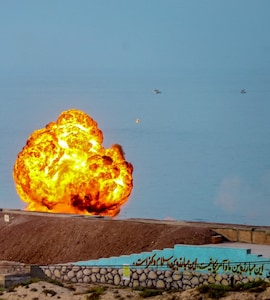
The escalation of military friction between the United States and Iran around the Strait of Hormuz is frequently analyzed through a purely geopolitical lens. This creates a critical blind spot. Military posturing in this corridor is fundamentally an exercise in economic asymmetric warfare, where the primary objective is not territorial conquest, but the manipulation of global risk premiums and supply-chain friction.
Iran's threats of "decisive" action following US airstrikes must be decoded using an operational framework that weighs the cost-infliction capabilities of a regional power against the enforcement constraints of a global maritime superpower.
The Geomechanical Reality of the Strait
To understand the strategic calculation of both actors, one must evaluate the physical and economic geography of the Strait of Hormuz. The passage represents the world’s most critical oil chokepoint.
The tactical vulnerability of the strait is defined by two structural constraints:
- The Shipping Lane Bottleneck: While the strait itself is roughly 21 miles wide at its narrowest point, the actual shipping channels used by supertankers consist of only two two-mile-wide lanes (one inbound, one outbound), separated by a two-mile buffer zone. These lanes fall entirely within the territorial waters of Oman and Iran.
- Volume Asymmetry: Approximately 20% to 21% of the world's petroleum liquids consumption passes through this bottleneck daily. This equates to an average of over 20 million barrels of crude oil, condensate, and refined products. Furthermore, more than an eighth of global liquefied natural gas (LNG) trade is routed through this single point.
This concentration of volume creates an extreme asymmetric leverage point. Iran does not need to physically close the strait to achieve its strategic objectives; it merely needs to increase the cost function of transit until the international shipping market forces an economic retreat or concessions.
The Cost Function of Maritime Friction
When US forces execute strikes on Iranian-aligned assets, the Iranian counter-strategy relies on escalating the financial and logistical risks for commercial shipping. This mechanism operates via three distinct economic vectors.
1. The War Risk Insurance Premium Hike
The most immediate consequence of kinetic activity in the Gulf is the recalibration of maritime insurance. Lloyd’s Joint War Committee designates specific zones as high-risk. When tension spikes, underwriters adjust the "War Risk Additional Premium" (WRAP).
For a standard Very Large Crude Carrier (VLCC) carrying two million barrels of oil, a spike in war risk premiums from 0.05% to 0.5% of the vessel's hull value translates to an additional hundreds of thousands of dollars per single transit. These costs are immediately passed down to the global energy supply chain.
2. The Freight Rate and Hull Value Escalation
Increased threat levels reduce the pool of willing vessel operators. This constriction of supply, combined with the necessity of rerouting ships or waiting out periods of active hostility, drives up spot freight rates. The economic cost is non-linear: a 10% reduction in available vessel capacity within the Persian Gulf can trigger a 40% to 50% increase in short-term charter rates.
3. Logistical Rerouting Friction
The alternative to transiting the Strait of Hormuz is utilizing overland pipelines or alternative maritime routes, both of which possess hard capacity limits.
| Pipeline Route | Operating Country | Maximum Capacity (Million bpd) | Available Spare Capacity (Estimated) |
|---|---|---|---|
| East-West Crude Pipeline (Petroline) | Saudi Arabia | 5.0 | ~2.0 |
| Abu Dhabi Crude Oil Pipeline | UAE | 1.5 | ~0.6 |
The combined spare capacity of these alternative land routes is less than 3 million barrels per day. This leaves over 17 million barrels per day entirely dependent on the maritime transit through the strait. The mathematical reality dictates that any prolonged disruption cannot be mitigated by alternative infrastructure.
Iranian Asymmetric Doctrine: Anti-Access/Area Denial (A2/AD)
The Iranian military apparatus recognizes that it cannot match the US Navy in a conventional, blue-water engagement. Consequently, its "decisive action" doctrine is built on a highly distributed, low-cost, high-impact Anti-Access/Area Denial (A2/AD) framework. This framework relies on three primary operational capabilities.
Swarm Warfare via Fast Inshore Attack Craft (FIAC)
The Islamic Revolutionary Guard Corps Navy (IRGCN) deploys hundreds of small, heavily armed fast boats. Operating in swarms, these vessels are designed to overwhelm the defensive tracking and engagement systems of larger western surface combatants. By attacking from multiple vectors simultaneously, they exploit the target saturation limits of modern naval close-in weapon systems (CIWS).
Smart Sea Mining
The waters of the Strait of Hormuz are shallow, averaging only 50 meters in depth. This environment is optimal for the deployment of bottom-dwelling, acoustic, magnetic, and pressure-sensitive naval mines. Moored and drifting mines deployed in the narrow shipping lanes force commercial vessels to stop entirely, as clearing these fields requires time-consuming minesweeping operations that are highly vulnerable to shore-based anti-ship cruise missile (ASCM) batteries.
Loitering Munitions and ASCMs
Iran has distributed mobile anti-ship missile systems along its rugged coastline and mountainous islands (such as Qeshm and Abu Musa). These systems, alongside low-cost loitering munitions (suicide drones), give Iran the capability to strike commercial vessels with minimal radar signature and near-zero warning time.
The US Counter-Strategy and Enforcement Limits
The US strategic mandate in the region is governed by the Carter Doctrine, which posits that any attempt by an outside force to gain control of the Persian Gulf region is regarded as an assault on the vital interests of the United States, to be repelled by any means necessary, including military force.
To enforce this, the US relies on forward-deployed assets under US Naval Forces Central Command (NAVCENT) and the Fifth Fleet. However, the enforcement mechanism faces severe structural limitations.
First, escorting every commercial vessel through the strait is logistically impossible. The volume of daily transits outstrips the available surface combatants assigned to the region.
Second, kinetic strikes on Iranian coastal infrastructure risk triggering the exact outcome the US seeks to avoid: an open conflict that completely halts commercial traffic due to the sheer density of ordnance in the airspace and water column.
This creates a paradox where US deterrence actions intended to stabilize the region can inadvertently catalyze the premium spikes and operational halts that constitute an economic disruption.
Strategic Forecast and Escalation Scenarios
The probability matrix for this confrontation does not point toward a total closure of the strait, as such an action would cut off Iran’s own economic lifeline—its oil exports to nations like China. Instead, the strategic trajectory points toward a calibrated, iterative escalation cycle.
The structural play for corporate and state energy strategists involves a permanent shift away from Just-In-Time inventory models for crude oil and LNG. Space capacity in Western and Asian Strategic Petroleum Reserves (SPR) will become the primary metric of economic resilience.
Iran will likely continue using sub-kinetic harassment—seizing single tankers under legal pretexts or deploying low-attribution drone strikes—to maintain a baseline level of risk premium. This maintains their geopolitical leverage without crossing the red line that would trigger an overwhelming conventional military response from the United States.
Organizations must model their supply chains under the assumption that the transit cost through the Persian Gulf will carry a structural 15% to 25% volatility premium for the foreseeable future.