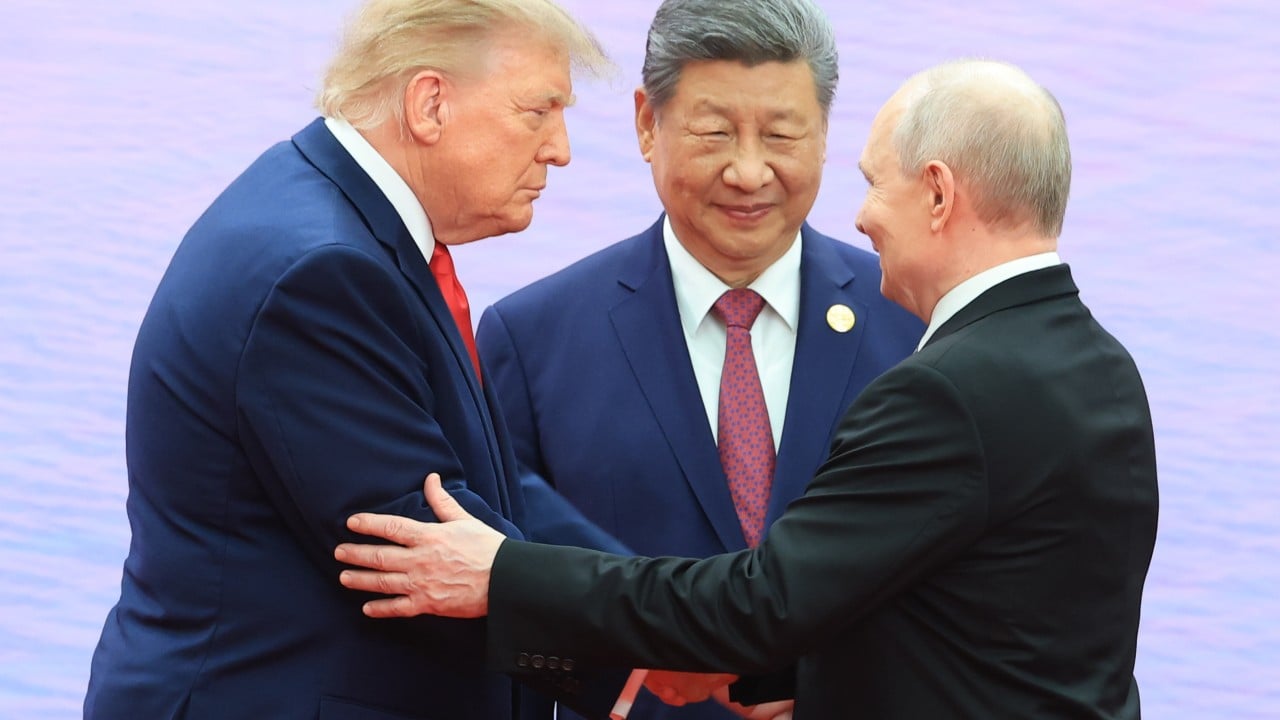
Every time three nuclear-armed leaders step onto a red carpet, the foreign policy press corps turns into a panel of amateur body-language detectives.
They zoom in on grip pressure. They measure the exact millisecond a handshake lingers. They dissect who patted whose shoulder and who stepped half an inch closer to the microphone in Shenzhen. It makes for great cable news chyrons and terrible geopolitical analysis. If you found value in this post, you might want to read: this related article.
If you are trying to decode the Xi-Trump-Putin dynamic by watching how they hug, you are looking at the theater while missing the bank heist happening behind the curtain.
The lazy consensus says summits like this are psychological chess matches won by the alpha male who dominates the photo op. That is pure fiction. Heads of state at this level do not improvise dominance on a tarmac. Every posture is rehearsed, every smile is calibrated for domestic television audiences, and none of it alters a single basis point of sovereign yield or a single metric ton of rare earth shipments. For another perspective on this story, check out the recent update from Al Jazeera.
The real power play in Shenzhen is not psychological. It is structural. And if you misread the choreography as the substance, your portfolio, your supply chain, or your policy forecast is going to get crushed.
The Myth of the Alpha Handshake
Let us dismantle the primary premise of summit journalism first.
Mainstream coverage treats international diplomacy like a high-stakes poker game played by three guys in bespoke suits. The narrative goes like this: Donald Trump uses unpredictable physicality—the famous pull-and-pat handshake—to throw counterparts off balance. Xi Jinping counters with stoic, imperial stillness to project unshakeable permanence. Vladimir Putin leans in with warm, almost fraternal familiarity toward Beijing while maintaining cool, transactional distance from Washington.
All of that is visually accurate. None of it matters.
In international relations theory, this obsession with interpersonal chemistry falls under the trap of first-image reductionism—the belief that the personal quirks and emotional bonds of individual leaders dictate state behavior. Kenneth Waltz tore this apart in 1959 in Man, the State, and War, yet pundits still fall for it every single summit cycle.
I have sat in briefing rooms with Fortune 500 risk officers who wasted millions hedging currency exposure based on whether a summit ended with a joint press conference or a frosty walk-away. Two weeks later, the underlying tariff schedules, export controls, and pipeline throughput numbers moved along the exact trajectory they were already on before the planes even landed.
Why? Because states do not have friends, and they do not have feelings. They have balance sheets, demographic cliffs, and resource bottlenecks.
Why Shenzhen Was Chosen Over Beijing
Look at the venue. That is the first real signal everyone ignored while staring at lapel pins.
Xi did not host this in the Great Hall of the People in Beijing, the ceremonial heart of Chinese state power. He chose Shenzhen—the hyper-capitalist, hardware-obsessed manufacturing engine of the Pearl River Delta.
When Beijing wants to project ideological authority, it brings you to the Forbidden City. When Beijing wants to remind Washington and Moscow who actually controls global industrial capacity, it brings you to the city that builds the world's smartphones, drones, electric vehicles, and telecom switches.
Putting Trump and Putin in Shenzhen is a non-verbal flex that requires zero handshakes: You two control the legacy hydrocarbon and financial architectures, and you are standing inside the factory floor of the twenty-first century.
Decoding the Actual Triangle
To understand what is actually moving between Washington, Beijing, and Moscow, throw out the psychology textbook and pull up a commodity ledger. You are looking at an asymmetric triangle where each player holds a distinct, non-overlapping monopoly on a critical global input.
- The United States holds the consumption and dollar-clearing engine. Despite decades of talk about de-dollarization, the U.S. consumer remains the buyer of last resort, and the Federal Reserve still controls the liquidity valves of global trade.
- China holds the midstream processing and manufacturing monopoly. You can mine lithium in Australia or Chile, and you can design chips in California, but you cannot scale hardware without Chinese refining, tooling, and assembly ecosystems.
- Russia holds the raw commodity and Eurasian land-bridge discount. Cut off from Western capital markets, Moscow is now a captive, discounted energy and raw-material supermarket fueling Chinese industrial competitiveness.
Watch what happens when you view the Shenzhen meeting through those three realities instead of through hugs and smirks.
The Illusion of the "Reverse Kissinger"
A popular talking point among Washington commentators is that Trump is attempting a "Reverse Kissinger"—peeling Russia away from China just as Richard Nixon and Henry Kissinger split Beijing from Moscow in 1972.
Here is the brutal truth: that is mathematically impossible right now.
In 1972, Mao Zedong and Leonid Brezhnev were fighting a shooting war along the Ussuri River, and China was an impoverished agrarian economy desperate for Western technology and capital. Today, Russia and China share a 2,600-mile border with zero active territorial disputes, deeply integrated military-industrial supply chains, and complementary economic needs.
Imagine a scenario where Washington offers Moscow partial sanctions relief and a face-saving exit in Eastern Europe in exchange for cooling ties with Beijing. Even if Putin wanted to take that deal—and he does not—he cannot survive without Chinese machine tools, microelectronics, and Yuan-denominated trade settlement. Russia's economy has been structurally rewired to run through Shenzhen and Shanghai. A handshake in a hotel lobby cannot undo five years of pipeline construction and banking integration.
What the Camera Missed Behind the Closed Doors
While analysts debated whether Putin looked overly deferential to Xi or whether Trump successfully dominated the center of the group photo, three hard-edged realities dictated every minute of the closed-door sessions.
1. The Tariff and Tech-Transfer Trap
Trump walks into every bilateral and trilateral meeting with one primary blunt instrument: market access. Tariffs are not merely revenue tools for him; they are leverage designed to force onshoring and bilateral trade concessions.
Xi's counter-move in Shenzhen is not to beg for tariff relief. China has spent the last decade rerouting its export supply chains through Vietnam, Mexico, and ASEAN nations precisely to blunt direct bilateral tariffs. Instead, Beijing's real bargaining chip is upstream chokepoints—specifically gallium, germanium, graphite, and rare earth processing.
When Xi smiles for the cameras next to Trump, he knows that American defense contractors and EV manufacturers cannot decouple from Chinese processed minerals within a single presidential term. No amount of alpha-male posturing changes the permitting timeline for a domestic American rare earth refinery, which takes roughly seven to ten years from discovery to production.
2. Moscow's Role as the Spoiler—and the Buffer
Why is Putin even in the room? If the real economic contest is between the G2 superpowers, Russia looks like the junior partner tagging along.
That is a dangerous misreading. Putin is there because Russia is the ultimate asymmetric spoiler.
Moscow does not need to out-produce the United States or out-innovate China to dictate terms. It only needs to threaten escalation in theaters where Washington is overextended—Eastern Europe, the Arctic, or the Middle East—or disrupt global grain and fertilizer markets. For Xi, having Putin at the table ensures that Washington cannot focus 100% of its military and economic bandwidth on the Indo-Pacific. For Trump, engaging Putin directly undercuts European intermediaries and tests whether Moscow can be pressured into freezing conflicts that drain U.S. fiscal resources.
3. Domestic Audience Calibration
Every photo from Shenzhen was edited for three completely different internal audiences, none of which care what The New York Times or The Financial Times thinks.
- For the American voter: Trump needs footage showing him standing toe-to-toe with America's two biggest adversaries, projecting strength and transactional deal-making while mocking traditional diplomatic protocol.
- For the Chinese public: Xi needs imagery confirming that China is no longer a rule-taker. Seeing the American president travel to a Chinese tech hub signals that Beijing is the center of gravity in global governance.
- For the Russian electorate: Putin needs proof that Western isolation has failed. Standing shoulder-to-shoulder with the leaders of the world's two largest economies destroys the narrative that Moscow is a global pariah.
All three men walked away with the exact B-roll they needed for their domestic media machines. Calling a "winner" based on who looked tougher on the red carpet is like declaring a winner in professional wrestling because one guy flexed harder during his ring entrance.
The Questions You Should Actually Be Asking
If you want to stop getting blindsided by geopolitical theater, stop asking who won the photo op. Start asking the questions that institutional capital allocators and intelligence analysts actually track.
Did anyone sign a binding enforcement mechanism?
Summits produce communiqués, "frameworks," and "understandings." None of those are worth the paper they are printed on. In high-friction great-power competition, the only agreements that matter are self-enforcing ones with immediate verification mechanisms—like simultaneous tariff rollbacks, specific agricultural purchase quotas with escrow penalties, or observable troop withdrawals. If a summit ends with warm words about "maintaining open channels of communication," nothing changed.
What happened to the Yuan-Dollar corridor?
Watch currency settlement data in the 90 days following a trilateral meeting like Shenzhen. Are Chinese state banks quietly tightening compliance on Russian industrial payments to avoid secondary U.S. Treasury sanctions? That tells you Xi blinked under American financial pressure. Are Beijing and Moscow expanding direct commodity-for-manufactured-goods barter systems outside SWIFT? That tells you Washington's sanctions weapon is losing its edge. Body language will never show you that; central bank clearing data will.
Who is quietly building inventory?
Pay attention to physical stockpiling immediately after the leaders fly home. When China accelerates strategic crude oil or copper purchases right after a "cordial" summit, Beijing is preparing for friction, regardless of how warmly Xi hugged Putin or shook hands with Trump.
The Blind Spot of Pure Realism
Let me be completely honest about the limitation of this cold, structural framework.
If you ignore human psychology entirely, you can miss sudden, irrational pivots. Leaders are not algorithms. History is full of moments where personal paranoia, ego, or miscalculation overrode pure economic rationality—from Nikita Khrushchev placing missiles in Cuba to Putin's decision to launch a full-scale invasion of Ukraine in 2022 despite catastrophic economic costs.
Personal rapport can occasionally grease the skids for a tactical pause, and personal hostility can accelerate a crisis when miscommunication strikes. Treating leaders purely as rational balance-sheet managers leaves you vulnerable to black-swan shocks driven by pride or domestic panic.
Even so, betting on a handshake over a supply chain is a losing trade nine times out of ten.
How to Read the Next Summit Without Getting Played
The next time three world leaders gather for a high-stakes summit and the media starts dissecting their posture, run this three-step filter before you react to a single headline:
- Mute the broadcast. Literally turn off the commentary and ignore every story featuring words like "frosty," "warm," "tense," or "triumphant" in the headline. Those are emotional adjectives designed to sell clicks, not intelligence.
- Track the boring agencies. Look at what the U.S. Commerce Department's Bureau of Industry and Security, China's Ministry of Commerce, and Russia's Central Bank actually publish in the 30 days after the summit. Export license approvals and tariff exclusions are the real scoreboard.
- Follow the physical bottlenecks. Watch shipping container rates out of Yantian Port in Shenzhen, Baltic Dry Index movements, and spot prices for critical industrial metals. Markets price actual concessions within hours; pundits argue about body language for weeks.
The cameras in Shenzhen captured three men smiling, gripping hands, and trading rehearsed pleasantries for the history books. Meanwhile, the real negotiation happened in the background—measured in megawatts, metric tons, and semiconductor wafers.
Stop watching their hands and start watching the shipping manifests.


