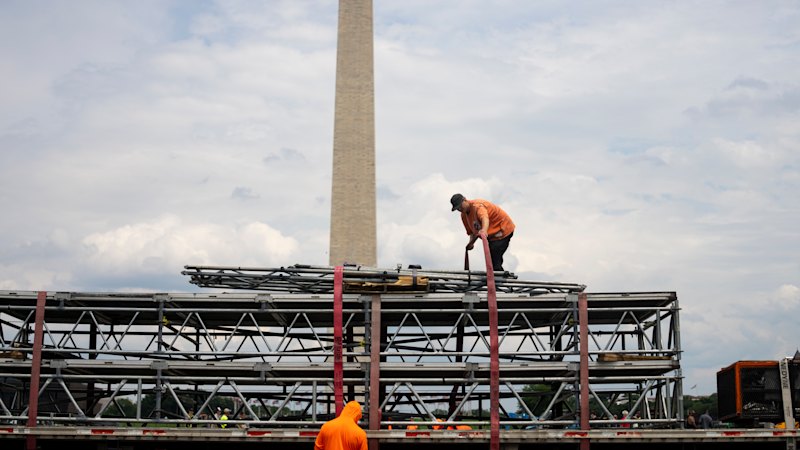
Every summer, the exact same hand-wringing opinion pieces hit the wire. Some pundit walks out onto the grass in Washington, D.C., looks at a chain-link fence, and pens a tear-jerker about how "America’s front yard is a construction zone." They lament the dirt, the diesel fumes, and the tragic loss of the perfect backdrop for tourists wearing matching family t-shirts.
It is a lazy, superficial grievance.
The mainstream media treats the National Mall like a static museum piece—a sacred patch of turf that should remain frozen in amber forever. They view scaffolding around the Washington Monument or a drained Reflecting Pool as a failure of civic stewardship.
They are entirely wrong.
The National Mall is not a painting. It is a workhorse. It is a highly engineered, high-traffic infrastructure corridor masquerading as a park. When we see fences and backhoes between the Capitol and the Lincoln Memorial, we aren't witnessing a tragedy. We are witnessing exactly how a living democracy stays functional. The real threat to our national identity isn't that the Mall is under construction—it's that we don't remodel it aggressively enough.
The Myth of the Untouched Sanctuary
Let's dismantle the historical romance right now. The idea of the National Mall as a pristine, rolling green lawn passed down intact from the Founding Fathers is a total fabrication.
When Pierre Charles L'Enfant first sketched out the city plan in 1791, his vision for the Mall was a grand, bustling, tree-lined avenue lined with houses and theaters. What did it actually become for most of the 19th century? A swampy, neglected wasteland. Cattle grazed on it. The Washington Canal, which ran right through what is now Constitution Avenue, was an open sewer choked with dead animals and industrial waste.
During the Civil War, the Mall was literally a military depot. The grounds around the unfinished Washington Monument were used as a slaughterhouse and a cattle yard to feed Union troops. Later, a literal railroad station—the Baltimore and Potomac Railroad depot—occupied a massive chunk of the Mall. If you wanted to visit the Capitol in 1890, you had to dodge active train tracks.
It wasn't until the McMillan Commission of 1901 that the government stripped away the train tracks, Victorian gardens, and greenhouses to create the open, neoclassical sweep we see today.
Historical Mall Evolution:
1791: L'Enfant's blueprint (Grand Avenue concept)
1850s: Downing's Romantic Plan (Winding paths, tree clusters, neglected marsh)
1861-1865: Civil War Depot (Slaughterhouses, barracks, grazing cattle)
1872: Railroad Invasion (Train tracks and depot dominate the landscape)
1901: McMillan Commission (The grand sweep cleared, modern layout born)
The lesson here is simple: every single feature we consider iconic about the National Mall was born out of massive, disruptive, industrial-scale construction. The Mall has spent more time being torn apart and rebuilt than it ever has sitting pretty. Peace and quiet is the historical anomaly; bulldozers are the norm.
The Math Behind the Mud
The tourists complaining about a closed sidewalk don't understand the sheer physical toll this space takes. I have spent years working alongside urban planners and civil engineers who look at municipal wear-and-tear data, and the metrics on the National Mall are staggering.
The National Park Service (NPS) manages this space, and they are tasked with an impossible math problem. The Mall hosts roughly 30 to 36 million visitors every year. To put that in perspective:
- It gets more annual foot traffic than Yellowstone, Yosemite, the Grand Canyon, and Zion National Parks combined.
- It faces higher density per square acre than almost any urban park on Earth, including Central Park.
- It hosts massive, unpredictable structural loads from presidential inaugurations, national protests, and major festivals.
Imagine hosting a party for 30 million people every single year on your front lawn. Your grass would turn to concrete-hard dirt within forty-eight hours.
This brings us to the actual mechanics of soil compaction. When millions of boots stomp over the same turf, oxygen is squeezed out of the soil. Tree roots suffocate. Water can no longer penetrate the ground, turning the entire area into a massive runoff hazard that dumps polluted water straight into the Tidal Basin and the Potomac River.
When the NPS puts up fences and tears up the sod, they are performing life support. In the major multi-phase restorations of the past two decades, engineers had to install massive underground cisterns capable of holding millions of gallons of water, strip out feet of dead dirt, put down high-tech layered drainage systems, and plant turf explicitly engineered to withstand the weight of armored security vehicles.
You cannot fix a fundamental engineering failure with a lawnmower and some fertilizer. You have to bring in the excavators.
The High Cost of the "Quick Fix"
The corporate world loves a cosmetic band-aid. I’ve seen developers and municipal boards waste tens of millions of dollars trying to avoid public backlash by choosing short-term aesthetic fixes over deep structural overhauls. They paint over rust, sod over dead dirt, and pray the structural failure happens on someone else's watch.
If the National Park Service bowed to the whiny travel bloggers and paused construction during peak tourist seasons, the long-term cost would skyrocket.
Let's look at the Tidal Basin seawall restoration project—a massive, multi-year undertaking happening right now. Because of sea-level rise and land subsidence (the dirt literally sinking under its own weight), the seawalls have been failing for years. At high tide, brackish river water regularly breaches the paths, drowning the famous cherry trees and undermining the foundations of the Jefferson Memorial.
A cowardly approach would involve patching the cracks overnight and putting down wooden boardwalks so the summer photos look nice. The contrarian, necessary approach is what we are seeing: a massive, disruptive, hundreds-of-millions-of-dollars overhaul that requires heavy machinery, closed pathways, and mud.
Yes, it ruins your vacation photo this year. But it ensures the monument actually exists for your grandchildren to look at. Admitting that deep maintenance requires ugly infrastructure management is a sign of civic maturity.
Dismantling the "People Also Ask" Flawed Premises
If you look at what people actually ask online about Washington D.C. tourism, the questions reveal a deep misunderstanding of how public spaces operate. Let's answer them honestly.
Why is the National Mall always under construction?
Because it is a working municipal space, not a movie set. The moment construction stops, the Mall begins to die. The climate is shifting, infrastructure is aging, and security requirements change constantly. The presence of construction orange is a sign of investment. A National Mall with no fences would mean a government that has abandoned its most symbolic public square to decay.
When will the National Mall finally be finished?
Never. And it shouldn't be. The day we declare the National Mall "finished" is the day we admit that America has stopped growing, evolving, and responding to new challenges. The Mall must change to accommodate new monuments, new technologies, and new environmental realities. Constant reinvention is the entire point of the American experiment.
How do I avoid construction during my trip to D.C.?
You don't. Change your mindset instead. Stop looking at scaffolding as an eyesore and start looking at it as a live demonstration of engineering and preservation. If you want a static, manicured, unmoving monument to state power, go visit Versailles. The National Mall is loud, messy, and constantly updating—just like a real democracy.
The Ultimate Insider Playbook for D.C. Travel
If you are traveling to Washington, stop trying to fight the construction schedules. The standard tourist advice tells you to wake up early, walk the entire length of the Mall from the Capitol to Lincoln, and get frustrated by every detour. That is a guaranteed recipe for sore feet and a bitter vacation.
Do this instead:
- Embrace the Flanks: The center line of the Mall is where the heaviest infrastructure stress occurs. If the center turf is fenced off, pivot immediately to the sculpture gardens flanking the museums. The Hirshhorn Sculpture Garden and the National Gallery of Art Sculpture Garden offer incredible design, shade, and architectural interest without the crowd crush.
- Go at 2:00 AM: The monuments don't close, and the construction crews usually knock off or run quiet operations late at night. Walking the Mall under the floodlights at midnight or 2:00 AM completely eliminates the visual noise of daytime construction. The fences fade into the shadows, the air is cool, and you will have the Lincoln Memorial entirely to yourself.
- Audit the Construction Itself: Instead of ignoring the work, look at the signs. Read the engineering specs posted on the fences. Understanding how they are lifting a multi-ton stone block or anchoring a sinking seawall is far more intellectually stimulating than looking at another generic statue of a guy on a horse.
Stop Demanding a Picture-Perfect Lie
The urge to scrub away the reality of labor and maintenance from our national spaces is a dangerous cultural impulse. We want our infrastructure to work flawlessly, but we want it to happen invisibly, overnight, like magic.
When we demand that the National Mall be a pristine, uninterrupted park 365 days a year, we are demanding a lie. We are asking for a cosmetic illusion that prioritizes consumer satisfaction over structural reality.
The dirt on the Mall is honest. The diesel smoke from the excavators is the smell of work being done. The chain-link fences are proof that we are actively paying the tax of preservation rather than passing the bill down to the next generation.
So stop writing the hand-wringing articles. Stop complaining about the detours on your way to the Smithsonian. Take a good look at the trenches, the cranes, and the poured concrete. That mess isn't a sign of American decline—it's proof that the front yard is still alive.