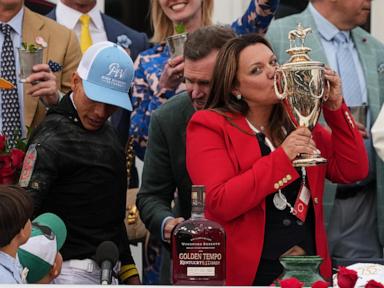
The media is tripping over itself to paint Cherie DeVaux’s victory with Golden Tempo as a glass-ceiling-shattering moment of pure progress. They want you to feel good. They want a neat, inspirational arc about a woman finally conquering "The Run for the Roses."
It is a lie.
Celebrating this win as a "milestone" ignores the systemic rot in horse racing’s apprenticeship and ownership pipelines. If you think Golden Tempo’s win is a sign that the sport has fixed its gender problem, you aren't paying attention to the math. Cherie DeVaux didn't win because the industry suddenly became a meritocracy; she won because she navigated a narrow, treacherous path that remains blocked for thousands of others.
The "first female" narrative is a distraction. It frames the delay as a lack of talent or "time needed for evolution" rather than a deliberate exclusion fueled by old-money gatekeeping and a refusal to modernize.
The Myth of the Level Playing Field
The most common defense of the status quo is the "Best Horse Wins" argument. It sounds logical. On race day, the gate opens, and the fastest animal crosses the wire. Gender doesn't hold the reins of the horse, right?
Wrong.
The race starts three years before the Derby. It starts in the sales ring at Keeneland and Fasig-Tipton. To win a Derby, you need "The Blood." You need seven-figure yearlings backed by owners with infinite pockets. Historically, those owners—the sheikhs, the titans of industry, the legacy families—have funneled their best stock to a tight circle of male trainers.
I have stood on the backside of Churchill Downs and seen how the "Boys Club" operates. It is an ecosystem of social proof. A billionaire owner doesn't pick a trainer based on a spreadsheet of win percentages; they pick the guy they’ve had drinks with for twenty years. DeVaux’s victory is an anomaly of individual excellence, not a proof of concept for the industry's inclusivity.
Why Golden Tempo is a Statistical Outlier
Let’s look at the cold, hard numbers that the "feel-good" articles won't touch.
In the history of the Kentucky Derby, only a handful of women have even saddled a horse. Before DeVaux, names like Shelley Riley and Kathy Ritvo were treated as curiosities rather than contenders. When we look at the total pool of licensed trainers in North America, women make up a significant portion of the workforce at the entry level—grooms, hot walkers, and exercise riders.
But as you move up the hierarchy to "Head Trainer" for elite Grade 1 stables, the percentage drops to near zero. This is the "Leaky Pipeline" of the backside.
- Access to Capital: Most female trainers start with "cheap" horses—claimers and mid-level allowance runners. They are forced to prove they can turn lead into gold before they ever get a shot at a blue-blooded colt.
- The Perception of Risk: Owners view female trainers through a lens of "risk," while male trainers are viewed through a lens of "potential." A male trainer can lose five big races and keep his job. A female trainer is often one bad season away from losing her entire barn.
- The Work-Life Fallacy: The industry still clings to an archaic 24/7/365 model that punishes anyone—male or female—who seeks a semblance of life outside the shed row. However, this burden falls disproportionately on women in a sport that hasn't updated its labor practices since the 1920s.
The Counter-Intuitive Truth: Talent is Being Wasted
By keeping the trainer pool restricted to a narrow demographic, the racing industry is actively hurting its own product. If you only fish in 50% of the pond, you miss 50% of the best trainers.
Cherie DeVaux didn't just "get lucky" with Golden Tempo. She applied a meticulous, data-driven approach that many of the old-school "gut feeling" trainers ignore. Her win proves that there is a massive surplus of untapped coaching talent that the industry is too stubborn to utilize.
The tragedy isn't that it took until now for a woman to win. The tragedy is the hundreds of potential Derby-winning trainers who quit the industry ten years ago because they couldn't get a single owner to return their phone calls.
The False Narrative of "Inspiration"
Stop telling little girls that they can be the next Cherie DeVaux. It’s a hollow sentiment until the structures change.
"Inspiration" is what we offer when we don't want to offer "Opportunity." When we focus on the individual hero, we stop looking at the broken system. We treat DeVaux like a superhero who overcame impossible odds. But why were the odds impossible in the first place?
In any other multibillion-dollar industry, a lack of diversity in leadership is seen as a business failure. In horse racing, it’s just "tradition."
How to Actually Disrupt the Sport
If the industry actually cared about progress, we wouldn't be talking about glass ceilings. We would be talking about:
- Diversifying Ownership Syndicates: Breaking the monopoly of the "Big Five" stables.
- Transparency in Stall Assignments: Churchill Downs and Santa Anita should be held accountable for how they distribute the most coveted real estate in the sport.
- Modernizing the Backside: Better pay, actual benefits, and childcare for the workers who keep the industry running.
DeVaux’s win with Golden Tempo was a masterclass in training. She managed the horse's peaking cycle perfectly. She chose the right jockey for the style. She blocked out the noise. She did her job better than everyone else on that track.
But don't let her excellence give the industry a pass.
The Kentucky Derby is a spectacle of wealth and power. For one Saturday in May, the world looks at Louisville. If all you see is a "historic win" for women, you are missing the much darker story about why it took 150 years to get here.
The industry doesn't need more "firsts." It needs a total overhaul of its social and economic architecture. Until that happens, every female win will be treated as a fluke or a "moment," rather than the standard.
Golden Tempo was the fastest horse. Cherie DeVaux was the best trainer. Everything else is just a PR spin designed to make a stagnant industry feel like it's moving forward.
Fix the pipeline. Stop the cheering. Get back to work.