Every cable news pundit and wire service editor just fell for the oldest optical illusion in Washington.
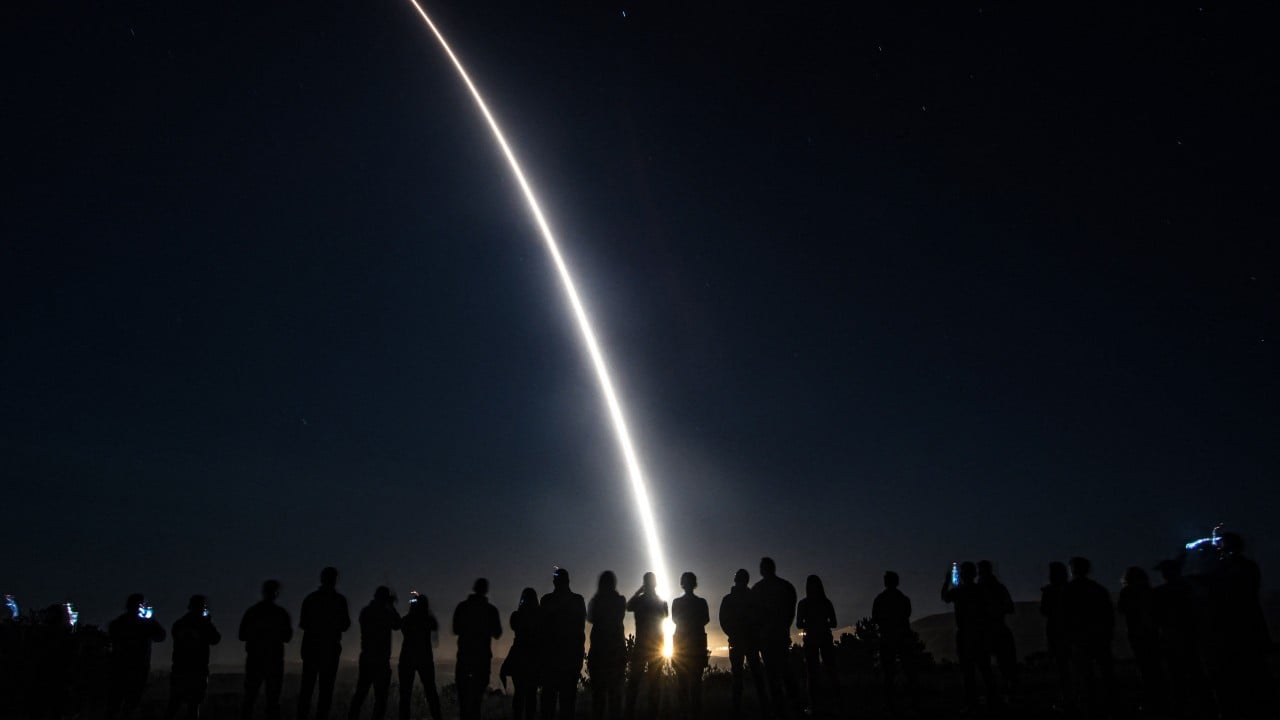
When an unarmed Minuteman III intercontinental ballistic missile roared out of Vandenberg Space Force Base in California hours before Air Force One touched down in China, the mainstream press immediately wrote the exact same headline. They framed it as a calculated, chest-thumping piece of nuclear theater. A deliberate message sent across the Pacific to rattle Beijing just as bilateral talks were set to begin. Don't miss our recent article on this related article.
That narrative is lazy, historically illiterate, and completely backward.
The real story isn't that the Pentagon tried to intimidate China with a nuclear delivery vehicle. The real story is that the bureaucratic machinery of the American nuclear enterprise is so rigid, so wildly expensive, and so logistically locked into multi-year calendars that not even a presidential summit can stop a scheduled test window. Worse, treating a routine operational test as an act of diplomatic brinkmanship reveals a dangerous misunderstanding of how nuclear deterrence actually works in the modern era. If you want more about the context here, BBC News offers an in-depth breakdown.
The Myth of the "Last-Minute" Missile Launch
Let’s look at the mechanics of a Minuteman III test launch, because the press corps clearly hasn't bothered to call anyone at Air Force Global Strike Command.
You do not wake up on a Tuesday morning, decide to send a geopolitical signal to Beijing, and roll a 79,000-pound, three-stage solid-fuel missile onto a launchpad by dinner.
A single operational test launch—designated internally as a Glory Trip mission—takes between six months and a full year of meticulous, grueling preparation. Technicians have to pull a random missile from an operational silo in Montana, Wyoming, or North Dakota. They remove its live thermonuclear warheads, install specialized telemetry packages to track flight data, transport the massive airframe across state lines under heavy armed escort, and lower it into a test silo on the California coast.
Then comes the range clearance.
To fire an ICBM 4,200 miles across the Pacific Ocean toward the Ronald Reagan Ballistic Missile Defense Test Site at Kwajalein Atoll, the United States must coordinate with the Federal Aviation Administration, the Coast Guard, international maritime authorities, and commercial airlines. Notices to Airmen (NOTAMs) and maritime hazard warnings are filed weeks in advance. Surveillance aircraft, telemetry ships, and tracking radars across the Pacific are booked months out.
Furthermore, under the Hague Code of Conduct against Ballistic Missile Proliferation—and long-standing bilateral pre-launch notification agreements with both Moscow and Beijing—Washington notifies foreign governments of these launches days before the countdown clock ever hits zero.
Beijing didn't learn about this launch from a breaking news alert while Air Force One was on final approach. Chinese military attachés had the exact launch window sitting on their desks long before the presidential motorcade ever left Andrews Air Force Base.
If you want to send a spontaneous, aggressive signal to an adversary, you move a carrier strike group. You scramble strategic bombers on a visible patrol route. You do not execute a pre-notified, telemetry-gathering engineering check that has been on a dry-erase board at Vandenberg since last spring.
Why the Press Always Falls for Nuclear Theater
I have spent years watching defense reporters and foreign policy commentators turn routine military logistics into grand strategic chess. Whenever a bomber flies over the Korean Peninsula or a missile leaves California during a diplomatic trip, the coverage defaults to the exact same cinematic trope: the Commander-in-Chief holding a nuclear card up his sleeve at the negotiating table.
It sells clicks. It creates drama. And it fundamentally misleads the public about what these tests actually represent.
The LGM-30G Minuteman III entered service in 1970. It is a Cold War relic running on aging infrastructure, maintained by an exhausted workforce, waiting on a replacement program—the LGM-35A Sentinel—that has been plagued by massive cost overruns and Nunn-McCurdy breaches.
When the Air Force fires an unarmed Minuteman III across the Pacific, it isn't flexing on China. It is checking to make sure the darn thing still works.
Because the United States hasn't conducted a live nuclear explosive test since 1992, the Pentagon relies entirely on subcritical experiments, supercomputer simulations, and flight tests of the delivery systems to certify the reliability of the nuclear triad. Every time a Minuteman III fails—like the aborted test in November 2023 when a missile had to be safely terminated over the Pacific due to an anomaly—alarm bells ring across the Pentagon.
The timing of this launch wasn't a masterstroke of coercive diplomacy. If anything, it was a bureaucratic refusal to let the State Department disrupt the Pentagon's testing schedule.
In past administrations, the White House has occasionally delayed routine ICBM tests to avoid muddying diplomatic waters—most notably during periods of acute tension with Russia or North Korea. When a White House chooses not to delay a test, the decision isn't to "send a message." The decision is simply to let the military do its scheduled maintenance without political interference.
There is a massive difference between weaponizing a test for leverage and refusing to let diplomacy paralyze routine readiness. Conflating the two makes Washington look erratic and makes Beijing look easily rattled. Neither is true.
What Beijing Actually Saw (And What You Should Worry About)
If you think Chinese President Xi Jinping or the Central Military Commission flinched because an unarmed Minuteman III splashed down near the Marshall Islands, you haven't been paying attention to the Pentagon's own China Military Power Reports.
China is currently executing the fastest, most ambitious nuclear modernization and expansion program in modern history. According to Defense Department estimates, Beijing has already surpassed 600 operational nuclear warheads and is on pace to field over 1,000 by 2030. They have constructed hundreds of new ICBM silos across their western deserts, fielded road-mobile DF-41 missiles capable of carrying multiple independently targetable reentry vehicles (MIRVs), and perfected fractional orbital bombardment systems.
Against that backdrop, watching the United States test-fire a single, 50-year-old missile design that carries a single warhead under New START treaty limits doesn't intimidate Beijing. It reminds them of how old America's land-based deterrent actually is.
Here is the uncomfortable truth that the "tough-on-China" pundits refuse to confront: theatrical displays of legacy hardware do not deter a peer competitor.
Thomas Schelling, the Nobel Prize-winning economist who practically wrote the book on nuclear strategy and coercive diplomacy in Arms and Influence, made a critical distinction between brute force and credible deterrence. Deterrence isn't built on flashy, coincidentally timed press releases. It is built on undeniable capability, survivable second-strike forces, and political resolve that doesn't need to be advertised through cable news talking points.
When commentators frame a routine Vandenberg test as a bold diplomatic warning, they inadvertently undermine deterrence. They train the public—and signal to adversaries—that the United States views basic operational readiness as an extraordinary escalation.
Think about the perverse incentive that creates. If every scheduled test launch is treated by the media as a deliberate provocation, then canceling or delaying a test becomes an automatic diplomatic concession. Every time the Pentagon wants to validate its own missile fleet, the White House has to weigh the engineering necessity against a manufactured news cycle.
Dismantling the "Coincidental Timing" Questions
Whenever a military event overlaps with a major diplomatic summit, the same predictable questions dominate the public conversation. Most of them rest on completely flawed premises.
Did the White House order this launch specifically to gain leverage in trade or security talks?
No. As established, the logistical tail of an operational test launch makes a last-minute political order physically impossible. The White House approved the launch window months prior through the normal interagency clearance process. Not canceling a launch is fundamentally different from ordering one.
Does launching an unarmed ICBM violate international law or escalate tensions with China?
It violates nothing. The United States has conducted roughly three to four of these test launches every single year for decades. Because the missile is stripped of its nuclear physics package and replaced with a dummy reentry vehicle packed with sensors, it poses zero threat to any nation. China conducts its own ballistic missile tests constantly—including a rare, full-range ICBM test into the Pacific Ocean in September 2024, the first such open-ocean test by Beijing in over four decades. Compared to Beijing's test, an American flight to Kwajalein Atoll is about as routine as a commuter flight from Los Angeles to Chicago.
What happens if a test like this goes wrong during a major diplomatic visit?
That is the actual risk the White House accepted—and it’s the only genuinely bold part of the equation. If a Minuteman III blows up on the pad or has to be destroyed mid-flight while Air Force One is taxiing in Beijing, the optical disaster is immense. Instead of projecting strength, the administration would be handing Chinese state media a gift-wrapped propaganda victory highlighting American technological decay. Letting the launch proceed wasn't a safe flex; it was a calculated gamble that Air Force engineering wouldn't embarrass the President on foreign soil.
The Blind Spot in My Own Argument
To be completely fair, perception in international relations can occasionally matter almost as much as reality.
Even if a launch is scheduled a year in advance, and even if Beijing received formal diplomatic notification days earlier, the optics still register with secondary audiences. Allies in Tokyo, Seoul, and Taipei watch the headlines closely. Domestic voters watch them too. In an era of hyper-polarized politics, appearing "strong" on the evening news has tangible political value for an administration, regardless of whether the Pentagon intended it that way.
Furthermore, strategic ambiguity works both ways. Sometimes, allowing an adversary to wonder whether a routine military movement carries a deeper political message keeps them slightly off-balance. Diplomats rarely go out of their way to downplay a coincidence that makes their boss look assertive.
But relying on media-manufactured optics is a terrible substitute for actual strategy. If you start believing your own press clippings—if policymakers begin thinking that letting a 1970s missile fly out of California actually moves the needle in high-stakes negotiations with Beijing—you are setting yourself up for catastrophic miscalculation.
How to Actually Read Military Movements During Summits
If you want to understand what is truly happening between Washington and Beijing the next time Air Force One crosses the Pacific, stop watching the rocket plumes in California and start tracking the invisible indicators that actually carry strategic weight.
Watch the Nuclear-Capable Bomber Task Forces, Not the Silos.
If the Pentagon wants to send a real-time, calibrated message to Beijing, it deploys B-52H Stratofortresses or B-2 Spirit stealth bombers to Guam or Diego Garcia, or flies them directly through contested airspace in the South China Sea. Unlike ICBMs bolted into concrete holes, bombers are visible, flexible, and can be recalled or redirected on a moment's notice. That is genuine coercive signaling.Track Submarine-Launched Ballistic Missile (SLBM) Notices.
The true backbone of American nuclear deterrence isn't the Minuteman III; it is the Ohio-class ballistic missile submarine fleet silently patrolling the world's oceans. When the Navy issues sudden, unscheduled maritime closure zones in the Atlantic or Pacific for Trident II D5 test launches, pay attention. That indicates a much higher tier of operational readiness validation.Follow the Logistics, Not the Press Releases.
Whenever a defense story breaks during a diplomatic trip, ask one simple question: When was the airspace cleared? If the NOTAMs were filed weeks ago, you are looking at a calendar coincidence, not a crisis. Real geopolitical signaling looks like sudden aerial refueling tanker surges, emergency satellite repositioning, or abrupt cancellations of scheduled port calls.Look at What Beijing Does, Not What State Media Says.
Ignore the fiery editorials in the Global Times. Watch the People’s Liberation Army Rocket Force (PLARF). If Beijing responds to an American summit by elevating the alert status of its road-mobile missile brigades or surging naval vessels into the Taiwan Strait, then—and only then—did a message actually land.
The next time a wire service screams that Washington just fired a nuclear-capable missile on the eve of historic talks, take a breath. Check the Vandenberg launch calendar. Look at the telemetry flight path.
Real deterrence doesn't need a headline to work, and routine maintenance doesn't become grand strategy just because a camera crew was watching.


