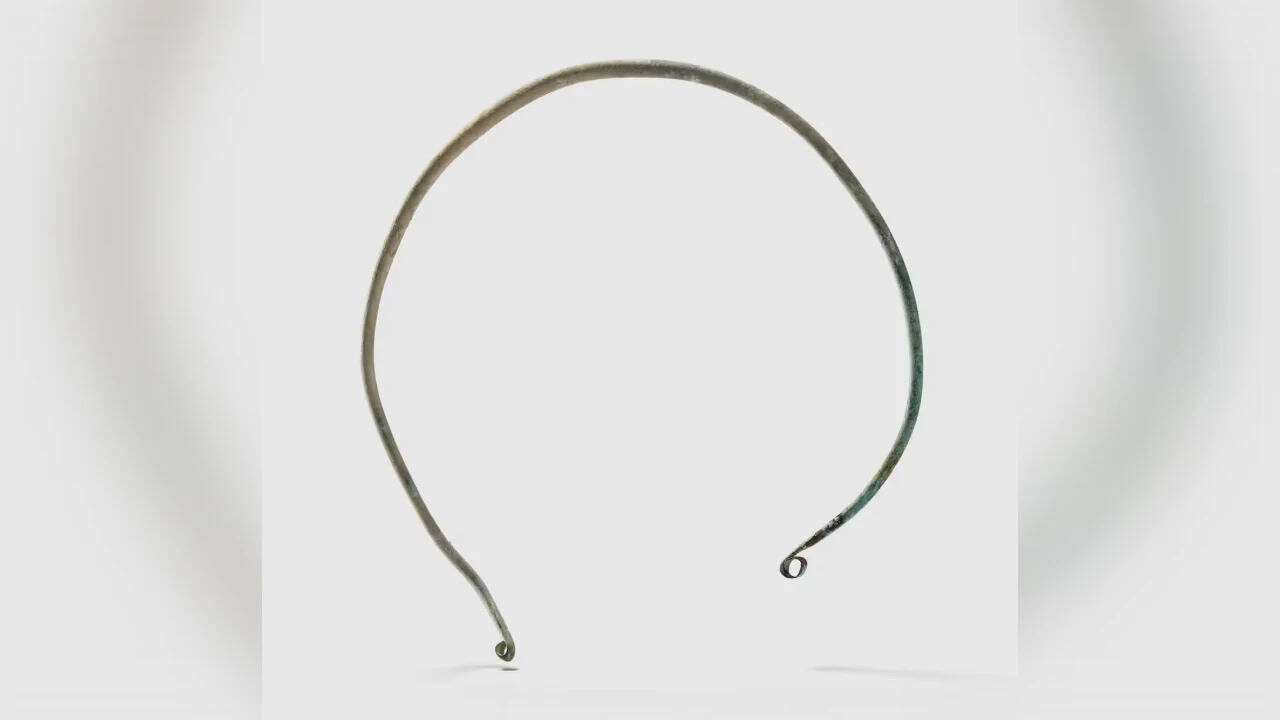
Every time a glacier retreats in the Swiss Alps and spits out an ancient piece of metal, the media runs the exact same story.
The headline writes itself. Melting ice reveals 4,000-year-old Bronze Age artifact. The comment sections fill up with climate-change doomerism on one side and armchair archaeologists marveling at "primitive" mountaineers on the other. Everyone nods along to the lazy consensus that some hapless Early Bronze Age traveler dropped his jewelry while shivering through a treacherous, frozen wasteland, only for modern global warming to finally give it back to us.
That narrative is lazy, historically illiterate, and completely backward.
If you actually look at the archaeological data coming out of the Alps—specifically high-altitude passes like the Schnidejoch, the Lötschenpass, and the Theodul Pass—the discovery of a 4,000-year-old bronze neck ring (known formally as an Ösenring or ingot torc) doesn't prove that the Alps are suddenly melting for the first time. It proves the exact opposite. It proves that four millennia ago, during the Early Bronze Age, those high mountain passes weren't impassable walls of permanent ice. They were open, bustling commercial highways.
The real story isn't about the ice melting today. The real story is why the ice wasn't there when the ring was lost.
The Myth of the "Accidental" Alpine Drop
Mainstream science journalism treats ancient high-altitude finds like lost car keys. The standard assumption is that a lone hunter or wandering shepherd got caught in a blizzard, panicked, and dropped a piece of personal ornamentation.
Anyone who has actually spent time studying Bronze Age metallurgy and Alpine trade networks knows how absurd that is.
Four thousand years ago—roughly 2000 to 1800 BCE—bronze was not casual costume jewelry. Copper had to be mined in places like the Mitterberg region of Austria or the Valais in Switzerland. Tin had to be hauled across hundreds of miles of hostile terrain from Cornwall, Brittany, or the Erzgebirge mountains. Smelting them required massive amounts of charcoal, specialized clay crucibles, and generational technical knowledge.
A heavy bronze neck ring with flattened, rolled ends wasn't a trinket. It was standardized bullion. Archaeologists call them Ösenringe because they functioned as both wearable status symbols and portable currency. You didn't just casually drop a month's worth of high-grade economic capital in a snowbank and walk away without tearing the mountain apart to find it.
When a bronze torc ends up at 2,700 meters above sea level, one of two things happened:
- It was deliberately deposited as a votive offering to mountain deities at a known, frequently traveled summit.
- It was lost during heavy, routine commercial transit across a pass that was completely free of perennial ice.
In either scenario, humans weren't "braving" a frozen wasteland. They were commuting.
The Holocene Thermal Optimum Nobody Mentions
To understand why a Bronze Age merchant was walking across a Swiss pass in leather shoes with a heavy bronze torc around his neck, you have to look at paleoclimatology, not just modern weather reports.
The competitor's framing relies on an unspoken assumption: that the massive glaciers of the 19th and 20th centuries represent the "natural," permanent baseline of the Swiss Alps. They don't. Those glaciers were largely the product of the Little Ice Age, a brutal cold snap that lasted from roughly 1300 to 1850 CE.
Go back 4,000 years, and you are looking at the tail end of the Holocene Thermal Optimum—specifically the warm phases of the Subboreal period. Dendrochronology (tree-ring dating) and subfossil wood found underneath modern retreating glaciers—documented extensively by Swiss glaciologists like Christian Schlüchter—prove that the Alpine timberline was significantly higher during the Early Bronze Age than it is today.
Where you currently see barren rock and retreating ice fields, there were once pine forests and alpine meadows.
The ice didn't just hide that bronze neck ring for 4,000 years. The ice formed over it centuries after it was dropped, sealing it in an anaerobic deep freeze during later cold periods like the Iron Age Cold Epoch and the Little Ice Age. Calling this find a simple byproduct of modern warming misses the bigger, more uncomfortable geological reality: the Alps are a dynamic, fluctuating corridor that has opened and closed to human civilization repeatedly over the last ten millennia.
Why "Primitive" Trade Networks Put Modern Supply Chains to Shame
Another massive misconception baked into conventional reporting on these finds is the subtle condescension toward Bronze Age logistics. Articles routinely express shock that people 4,000 years ago could cross high mountain passes without Gore-Tex, crampons, or GPS.
This is pure chronological snobbery.
Early Bronze Age Europeans were not stumbling blindly into the mountains. They were operating sophisticated, trans-continental supply chains that linked the Mediterranean world to the North Sea. The Swiss Alpine passes were the critical chokepoints—the Panama Canals—of the ancient world.
Consider what was moving through these exact corridors around 2000 BCE:
- Baltic Amber: Fossilized tree resin from the shores of Poland and Lithuania regularly shows up in elite graves in northern Italy and Greece. It didn't fly there. It was carried on human backs and pack animals straight over the Swiss and Austrian passes.
- Alpine Copper and Salt: The Hallstatt salt mines and Alpine copper veins fueled the rise of the Únětice culture in Central Europe, one of the wealthiest, most technologically advanced societies of the era.
- Textiles and Leather: At the Schnidejoch pass—just a few miles from where many of these bronze artifacts surface—retreating ice yielded Neolithic and Bronze Age leather trousers, shoes, and woven bast fibers. These weren't rags. They were engineered, multi-layered cold-weather gear tailored specifically for high-altitude logistics.
When you find an Ösenring on a Swiss pass, you aren't looking at a curiosity. You are looking at a dropped pallet from an ancient freight network. The people moving that metal knew the weather windows, maintained established trail cairns, and operated relay stations in the valleys below.
The Preservation Paradox: Why Rapid Melt Is Actually a Disaster for Archaeology
Here is where the mainstream narrative gets even more twisted. While climate activists use these discoveries as triumphant proof of global warming, and history buffs celebrate the "treasure" being uncovered, field archaeologists are quietly panicking.
I've watched regional heritage offices scramble with zero budget while centuries of pristine organic history turn to mush in a matter of weeks.
Glacial archaeology is a race against immediate biological destruction. As long as an artifact—especially anything made of wood, leather, bone, or textile—remains locked in perennial ice, it is effectively immortal. The moment that ice recedes, the clock starts ticking.
Once exposed to UV radiation, fluctuating freeze-thaw cycles, wind, and bacteria:
- Leather dries out, cracks, and disintegrates into dust within a single summer.
- Wood warps, splits, and rots.
- Bronze itself, while durable in ice, suddenly faces accelerated oxidation and mechanical abrasion from shifting scree slopes and meltwater torrents.
Even worse, the romanticized media coverage triggers a wave of amateur metal detectorists and souvenir hunters who hike up to newly exposed ice patches and loot the sites before professional surveyors can map the stratigraphy. Once a bronze neck ring is yanked out of the mud without its exact GPS coordinates, elevation data, and surrounding organic context recorded, 90 percent of its scientific value is destroyed. It becomes just another pretty piece of green metal sitting in a drawer.
Dismantling the "People Also Ask" Fallacies
If you search for this discovery online, you are immediately hit with a wall of repetitive, poorly framed questions that reinforce the wrong mental models. Let's tear through the most common ones.
"How did Bronze Age people survive the freezing Alpine glaciers?"
They didn't. They walked across grass, dirt, and seasonal snowfields during warmer climatic windows. When the glaciers expanded during colder centuries, human traffic across those high passes dropped to near zero. People weren't superhuman; they were pragmatic. When a pass froze over, they took a lower, longer route.
"Was the bronze neck ring worn by a man or a woman?"
Asking whether an Ösenring was "men's or women's jewelry" projects modern fashion binaries onto Bronze Age economics. In Early Bronze Age Central Europe, these rings were found in both male and female burials, as well as in massive buried hoards containing hundreds of identical rings tied together. They were a store of value. Wearing one around your neck was the 2000 BCE equivalent of carrying your bank account on your person—both a display of status and a liquid asset ready to be traded for salt, grain, or raw tin.
"Does finding this artifact prove the climate is warmer now than in the Bronze Age?"
Not necessarily. Ice volume in the Alps is a lagging indicator. A glacier doesn't vanish overnight when temperatures rise, nor does it appear instantly when temperatures drop. Finding a 4,000-year-old artifact at the edge of a retreating ice patch proves that the pass was ice-free at least 4,000 years ago, and that the ice has only recently melted back to that specific spatial boundary. In many Alpine locations, subfossil trees emerging from beneath the ice show that those areas remained forested for centuries during the Bronze and Roman eras before the ice finally took over.
The Uncomfortable Truth About Modern Archaeology's Blind Spots
To be fair, the contrarian view has its own blind spots if pushed too far. Climate skeptics love to weaponize Alpine archaeological finds to argue that modern warming is "completely natural" and nothing to worry about. That is just as intellectually dishonest as the media's "frozen wasteland" trope.
The rate of ice loss observed in the Swiss Alps over the last three decades—documented rigorously by the Swiss Glacier Monitoring Network (GLAMOS)—is staggering in its speed. While past warming phases like the Holocene Thermal Optimum unfolded over centuries due to shifts in Earth's orbital mechanics (Milankovitch cycles), the current retreat is happening within a single human lifespan.
Both things can be true at the same time:
- The Bronze Age Alps were warmer, greener, and far more populated at high altitudes than pop history admits.
- Today's glaciers are collapsing at a pace that is overwhelming our ability to salvage the history trapped inside them.
Refusing to acknowledge the first truth makes us ignorant of human ingenuity. Refusing to acknowledge the second makes us blind to the destruction of our own archaeological record.
How to Actually Read Archaeological News Without Getting Played
If you want to stop falling for clickbait science journalism every time a hiker trips over an ancient spearhead or a bronze torc, change how you filter the story.
- Ignore the "mystery" framing. Archaeologists rarely find "unexplained mysteries." A 4,000-year-old bronze ring on a mountain pass has a completely logical explanation: trade, tribute, or transit. When a headline calls an artifact "mysterious," it usually means the writer didn't bother to read the regional excavation report.
- Look for the elevation and the pass name. Context is everything. An artifact found at 2,700 meters on a north-facing slope tells a completely different climatic story than one found at 2,200 meters on a sun-drenched south-facing ridge.
- Follow the metallurgy, not the romance. Ask where the copper and tin came from. Isotope analysis of Bronze Age metal tells us the exact mine the ore was dug out of. That data maps the real geopolitical highways of the ancient world—highways that existed long before Rome laid a single cobblestone.
- Support rapid-response glacial surveys. If you care about history, stop applauding the melt and start paying attention to the underfunded cantonal archaeologists in Switzerland, Austria, and Italy who are hiking into dangerous, unstable scree fields every August to rescue disintegrating history before the autumn snows bury it again.
That 4,000-year-old bronze neck ring wasn't waiting to teach us a lesson about modern politics. It was dropped by a sophisticated, well-equipped traveler walking an open mountain road in a world far warmer and more connected than we give our ancestors credit for. Stop staring at the melting ice and start looking at the highway it just uncovered.