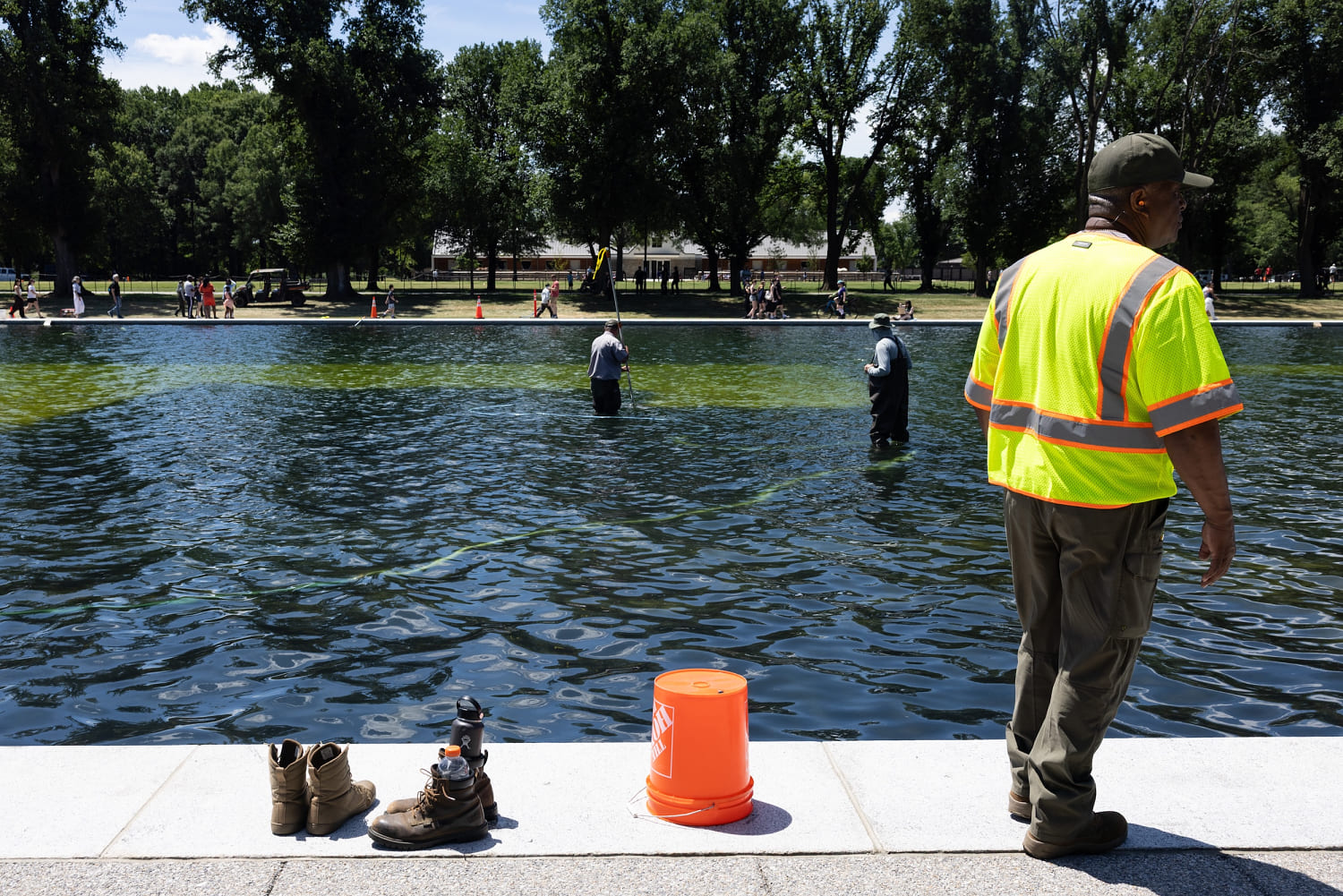
Politicians love a scapegoat. It shifts the blame, satisfies the cameras, and lets them avoid looking at the actual invoice. When politicians look at the murky, troubled waters of the Lincoln Memorial Reflecting Pool and blame anonymous vandals or algorithmic bad luck for its constant closures, they are selling a comforting lie.
The media eats it up. They run headlines focused on the drama of draining the pool, the political theater of pointing fingers, and the superficial shock of seeing a national landmark turned into a concrete pit.
They are asking the wrong question. They want to know who broke the pool.
The real question is why we are still using a municipal design philosophy from the early twentieth century to manage a highly complex, ultra-high-load aquatic ecosystem in the twenty-first century. The Washington Reflecting Pool does not have a vandal problem. It has a structural engineering, biological loading, and budgetary self-delusion problem.
I have spent years auditing municipal water systems and large-scale public infrastructure projects. I have seen cities blow millions trying to patch over fundamental design flaws with temporary chemical band-aids. The Reflecting Pool is the ultimate monument to this failure. Draining it again will solve nothing.
The Biological Reality of Thousands of Gallons of Stagnant Water
Let's dismantle the premise that this is a security issue. The Reflecting Pool holds roughly 6.75 million gallons of water. It is shallow, it has a massive surface area exposed to intense sunlight, and it sits directly in the path of heavy urban runoff and wildlife migration.
When you build a giant, shallow concrete tray and fill it with water, you are not creating a mirror. You are building a massive incubator for algae and bacteria.
To keep that water clear, you cannot rely on hope or a nightly patrol. You need continuous, high-volume turnover and aggressive filtration. The National Park Service (NPS) completed a massive $34 million overhaul of the pool, replacing the old system that drew water directly from the Tidal Basin with a closed-loop system using water from the city's supply, complete with a new filtration plant.
Yet, the pool still gets choked with algae, experiences spikes in dangerous bacteria, and requires frequent draining. Why? Because the system design grossly underestimates the actual biological load.
Consider the sheer volume of organic matter entering that water daily:
- The Wildlife Load: Hundreds of ducks and geese use the pool as a public restroom. A single goose can drop up to three pounds of manure per day. Multiply that across a resident flock, and you have a massive, continuous injection of phosphorus and nitrogen.
- The Anthropogenic Factor: Thousands of tourists walk along the edges every single hour. They drop food, spill drinks, toss coins, and blow trash into the water. This is not "vandalism" in the criminal sense; it is the predictable baseline behavior of human crowds.
- The Atmospheric Deposition: Dust, pollen, and urban emissions settle directly onto the massive surface area, acting as premium fertilizer for algae blooms.
When a politician says a vandal threw a chemical or some trash into the water and ruined the system, they are hiding the fact that the system was already running at its absolute limit. A robust infrastructure asset should not collapse because a few teenagers threw something into it. If a system is that fragile, the design is the culprit, not the public.
The Financial Insanity of the Drain and Fill Cycle
Every time the Reflecting Pool is drained, the public loses. The standard response to a major water quality failure is to empty the basin, scrub the concrete, and refill it.
This is an environmental and financial crime disguised as maintenance.
[Standard Drain & Fill Cost Breakdown]
6.75 Million Gallons of Treated City Water: ~$60,000 - $80,000
Labor (Scrubbing, Debris Removal, Heavy Equipment): ~$40,000 - $70,000
Chemical Reset (Chlorination, Stabilizers): ~$15,000 - $25,000
Total Direct Cost Per Cycle: ~$115,000 - $175,000
This table does not even account for the opportunity cost of having a premier national tourist attraction look like an empty construction site for weeks at a time.
Imagine a scenario where a private resort managed its main water feature this way. The chief operating officer would be fired within a fiscal quarter. In the private sector, you do not throw away millions of gallons of treated water because your filtration loop fell behind the biological load. You upgrade the turnover rate, optimize the chemical automation, or introduce bio-filtration methods that neutralize nutrients before they turn into an algae explosion.
But public infrastructure operates under a different incentive structure. It is easier for an administration to get a line-item budget approval for an "emergency cleaning due to vandalism" than it is to get capital expenditure authorization for a massive upgrade to an infrastructure asset that was supposedly fixed a decade ago. It is public relations management masquerading as engineering.
Dismantling the People Also Ask Myth Around the Pool
The general public looks at the water problem through a series of flawed assumptions. Let's correct them directly.
Can't we just use stronger chemicals to keep it clean?
No. Dumping massive amounts of chlorine or copper sulfate into an open, un-fenced public basin creates a toxic hazard. The wind whips that water into a mist that tourists breathe. Dogs drink from the edge. Children dip their hands in it. You cannot treat a public monument like a commercial cooling tower or an industrial wastewater pond. The chemical threshold is strictly limited by public safety regulations. If your filtration system cannot handle the load naturally, you cannot just poison the water clean.
Why not just fence it off to prevent people from messing with it?
Because that destroys the very purpose of the space. The architectural intent of the National Mall is openness, accessibility, and reflection. The moment you put up chain-link fences or security barriers around the water to protect it from the people, the infrastructure has defeated the asset. We should build infrastructure that serves human behavior, not force humans to adapt to weak infrastructure.
Is draining the pool the only way to clean it thoroughly?
Absolutely not. Modern lake and large-aquatic-feature management utilizes specialized underwater vacuums, continuous automated skimming networks, and floating wetlands or bio-curtains that strip out phosphates without disrupting the water level. Draining is the lazy option. It is the equivalent of buying a new car because your windshield got dirty.
The Downsides of Fixing It Right
Let's be completely transparent about the contrarian solution. If we stop the stupid cycle of draining and pointing fingers, the alternative is painful, expensive, and politically uncomfortable.
To make the Reflecting Pool truly resilient against biological loads and minor human interference, we would need to tear up parts of the Mall again. We would need to install a high-efficiency ozone treatment system or a massive ultraviolet (UV) sterilization loop capable of cycling those 6.75 million gallons every 4 to 6 hours, rather than the current sluggish turnover rate.
That means more construction. More closed pathways. More angry tourists in the short term. It requires admitting that the previous multimillion-dollar modernization project fell short of what was actually needed to handle the real-world usage patterns of the National Mall.
It requires politicians to look into a camera and say, "We miscalculated the engineering requirements," instead of saying, "Bad people ruined our beautiful pool."
Stop Romanticizing Stagnant Monuments
The wider crisis here is our obsession with static monuments. We treat our national infrastructure like museum pieces that must be preserved exactly as they were envisioned in 1922, ignoring the fact that urban density, climate baselines, and human traffic have fundamentally shifted.
The Reflecting Pool is an open-air wastewater treatment challenge disguised as a mirror. Until we treat it like an industrial hydraulic problem requiring advanced engineering, automated nutrient management, and aggressive mechanical turnover, we will keep repeating this cycle.
Stop looking for vandals in the bushes. The failure is sitting right there in the blueprints. Turn off the microphones, fire the public relations teams, and hire a team of industrial water engineers who care more about flow rates than political cover.