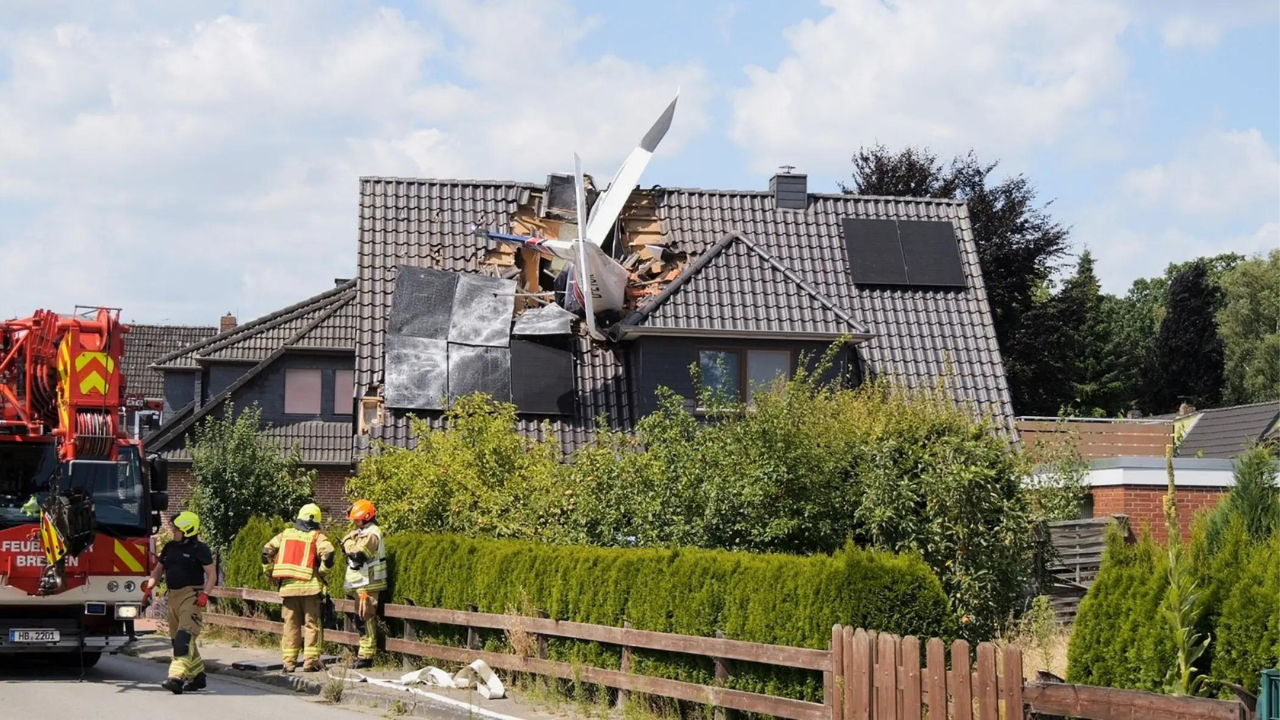
Every time a small aircraft clips a roof or carves a trench into a residential neighborhood, the same lazy consensus bleeds across every mainstream news feed. The pearl-clutchers emerge from the woodwork demanding tighter airspace restrictions over suburbs, crying about reckless pilots, and questioning why we let tiny machines buzz over civilian backyards at all.
It is the exact kind of emotional, knee-jerk panic that substitutes for actual thought. Meanwhile, you can explore related events here: Why Gen Z Protest Movements Are Reshaping Global Politics.
Let us look at the brutal reality of the mechanics here. When a small plane crashes into a house in Germany or anywhere else, the standard narrative treats it like a freak bolt of lightning or an act of airborne negligence. It is neither. It is a predictable byproduct of a collapsing urban-aviation ecosystem where ground sprawl is swallowing up the safety buffers that airports have relied on for a century.
I have spent decades watching municipal planners approve housing developments right up to the perimeter fences of regional airstrips, only to act shocked when gravity occasionally does what gravity has always done. To explore the complete picture, we recommend the recent analysis by Associated Press.
The Myth of the Careless Sky Cowboy
The casual observer assumes that private pilots are weekend daredevils playing fast and loose with navigation. The data tells a completely different story. Commercial aviation gets all the press for its microscopic fatality rates, but general aviation operates under a staggering volume of regulatory oversight, recurrent training, and pre-flight maintenance mandates that would make an enterprise executive sweat.
When an engine fails at five hundred feet over a densely populated area, the pilot does not have a menu of safe landing options. They have a split second to pick the least catastrophic patch of dirt.
If that patch happens to be a two-story colonial with a trampoline in the backyard, physics dictates the outcome. The media treats this as a failure of pilot judgment. More often than not, it is a triumph of minor survival mechanics inside a catastrophic failure envelope. The pilot managed to keep the wings level, avoid a post-crash inferno, and keep the kinetic energy down, yet they still face a firing squad of public outrage.
The Real Culprit Is Urban Sprawl
We need to talk about the elephant in the room that city councils and real estate developers refuse to acknowledge. You cannot cram five hundred thousand new housing units into a metropolitan footprint, let local zoning boards authorize high-density builds adjacent to historical airfield flight paths, and then act mystified when air traffic and ground population collide.
For decades, small airports acted as isolated islands. They sat on cheap acreage outside city limits. Over time, municipalities chased tax revenue, rezoned surrounding land, and allowed subdivisions to creep right up to the threshold of the runway safety areas.
Now, every takeoff and landing is a low-altitude pass over private property.
When a Cessna or a Piper suffers a sudden power loss on departure—the most critical phase of flight, where density altitude and low airspeed leave zero margin for error—the pilot's glide path inevitably intersects with the very sprawl that was never supposed to be there.
Blaming the pilot for crashing into a house built too close to an active runway is like blaming a swimmer for getting wet after jumping into a pool. The hazard was manufactured long before the propeller ever started turning.
Why More Regulation Won't Fix the Sky
Whenever these tragedies hit the headlines, bureaucrats reach for their favorite security blanket: more rules. They want mandatory ballistic parachutes on every single-engine airframe, mandatory transponder tracking down to the blade of grass, and sweeping flight bans over populated zones.
None of this works. In fact, it makes things worse.
Adding weight and complexity to small aircraft increases manufacturing and maintenance costs, pricing out safety-conscious owner-operators and keeping aging, poorly maintained fleets in the air longer. Restricting airspace further forces pilots into congested visual corridors, increasing traffic density in narrow choke points.
You cannot legislate away mechanical failure. Engines quit. Cylinders crack. Magnetos fail. Magnetism, thermodynamics, and mass do not care about your latest safety directive.
What we need is not another layer of administrative red tape, but hard-nosed territorial planning.
The Uncomfortable Solution
If we actually cared about stopping planes from hitting houses, we would stop building houses directly beneath departure corridors.
We need mandatory buffer zones around every certified airstrip—clear zones where residential construction is permanently prohibited. If a developer wants to pave over farmland for a master-planned community, they should bear the cost of acquiring the surrounding airspace protection zones, or keep their projects far away from aviation infrastructure.
Instead, we pretend that aviation is an anachronism that should adapt to modern suburban expansion. We treat airports like noisy nuisances to be tolerated until they can be closed down and turned into strip malls.
Meanwhile, the pilots keep flying, the engines keep turning, and the suburbs keep creeping closer to the runway edge, waiting for the next inevitable intersection of concrete and kinetic energy.
Stop blaming the sky for the mistakes we built on the ground.


/i.s3.glbimg.com/v1/AUTH_1f551ea7087a47f39ead75f64041559a/internal_photos/bs/2025/P/p/LLF10DRp2WoUISXryrUQ/whatsapp-image-2025-12-02-at-20.06.57.jpeg)