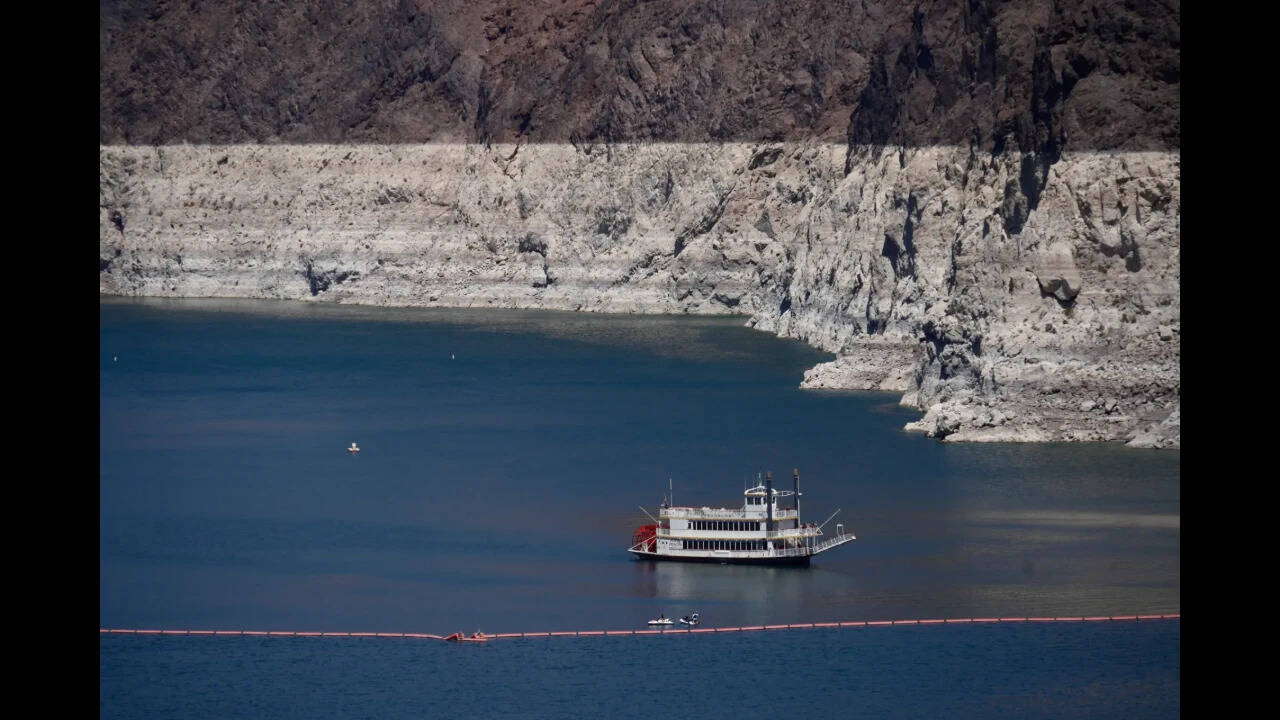
Every summer, the mainstream media rolls out the exact same tired script. Lake Mead drops another ten feet, hitting a new psychological milestone like 1,040 feet, and the panic machines whir to life. You get the aerial drone shots of bathtub rings on sandstone cliffs, the tragic B-roll of rusted boat ramps stranded a mile from the water, and the inevitable sob story about the impending apocalyptic dry-up of the American Southwest.
The lazy consensus is always identical. Climate change is stealing our water. Mother Nature is punishing us for our carbon sins. The Colorado River basin is drying up because the sky has stopped raining.
It is a comfortable narrative. It places the blame squarely on a nebulous, unmanageable atmospheric crisis where nobody in particular is at fault. It lets every politician, agricultural lobbyist, and municipal water manager off the hook.
It is also complete nonsense.
The Colorado River is not dying of natural thirst. It is being murdered by bureaucratic inertia, archaic legal fictions, and an economic system that treats a scarce desert resource like an infinite open bar. I have spent the last fifteen years auditing industrial water portfolios across the Intermountain West, and I can tell you firsthand that we do not have a supply crisis. We have an administrative catastrophe born of sheer human greed and legal cowardice.
The Fiction of the Natural Drought
Let us look at the data that the headlines conveniently ignore. The Colorado River Compact of 1922 divided up the river's water based on data gathered during one of the wettest twenty-year periods in five centuries. The architects of this legal framework allocated fifteen million acre-feet of water a year to seven states and Mexico, assuming the river could always provide it.
The historical average natural flow is closer to thirteen million acre-feet in a good year, and current scientific reconstructions show it is significantly less than that over long horizons.
We built a multi-trillion-dollar civilization on the banks of a dry wash and pretended the math worked. When you allocate more water than nature physically manufactures every single year, your reservoir level is not dropping because of a drought. It is dropping because your withdrawal rate exceeds your replenishment rate by design.
Calling this a natural disaster is like maxing out five credit cards on luxury vacations, missing a car payment, and blaming the bank for a sudden liquidity shortage.
The Alfalfa Absurdity
If you want to find where the water is actually going, stop looking at the suburban lawns in Las Vegas or the golf courses in Phoenix. Yes, municipal conservation matters, but residential use is a rounding error in the grand ledger of the Colorado River basin.
Roughly seventy percent of the entire water allocation goes to agriculture. Not to feed a starving nation with high-value crops grown in suitable climates, but to grow flood-irrigated alfalfa in the middle of the scorching Mojave and Sonoran deserts.
Alfalfa is a water-guzzling forage crop. A massive percentage of that desert-grown alfalfa is baled up, loaded onto cargo ships, and exported to feed dairy cows in China and Saudi Arabia.
Read that again. We are draining Lake Mead to 1,040 feet, risking the structural integrity of Hoover Dam's power generation, and rationing municipal supplies so foreign conglomerates can buy heavily subsidized desert water to feed overseas livestock.
The legal doctrine of Prior Appropriation—first in time, first in right—protects senior water rights holders, mostly ancient agricultural irrigation districts, regardless of how economically absurd their usage has become. They have a legal right to pump millions of acre-feet of water, flood flat dirt fields under the blazing noon sun through century-old open ditches where half of it evaporates before touching a root, and sell the resulting low-value hay for pennies on the dollar.
If a tech company or a housing developer wasted eighty percent of their raw material through sheer evaporation and inefficiency, they would go bankrupt inside of a quarter. But because of nineteenth-century legal relics, agricultural water right holders are financially incentivized to use every drop of their allocation every single year. If they conserve a single drop, they risk losing the right to it permanently next season. Use it or lose it is the golden rule of the basin, and it is bleeding the river dry.
The Pricing Illusion
Economics 101 teaches us that when a commodity becomes scarce, its price rises, which naturally triggers conservation and efficient reallocation.
Water in the Colorado River basin completely defies this basic law of capitalism.
Urban water districts pay artificially suppressed rates fixed by political bodies. Farmers pay fractions of a cent per thousand gallons—rates so low that installing modern drip irrigation or soil-moisture sensors is a net financial loss. Why invest a million dollars in efficiency when water is practically free?
Imagine a scenario where water prices in the Southwest floated freely based on true basin-wide scarcity. An acre-foot of water would instantly skyrocket in value. Suddenly, flood-irrigated alfalfa in Arizona would become economically unviable overnight. The market would instantly force that water away from low-value, high-evaporation feed crops and toward high-value urban centers, advanced manufacturing, and high-tech industries that generate hundreds of jobs per gallon instead of a few stalks of hay.
Instead, we shield agricultural barons from economic reality through taxpayer-funded subsidies and political fiat. We subsidize their inefficiency, watch Lake Mead approach dead pool status, and then run to the federal government begging for bailouts to build multi-billion-dollar desalination plants or pipeline dreams that treat the symptoms while ignoring the disease.
The Hard Realities of the Shortage Guidelines
Federal negotiators and state representatives love to pat themselves on the back every time they strike a voluntary conservation deal. They announce modest cutbacks, claiming they have saved another million acre-feet of water for the lake.
It is financial sleight of hand. The cuts are too small, too late, and dependent on wet winter anomalies that we can no longer count on.
When Lake Mead hits critical elevations like 1,025 feet or 1,000 feet, the mechanical constraints of Hoover Dam change entirely. At around 950 feet, the turbines stop spinning altogether. The hydropower generated by the dam—which powers millions of homes and businesses across Nevada, Arizona, and California—vanishes. Not only do you lose the water supply, but you also lose the clean baseline energy that stabilizes the regional grid, forcing utilities to fire up expensive, high-emission natural gas plants to pick up the slack.
The cascading failures of reaching dead pool are not decades away if current extraction trends continue unchecked. They are mathematically locked in unless we fundamentally rewrite the social contract of the American Southwest.
What Real Reform Looks Like
Solving the crisis at Lake Mead requires an aggressive, politically brutal dismantling of the status quo. We need to stop tinkering at the margins and execute three non-negotiable structural shifts.
First, we must decouple water rights from specific land parcels and establish a functioning, transparent water market across state lines. Let senior agricultural right holders lease or sell their water to municipal districts at market rates. If a farmer can make more money leasing their water right to Phoenix than growing low-grade hay, they should have the legal right to do so without forfeiting their underlying asset. This single move would flood cities with sustainable water supplies overnight without drilling a single new well.
Second, we must abolish the use-it-or-lose-it rule permanently. Conservation should be rewarded, not penalized. If an irrigation district slashes its consumption by forty percent through advanced drip technology, it should be allowed to bank, trade, or retain the surplus value of that saved water.
Third, federal subsidies for water-intensive export crops grown in hyper-arid desert basins must end. If you want to farm water-heavy commodities in the desert, you should pay the actual marginal cost of transporting and managing that water in a drought-stressed environment. Let the market decide if desert alfalfa pencils out when priced at its true replacement cost.
The Choice Ahead
The plummeting water level at Lake Mead is a mirror reflecting our collective refusal to manage finite resources with adult logic. Every time an outlet warns you about climate doom dropping the water level, look past the dramatic photography. Look at the balance sheet. Look at the legal frameworks. Look at the political cowardice that protects inefficient waste at the expense of regional survival.
We can keep pretending that the rain will bail us out, or we can face the harsh economic reality that our water crisis is self-inflicted.
The water is there. The laws are the problem. Change the laws, or watch the basin run dry.