The rain in Paris has a way of blurring the edges of history. On a gray afternoon along the banks of the Seine, tourists crowd beneath umbrellas, their eyes drawn upward to the soaring ironwork of the Eiffel Tower or the grand facade of the Louvre. They are walking through a city that has mastered the art of remembrance. Every corner has its plaque; every boulevard is named after a victory or a loss. Yet, for three decades, a profound and terrible silence lingered in the heart of the French capital.
Memory is not passive. It is a battle against the quiet erosion of time. When more than eight hundred thousand human lives are extinguished in the span of just one hundred days, the sheer scale of the horror tends to paralyze our comprehension. The 1994 genocide against the Tutsi in Rwanda becomes a statistic in a textbook, a distant tragedy relegated to the late twentieth century. We read the numbers, but we do not feel the weight.
That weight requires a physical anchor. It demands a place where the living can look at the stone and acknowledge the dead.
The Weight of Absence
To understand why a monument in Paris matters, one must first understand the agony of an unmarked absence.
Consider a hypothetical survivor named Marcel. Marcel lives in a modest apartment in the 18th arrondissement. He has built a quiet life in France, works a regular job, and speaks with a gentle, deliberate cadence. But every April, the spring air brings back a crushing vertigo. In 1994, Marcel lost his parents, his three sisters, and his childhood. They have no graves. Their bodies were discarded into rivers or left in the red dirt of the hills of Kigali, stripped of the dignity of a final resting place.
For thirty years, Marcel walked the streets of Paris, surrounded by monuments to European wars, while his own catastrophic grief remained invisible to the world around him.
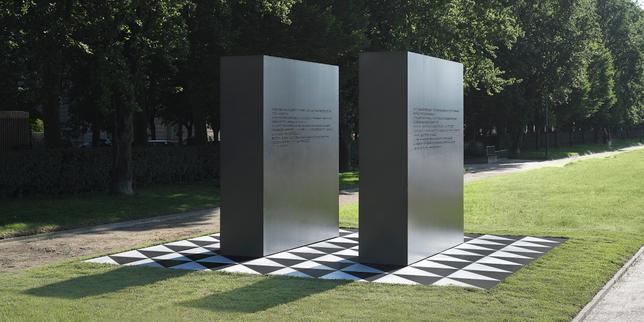
This is the psychological void that a new memorial on the Esplanade des Villes-Compagnons-de-la-Libération aims to fill. Located in the 7th arrondissement, right on the banks of the Seine, this permanent memorial is not just an artistic installation. It is a diplomatic, historical, and deeply personal intervention. It places the memory of the Tutsi genocide squarely within the public consciousness of France, a nation whose historical ties and political actions during that era remain a subject of intense scrutiny and painful debate.
Statues are often built to celebrate triumphs. This one is built to carry a scar.
More Than Material
The creation of this memorial was never going to be a simple bureaucratic exercise. It required an alignment of political will, artistic vision, and collective mourning. The project, heavily backed by the City of Paris and various advocacy organizations, represents a formalized recognition that has been decades in the making.
But what does it mean to turn trauma into stone?
The design of a monument forces a confrontation with the impossible. How do you represent the systematic slaughter of a minority population without resorting to gratuitous horror? How do you honor the dead while reminding the living of their collective failure to intervene?
The selected memorial relies on a language of stark, evocative geometry. It does not attempt to replicate the violence; instead, it creates a space for contemplation. Imagine a structure that cuts into the Parisian landscape, a deliberate rupture in the neat stone quays of the Seine. It uses materials that weather and change, reflecting the passage of time and the permanence of grief.
When you stand before it, the bustling noise of Paris fades slightly. The river keeps moving, but the monument forces you to stand still. It serves as a physical manifestation of a truth that many tried, for years, to look away from.
The Invisible Stakes of Geography
The location itself carries immense symbolic gravity. The 7th arrondissement is the seat of French institutional power. It is the neighborhood of ministries, embassies, and historical grandeur. Placing the memorial here is an act of defiance against political amnesia.
France’s relationship with Rwanda during the early 1990s is a labyrinth of geopolitical missteps, classified documents, and decades of defensive rhetoric. For a long time, the official stance was one of deflection. It took years of rigorous historical research, culminating in the landmark Duclert report in 2021, for France to formally acknowledge its "heavy and overwhelming responsibilities" in the events that led to the genocide, even while concluding there was no complicity in the intent to destroy the Tutsi population.
Therefore, this monument is not a gift from a city to a diaspora. It is a confession.
By embedding this memorial into the very dirt of Paris, the city ensures that future generations of French citizens, international diplomats, and global travelers will walk past it and ask questions.
What happened there?
Why is this here?
What did we do?
The answers to those questions are uncomfortable. They should be. If a memorial makes the viewer feel entirely comfortable, it has failed its purpose. It has become decoration rather than history.
Healing Across Oceans
For the Rwandan diaspora in France, the significance of this space cannot be overstated. Grief without a geographic focal point is a wandering, restless thing.
During the annual commemorations, known as Kwibuka, survivors have previously gathered in various temporary locations across Paris, holding candles against the wind, carrying their memories in rented halls or temporary squares. They were visitors in their own mourning.
Now, they have a home for their sorrow.
The monument acts as a bridge between two worlds separated by thousands of miles and vast cultural differences. It connects the manicured banks of the Seine to the terraced hills of East Africa. It allows a survivor to lay a flower on a piece of stone in Paris and know that the gesture reaches across the ocean, honoring a mother or a brother whose bones are part of the Rwandan earth.
It also changes the narrative for the children of survivors. Born in France, navigating a dual identity, these young people often grow up with the heavy, unspoken trauma of their parents hanging over the dinner table. This public monument validates their family history. It tells them that their heritage, including its darkest chapter, is recognized by the republic they call home.
The Danger of the Final Stone
There is, however, a subtle trap hidden within the construction of any grand monument.
Once the stone is carved, the speeches are delivered, and the ribbons are cut, there is a temptation to close the book. The danger is that the monument becomes a substitute for ongoing justice. Society can easily look at a beautiful piece of bronze or granite and say, "We have remembered them. Our duty is done."
But the real struggle lies elsewhere.
Memory is a living muscle. A monument is merely the skeleton. The muscle must be flexed through education, through the continuous prosecution of those who participated in the killings and found refuge on European soil, and through a relentless refusal to allow revisionist histories to take root.
In recent years, the world has witnessed a troubling resurgence of denialism and hate speech, often amplified by the digital ether. The tactics used to dehumanize the Tutsi in 1994—the dehumanizing language broadcast over the radio, the systematic categorization of human beings as pests—are not relics of the past. They are blueprints that can be reused anywhere the living grow careless.
The stone in Paris must stand as an active warning system, not a mausoleum for a closed chapter of human history.
Standing in the Present
The afternoon yields to evening, and the lamps along the Seine flicker to life, casting long shadows across the pavement. The water reflects the lights of the passing Bateaux Mouches, filled with dinners and laughter.
A few steps away, the memorial stands resolute, cold to the touch but burning with an quiet intensity.
People will come to this space for many reasons. Some will come because they are searching for a name that is etched into their hearts. Others will stumble upon it by accident while looking for a view of the river, pausing mid-stride as the gravity of the inscription catches their eye.
Marcel stands there, his coat collar turned up against the damp chill. For the first time in thirty years, he does not feel entirely alone in his remembering. The city is still moving around him, fast and indifferent, but the stone is holding his ground. It remains there, rooted deeply into the Parisian earth, a silent, unyielding witness ensuring that the names of those who were lost are never completely swallowed by the river of time.