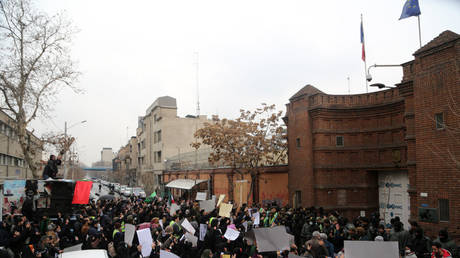
The forcible closure of the French Language Center in Tehran by Iranian judicial and security authorities represents a predictable inflection point in bilateral friction rather than an isolated administrative dispute. State-backed entities executed the shutdown under the explicit justification of national security protection, citing long-standing operations conducted beneath an educational veneer. Deconstructing this event requires an analysis of diplomatic tit-for-tat cycles, state control over human capital, and the narrowing channels of Western engagement inside the Iranian political architecture.
The Structural Anatomy of State-Level Interventions
Diplomatic outposts and affiliated cultural institutions operate within a fragile regulatory equilibrium. Host governments grant operational permissions contingent upon adherence to strict statutory boundaries. When geopolitical tensions escalate, these institutions transition from instruments of soft power into suspected hubs for intelligence gathering, elite networking, and subversion.
The Iranian judiciary targeted the French Language Center through a calculated framework of accusations. State-linked media outlets articulated three core charges against the facility:
- The implementation of cultural programs contrary to state-defined ideological norms.
- The systemic identification and mapping of high-value professional and intellectual strata.
- The facilitation of emigration corridors for local talent out of the country.
Each charge highlights a distinct anxiety within the security apparatus. Autocratic regimes view foreign-sponsored educational spaces not as neutral academies, but as unmonitored nodes where domestic citizens interact with foreign diplomats, absorb alternative worldviews, and establish independent professional networks. By framing language instruction as a security threat, the state establishes a legal precedent for criminalizing any unvetted institutional contact between its citizenry and Western representatives.
Historically, authoritarian states evaluate foreign cultural institutes through the lens of counter-intelligence. When internal dissent or systemic economic instability threatens regime stability, authorities systematically restrict external channels that offer alternative paths for upward mobility or ideological alignment. The French Language Center, operating for years under varying degrees of political tolerance, became vulnerable the moment the cost-benefit calculation of the Iranian security apparatus shifted toward total insulation.
The Cost Function of Elite Attrition
The accusation regarding the facilitation of elite departure addresses a critical structural vulnerability facing contemporary Iran. A sustained brain drain plagues the domestic economy, stripping the country of engineers, scientists, medical professionals, and academics who face severe economic contraction, inflation, and political repression.
Institutions offering foreign language instruction function as primary accelerators for this demographic shift. Proficiency in French or English serves as a mandatory prerequisite for migration to Europe or North America. When authorities accuse a foreign cultural center of orchestrating exit pathways for skilled workers, they target the mechanics of human capital flight.
The transaction costs for the state associated with losing top-tier talent compound over time. Public investments in higher education yield zero domestic return when graduates emigrate. Rather than implementing structural economic reforms to incentivize domestic retention, security agencies utilize coercive measures to dismantle the intermediaries that assist citizens in securing foreign visas, university admissions, and international employment.
This dynamic exposes a fundamental tension in modern state management. While the regime demands absolute loyalty and intellectual conformity, globalization provides high-value workers with external exit options. By shutting down language training facilities affiliated with Western embassies, authorities attempt to choke off the informational and linguistic pipeline that enables emigration. However, this intervention treats the symptom rather than the root cause of professional flight, failing to address the macroeconomic drivers that compel citizens to leave.
Diplomatic Reciprocity and Escalation Ladders
Bilateral relations between Paris and Tehran operated under severe strain prior to the closure of the language center. Diplomatic friction manifested through a succession of reciprocal expulsions and retaliatory detentions. Months before the raid on the center, France expelled Iranian diplomats in direct response to the brief detention and expulsion of French envoys on contested interference charges.
This sequence follows a rigid game-theoretic model of tit-for-tat escalation. When one state penalizes diplomatic personnel, the opposing state looks for asymmetric retaliation points. Because foreign embassies possess sovereign immunities, direct retaliation against senior diplomats carries high risks of total diplomatic severance. As a result, security planners select soft targets within the host country's jurisdiction, such as cultural affiliates, language academies, and commercial chambers.
Closing a cultural facility inflicts minimal direct economic damage on the aggressor state while delivering high symbolic utility to domestic hardliners. It signals resolve to internal constituencies and demonstrates a willingness to absorb diplomatic blowback. The French Foreign Ministry condemned the action as an unjustifiable violation of diplomatic norms and summoned the Iranian ambassador, yet historical precedents indicate that formal protests rarely alter the security calculus of a regime prioritizing internal control over international standing.
The asymmetry of power in these bilateral disputes favors the host government regarding physical assets on its territory. While European capitals possess vast economic and financial sanctions tools, they lack localized physical leverage to compel compliance on domestic policing matters. Consequently, physical closures of embassies, cultural centers, and educational institutes become the primary instruments through which host governments exert pressure during diplomatic crises.
Information Control and Sovereignty Assertions
Modern statecraft relies heavily on information sovereignty. Authoritarian governments maintain strict monopolies over communication channels, educational curricula, and public assembly. Foreign cultural centers introduce external variables into this controlled environment. They provide unfiltered access to literature, media, and interpersonal networks that bypass state censors.
The closure of the facility in Tehran reflects an ongoing campaign to purge Western cultural footprints from the capital. Over preceding years, similar institutions representing other European nations faced intensified scrutiny, bureaucratic strangulation, or outright shuttering. The operational space for foreign missions contracts progressively, reducing embassies to functional consular fortresses divorced from civil society engagement.
This contraction carries long-term strategic implications for European foreign policy. Without physical outposts capable of engaging local academics, students, and civil society actors, intelligence gathering and diplomatic assessment degrade significantly. Policymakers in Western capitals rely on embassy staff and affiliated cultural networks to gauge domestic sentiment, political stability, and civil unrest. Severing these connections creates an intelligence vacuum, increasing the probability of miscalculation during future crises.
Information sovereignty is not merely about censoring external media; it involves controlling the social architectures through which citizens form collective identities. When a foreign language center operates successfully, it fosters cosmopolitan identities that transcend nationalist narratives promoted by the state. Eliminating these centers is an ideological imperative designed to eliminate competing centers of social gravity.
Systemic Limitations of Retaliatory Diplomacy
The options available to the French government in responding to the shuttering of its cultural infrastructure remain structurally constrained. Economic sanctions already target the core sectors of the Iranian economy, leaving few untapped financial levers. Military deterrence operates independently of cultural disputes, while total diplomatic withdrawal forecloses the last remaining channels for consular protection of dual nationals detained inside the country.
Diplomatic protests and retaliatory expulsions serve primarily as signaling mechanisms rather than corrective tools. They establish a baseline of disapproval designed to deter future escalations, though empirical evidence suggests that such warnings carry negligible weight against domestic security imperatives in Tehran. The Iranian security apparatus operates with absolute autonomy regarding internal threat perceptions, rendering foreign ministerial statements largely inconsequential to their operational calculus.
When diplomatic channels narrow to functional minimums, the mechanisms for resolving misunderstandings vanish. Each retaliatory action closes a door, making future de-escalation increasingly difficult to negotiate. The loss of cultural infrastructure strips away the informal communication channels that diplomats traditionally utilize to test policy proposals before formal implementation.
Strategic Forecast for Bilateral Engagement
The trajectory of Franco-Iranian relations points toward complete diplomatic minimalism. As bilateral trust approaches zero, remaining cultural, educational, and scientific cooperation agreements face imminent suspension. The closure of the language center marks not a temporary aberration, but the structural baseline for future interactions between Paris and Tehran. Future friction points will likely center on consular disputes, maritime security in regional waterways, and cyber operations, with cultural infrastructure serving as the primary expendable asset sacrificed during each escalation cycle.
To navigate this environment, external powers must recalibrate their long-term expectations regarding cultural diplomacy in hostile jurisdictions. Traditional models of soft power projection rely on open exchange, institutional presence, and mutual engagement. When a host government rejects the foundational premise of cross-cultural interaction, traditional foreign policy toolkits fail. The future of engagement requires digital-first, decentralized approaches that operate independently of physical real estate inside closed jurisdictions, bypassing state-controlled conduits entirely to maintain intellectual continuity with isolated populations.