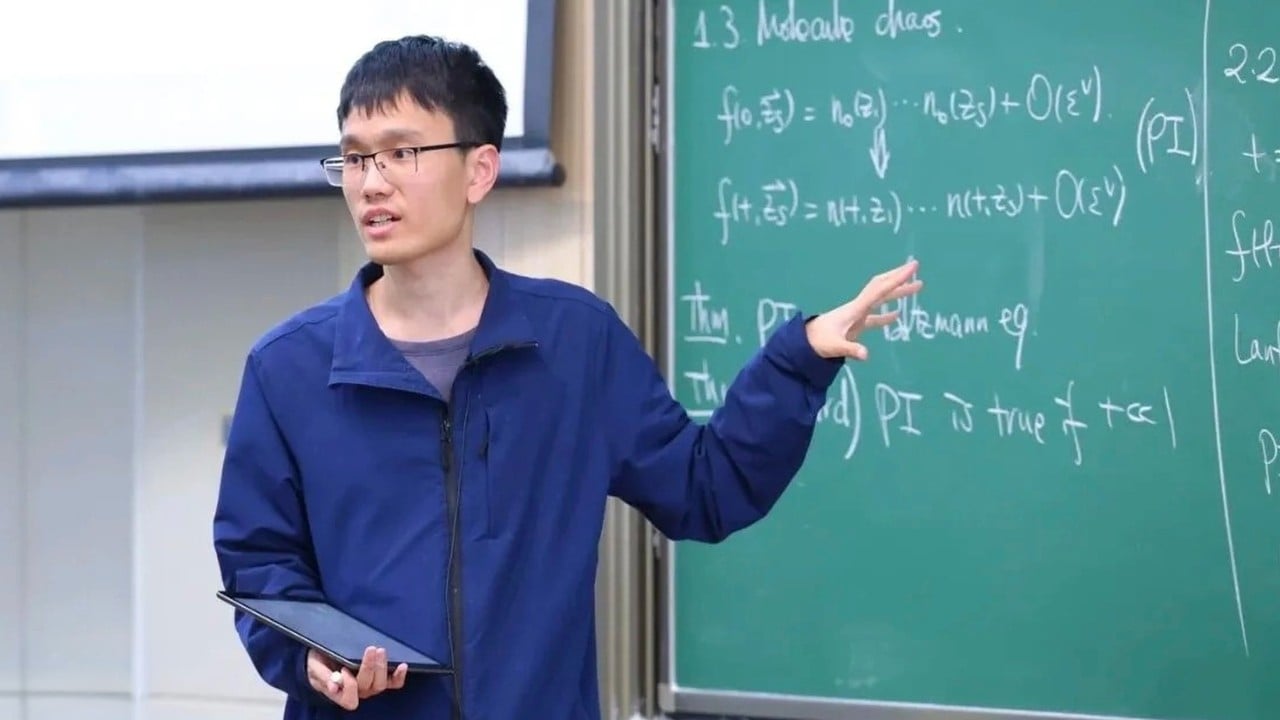
Another high-profile researcher just walked away from Western academia, and honestly, the math behind the move makes total sense. Ma Xiao, a rising star in pure mathematics who spent years building his reputation across top institutions in France and the United States, has packed his bags for China.
He didn't just switch time zones. He switched disciplines entirely.
After earning his doctorate at Université Paris Cité and spending years deep in complex differential geometry and spectral theory at the University at Buffalo, Ma has joined Nankai University's Chern Institute of Mathematics in Tianjin. Even more surprising? He is pivoting his focus toward artificial intelligence.
If you follow academic migration trends, you've probably noticed a pattern here. Top-tier theoretical minds are increasingly trading pure, abstract research in the West for applied computational power and massive institutional backing in China. Let's break down who Ma Xiao actually is, why his specific brand of math matters to modern AI, and what this move signals for the global tech race.
Who Is Ma Xiao and Why Does His Departure Matter
To understand why universities care when someone like Ma Xiao leaves, you have to look at his pedigree. Pure mathematics is an unforgiving field where breakthroughs take years of solitary, grueling work. You don't stumble into elite status by accident.
Ma completed his undergraduate studies at the University of Science and Technology of China (USTC), an institution famous for churning out some of the sharpest quantitative minds on the planet. From there, he headed to Europe, earning his PhD in 2018 at Université Paris Cité under the supervision of Xiaonan Ma, a prominent figure in global analysis and geometry.
Following his doctorate, Ma moved to the United States, taking on research and teaching roles at the University at Buffalo, part of the State University of New York (SUNY) system. During his time in the West, he published heavily in respected journals, tackling intricate problems in complex geometry, index theory, and Bergman kernels.
That isn't casual Sunday reading. It's the kind of foundational mathematics that underpins how we understand high-dimensional spaces.
When someone with that exact background leaves a US research university to return to China, it isn't just a routine faculty transfer. It's a loss of specialized intellectual capital that takes decades to cultivate. And because Nankai University's Chern Institute of Mathematics—founded by the legendary geometer Shiing-Shen Chern—is one of China's premier mathematical hubs, Ma isn't stepping down in prestige. He's stepping into an environment specifically engineered to retain elite talent.
The Bridge Between Pure Geometry and Artificial Intelligence
At first glance, pivoting from pure differential geometry to artificial intelligence sounds like trading a violin for a jackhammer. One deals with eternal, abstract truths on a chalkboard; the other deals with massive server farms, messy data, and commercial software.
In reality, the two fields are colliding faster than most outsiders realize.
Modern AI—especially large language models and advanced neural networks—operates in absurdly high-dimensional vector spaces. When engineers train a model with hundreds of billions of parameters, they are essentially trying to navigate a complex geometric surface to find the lowest error points.
Here is why pure mathematicians are suddenly the hottest recruits in AI research:
- Understanding the "Black Box." Computer scientists are great at scaling models up, but they often struggle to explain why a neural network suddenly develops new capabilities or fails unpredictably. Differential geometry and topology give researchers the mathematical tools to map how information actually flows and compresses inside these networks.
- Optimization and Efficiency. Training frontier AI models burns through millions of dollars in compute. Mathematicians who understand manifold learning and spectral theory can design smarter algorithms that achieve the same results with a fraction of the energy and hardware.
- AI for Mathematics. The street runs both ways. Projects like Google DeepMind's AlphaProof and AlphaGeometry have shown that AI is getting scary good at solving Olympiad-level math problems. Universities want researchers who can build AI systems capable of assisting with formal theorem proving and automated mathematical discovery.
Ma Xiao isn't abandoning his mathematical roots. He's taking a toolkit forged in one of the hardest theoretical disciplines on Earth and pointing it directly at the defining technology of our decade.
What Is Driving Chinese Researchers Back Home
If you ask ten different policy analysts why scholars like Ma Xiao are leaving the United States, you'll get ten different political talking points. Strip away the noise, though, and the practical realities on the ground tell a much clearer story.
First, look at the funding landscape. In the US, securing federal grants for theoretical research—or even interdisciplinary AI work—has become an exhausting bureaucratic grind. Young professors spend half their lives writing grant proposals just to keep their labs afloat, often facing fierce competition for shrinking pools of pure science funding. Meanwhile, China has poured billions of yuan into national talent programs, university research institutes, and dedicated AI initiatives. When a researcher gets an offer that includes guaranteed multi-year funding, a dedicated team, and zero red tape, the decision gets a lot easier.
Second, the academic environment in the US has grown increasingly tense for researchers of Chinese descent. Over the past several years, heightened scrutiny over national security, visa delays, and investigations into academic collaborations have created a pervasive sense of unease. Even when researchers have nothing to hide, the constant friction around travel, funding disclosures, and international partnerships wears people down.
Third, the gravitational pull of China's domestic AI ecosystem is massive right now. From startups in Beijing and Hangzhou to state-backed labs in Tianjin and Shanghai, the speed at which theoretical ideas move into real-world deployment is staggering. For a mathematician looking to pivot into AI, joining a top Chinese institute puts them right next to a massive talent pool of hungry engineering students and aggressive tech companies eager to test new theories.
What Most People Get Wrong About This Brain Drain
Whenever news breaks about a prominent scientist leaving the US for China, the internet immediately splits into two predictable camps. One side panics that Western science is collapsing overnight. The other side shrugs it off, assuming the US can simply import more talent from elsewhere.
Both takes miss the real issue.
The US still holds massive advantages in frontier AI hardware, private venture capital, and elite research labs. One mathematician moving to Tianjin doesn't suddenly flip the global balance of power. However, treating these departures as isolated incidents is a massive mistake.
Scientific ecosystems rely on network effects. A star researcher doesn't just publish papers in a vacuum; they mentor graduate students, attract postdocs, organize conferences, and spark collaborations across departments. When Ma Xiao joins the Chern Institute at Nankai University, he becomes a magnet for the next generation of Chinese math students who might otherwise have applied to PhD programs in California, New York, or Paris.
Over five or ten years, those missing graduate students turn into missing faculty members, missing startup founders, and missing breakthroughs. You don't feel the impact of a slow leak in the foundation on day one. You feel it five years later when the house starts tilting.
How Research Institutions and Tech Leaders Should Respond
Watching talent flow across borders isn't something an individual reader can stop, but if you work in academia, tech recruiting, or R&D strategy, this trend directly affects how you build teams and plan for the future.
If you're recruiting technical talent, stop over-indexing on narrow software engineering resumes. The biggest breakthroughs in AI over the next five years won't come from people who just know how to wire up existing APIs. They will come from physicists, pure mathematicians, and statisticians who understand the underlying geometry and mechanics of learning systems. Look for candidates with deep theoretical backgrounds who are hungry to apply their skills to computational problems.
If you're an early-career researcher or student weighing your own path, pay close attention to where Ma Xiao placed his bet. Pure theory is noble, but the most exciting intellectual territory right now sits right on the border between abstract mathematics and machine intelligence. Learning how to translate theoretical rigor into computational experiments will make you virtually indispensable, regardless of which country you choose to call home.
For universities and policymakers in the West, the lesson is blunt. You cannot retain world-class minds on legacy prestige alone. If you bury researchers in grant bureaucracy, restrict their ability to collaborate freely, and underfund foundational science while competitors roll out the red carpet, smart people will eventually do the math and walk out the door.