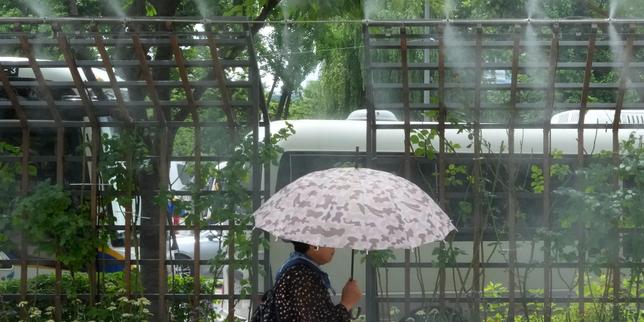
The media is panicking over Seoul. When South Korea raised its heatwave warning to the highest "serious" level for the first time in years, headlines rushed to paint a picture of an impending infrastructure collapse. They showed images of melting asphalt, weary citizens, and issued dire warnings about the imminent failure of the East Asian power grid.
This reaction is completely wrong. In other news, take a look at: The Anatomy of Mass Displacements Evaluating Chinas Logistical Defense Against Typhoon Bavi.
The mainstream press views a maximum-level weather alert as a sign of systemic failure. In reality, it represents the exact opposite. It proves that a highly industrialized, dense nation has built an administrative and engineering framework capable of quantifying, predicting, and neutralizing extreme thermal events before they turn into disasters. The alert is not a white flag. It is an operational trigger.
For two decades, I have analyzed industrial grid resilience and municipal energy deployments across Asia. I have watched Western commentators project their own infrastructure anxieties—born from aging, brittle grids in Texas or Western Europe—onto Asian nations that operate on an entirely different level of structural preparation. South Korea is not on the brink of a blackout. The country is executing a carefully planned playbook. USA Today has also covered this important topic in great detail.
The Flawed Metric of Peak Demand Panic
The core argument of the alarmist narrative relies on a simple, flawed equation: higher temperatures equal higher air conditioning use, which equals an inevitable grid failure.
This logic is primitive. It ignores the mechanics of modern power grid management, specifically the concept of the operating reserve margin.
Reserve Margin = (Capacity - Peak Demand) / Peak Demand
When South Korea’s Ministry of the Interior and Safety triggers a maximum alert, the Korea Electric Power Corporation (KEPCO) does not panic. They look at the numbers. During peak summer events, the media focuses entirely on total megawatts consumed, treating each new record as a step closer to the abyss. They ignore the reserve margin, which routinely stays above a comfortable 10% to 11% buffer, even during sustained 38°C runs.
+------------------------------------------+
|  Typical Severe Heatwave Grid Profile    |
+------------------------------------------+
| Total Available Capacity:  104,000 MW    |
| Projected Peak Demand:      93,600 MW    |
| Operational Buffer:         10,400 MW    |
| Net Status: Fully Stable                 |
+------------------------------------------+
South Korea’s grid does not survive these peaks by accident or through luck. It survives because the state systematically expanded its baseload capacity over the last decade, combining heavily automated liquefied natural gas (LNG) peaking plants with a highly dependable nuclear foundation. While European nations spent the last ten years prematurely mothballing nuclear assets and creating artificial vulnerability to seasonal shifts, Seoul did the reverse. They reinforced their baseline.
The true vulnerability during a heatwave is not a lack of raw generation capacity. It is local transformer failure caused by poor thermal dissipation. When an individual apartment complex loses power in Incheon or Busan during a heatwave, it is almost never because the national grid ran out of electricity. It happens because localized, decades-old distribution transformers overheat under sustained, non-linear residential loads. Media outlets routinely mistake these hyper-local equipment failures for national grid crises, revealing a fundamental ignorance of electrical engineering.
The Myth of the Flatline Economy
Another common narrative claims that extreme heat alerts freeze economic output. Pundits warn of shuttered factories, stalled supply chains, and massive losses in industrial productivity.
This claim ignores the structural reality of heavy industry.
Major South Korean conglomerates—the chaebols like Samsung, Hyundai, and SK Hynix—do not operate at the mercy of the daily weather report. Their manufacturing environments are highly isolated from external atmospheric conditions. A semiconductor fabrication plant (fab) requires strict climate control, constant pressure, and absolute particulate filtration 365 days a year.
These facilities utilize high-efficiency industrial district cooling systems and localized trigeneration plants that produce electricity, heat, and cooling simultaneously.
Industrial Trigeneration Mechanism:
[Fuel Input] -> [Gas Turbine / Power Generation] -> [Electricity to Fab]
                       |
                       v (Waste Heat Recovery)
         [Absorption Chiller Infrastructure] -> [Chilled Water for Cooling]
The thermal inertia of these massive industrial complexes is heavily managed. Long before a summer heatwave arrives, these companies secure power purchasing agreements (PPAs) and establish automated demand-response protocols with KEPCO. If the national grid requires temporary relief, heavy industrial plants do not shut down. They seamlessly shift non-essential thermal loads, activate on-site energy storage systems (ESS), or draw from pre-cooled thermal water reservoirs.
The idea that a 39°C day halts a nation's industrial output is an outdated view based on agrarian economics. In a highly automated, advanced manufacturing economy, climate exposure is concentrated in outdoor construction and manual logistics. While these sectors require necessary operational adjustments and mandatory rest periods for worker safety, their temporary slowdown does not dent national GDP in the manner alarmists suggest.
The Misunderstood Role of Urban Infrastructure
Critics frequently point to Seoul's dense urban layout as a critical vulnerability during extreme heat alerts. They focus heavily on the Urban Heat Island (UHI) effect, arguing that concrete and asphalt turn the city into an inescapable furnace.
This analysis misses half the equation. While urbanization increases ambient nighttime temperatures, it also provides the exact density required to deploy highly efficient, large-scale mitigation infrastructure that is impossible to implement in sprawling Western suburbs.
Consider the deployment of district cooling networks. Instead of relying on millions of inefficient, individual residential condensing units dripping hot air into narrow alleys, modern Korean urban developments use centralized district cooling plants. These systems use chilled water produced centrally—often utilizing waste heat from nearby power plants or trash incinerators through absorption chillers—and distribute it through insulated underground networks to entire city blocks.
[Centralized Cooling Plant]
           |
           +---> (Insulated Underground Main) ---> [High-Rise Complex A]
           |
           +---> (Insulated Underground Main) ---> [Commercial Center B]
           |
           +---> (Insulated Underground Main) ---> [Residential Block C]
This centralized approach delivers a massive thermodynamic advantage:
- Higher Coefficient of Performance (COP): Industrial-scale chillers operate at much higher efficiencies than split-system home air conditioners.
- Reduced Urban Heat Dumping: Heat rejected from the cooling process is managed at a centralized facility away from pedestrian levels, often using water-cooling towers or deep-ground heat sinks, rather than dumping thermal energy directly into street-level air.
- Grid Load Balancing: Central plants can manufacture ice or chilled water during off-peak nighttime hours when electricity demand is lowest, storing thermal energy for deployment during the peak afternoon heat.
The density that alarmists criticize is the very attribute that makes advanced, efficient thermal management economically viable. A suburban landscape cannot support a district cooling network; a dense East Asian metropolis can.
Dismantling the Premium Mitigation Industry
Whenever a maximum heatwave alert is called, an industry of consultants, green-tech startups, and vendors emerges to sell superficial solutions. They advocate for expensive, unproven technologies like retrofitting entire cities with specialty cooling gels, installing massive outdoor misting fans, or deploying delicate, high-maintenance green roofs across every square meter of concrete.
These initiatives are expensive distractions. They focus on micro-level surface temperatures while ignoring macroscopic energy flows.
The most effective heatwave mitigation strategy is not a flashy tech gimmick. It is basic, rigorous maintenance of existing civil infrastructure and the optimization of building envelopes. High-performance double-skin facades, automated external shading systems, and standard low-emissivity (Low-E) glass do far more to reduce cooling loads than experimental urban coatings.
+-------------------------------------------------------------+
|               Thermal Mitigation Comparison                 |
+-------------------------------------------------------------+
| Strategy            | Scalability | Capital Cost | Efficiency|
+---------------------+-------------+--------------+-----------+
| Green Roof Retrofit | Low         | Very High    | Marginal  |
| Outdoor Misting     | Very Low    | Low          | Negligible|
| Low-E Glass Windows | High        | Moderate     | High      |
| District Cooling    | High        | High (Capex) | Extreme   |
+-------------------------------------------------------------+
Furthermore, over-reliance on smart-city automation can introduce new failure modes. I have seen municipal districts install complex, sensor-driven automated windows intended to optimize natural ventilation during shifting diurnal temperatures. When a sustained extreme heatwave strikes, these systems often struggle with the sheer volume of data, or cross-ventilate with hot, humid air during unexpected peak hours due to faulty sensor calibration. The most reliable system is simple, heavily insulated, well-shaded, and backed by a robust, high-capacity centralized utility network.
The true test of a nation's resilience during an extreme weather event is not whether it can avoid triggering its highest alert level. The test is what happens after the alert is sounded. When South Korea triggers its maximum alert, train speeds are adjusted to account for thermal expansion of rails, energy reserves are actively rebalanced via automated software, and medical services deploy targeted resources based on pre-mapped vulnerability data.
The alert is a demonstration of control, precision, and infrastructural strength. Stop treating it like a catastrophe.