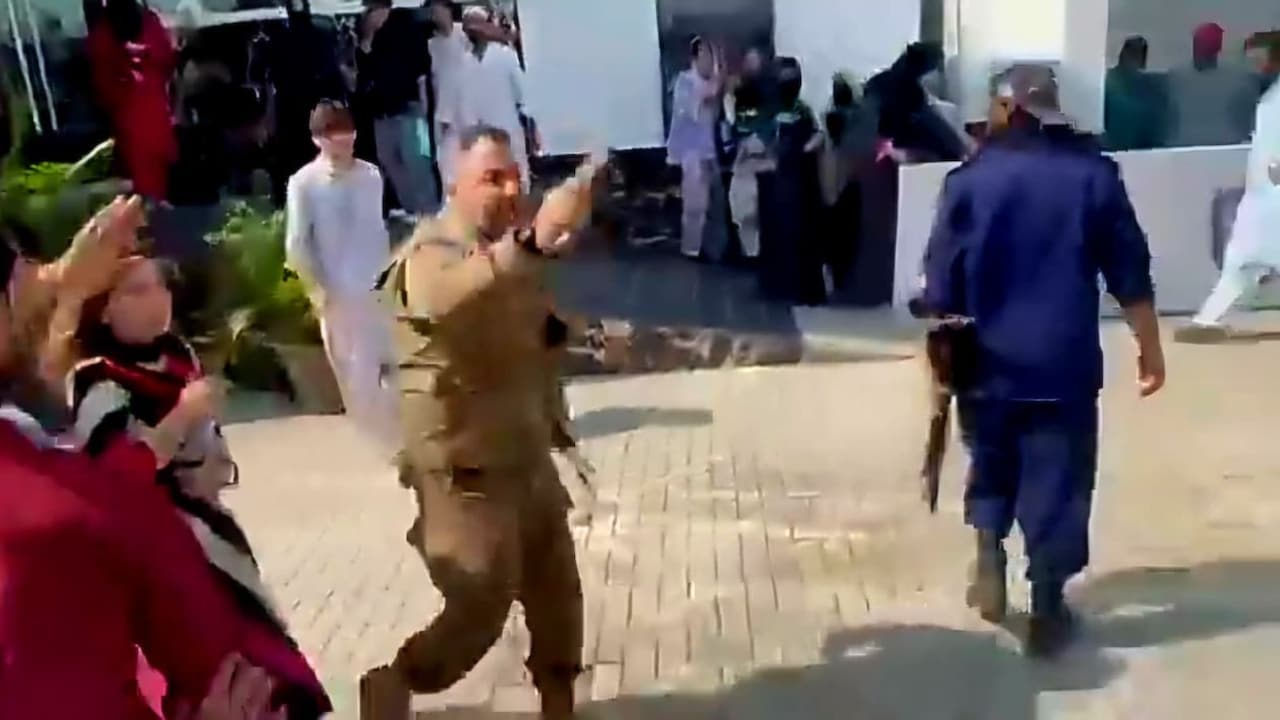
The air in the garrison town was heavy, thick with the kind of summer humidity that makes tempers fray before the sun has even climbed to its peak. Outside the compound walls, a low rumble was building—not yet a roar, but the steady, rhythmic murmur of hundreds of young voices demanding to be heard. Students. They carried no weapons save for their placards, their fury born of economic despair and futures slipping through their fingers like dry sand.
Inside a modest home just blocks away, another kind of pressure was mounting.
Captain Farhan sat at a small kitchen table, staring down at a cold cup of tea. His boots, polished to a mirror shine that reflected the harsh fluorescent bulb overhead, felt like lead weights. For months, the burden of a nation's fracture had rested on his shoulders. He was an officer of the Pakistan Army, a man trained in logistics, tactical deployment, and the cold calculus of command. But command does not prepare you for the grocery bill. It does not teach you how to look your children in the eye when the price of flour has doubled in a fortnight.
His wife stood by the counter, her hands gripping the edge of the laminate table so hard her knuckles turned white.
"They are outside," she said, her voice barely a whisper, yet it cut through the silence of the room sharper than a bayonet. "The boys from the college. They are shouting about the electricity tariffs. They are shouting about bread."
Farhan didn't look up. "That is a matter for the civil administration. The police are handling the perimeter."
"The police are running out of tear gas, Farhan," she snapped, turning to face him, the exhaustion of a dozen deferred dreams etched into her face. "You want to sit here and drink tea while the world burns down our doorstep? Go out there. Use your authority. Make them stop. Do something."
It was a demand born of desperation, not logic. In a country where institutions bleed into one another, where the boundary between civilian governance and military might has long since blurred into a smear of khaki and bureaucracy, families of servicemen feel the friction of the streets just as sharply as anyone else. To her, her husband was not just an army officer; he was a symbol of order in a land sliding into chaos. If he could not fix the street outside, what good was the uniform hanging in the closet?
The argument escalated, sharp and jagged, fueled by months of sleepless nights and unpaid anxieties. When Farhan finally stood, the chair scraped violently against the floor. He grabbed his sidearm—standard issue, meant for external enemies, meant for the borders far away in the rugged mountains—and stepped out into the blinding afternoon glare.
He walked straight into the flashpoint.
What happened next is a grim study in what occurs when the state turns its internal mechanisms against its own children. The protest was not an insurrection; it was a cry of pain. But pain, when met with a loaded barrel and a frayed nerve, does not subside. It detonates.
When the shots rang out, the narrative of the nation fractured a little more.
We must pause here and ask ourselves what we are actually looking at when a headline reads like a dispatch from a failed state. We see a man in uniform, a wife at a breaking point, a crowd of students seeking dignity. But beneath the sensationalism of the report lies a deeper, more terrifying pathology: the militarization of daily civilian life.
Consider the sheer weight placed upon the shoulders of the military rank and file in Pakistan. For decades, the institution has expanded its footprint not merely as a defense force, but as the ultimate arbiter of national stability. From managing wheat distribution to overseeing election logistics, the army is everywhere. When the civilian administration falters—whether due to corruption, incompetence, or structural collapse—the default reflex of the state is to drop the heavy hand of military authority onto the problem.
And so, soldiers find themselves policing their own neighbors, their own cousins, the very youth they are ostensibly sworn to protect.
The psychological toll of this dynamic is rarely calculated in official reports. Imagine living in a pressure cooker where you are simultaneously expected to be the savior of the economy, the enforcer of public order, and a provider for a family whose purchasing power evaporates by the day. The stress fractures run deep through the barracks. They manifest in sudden outbursts, in domestic friction, and tragically, in bullets fired into the concrete of a public street when the frustration of home spills over into the arena of public dissent.
The students who gathered that day were not terrorists. They were young men and women reading poetry by Faiz Ahmed Faiz on their smartphones, worrying about semester fees, watching their parents calculate whether to buy medicine or gas. When they saw an army officer step into the street with a weapon drawn, they didn't see a protector. They saw the mask slip. They saw the state admit that it had no language left to speak to its youth except the language of coercion.
Chaos ensued in seconds. A warning shot fired into the asphalt intended to clear the road instead shattered the fragile social contract binding the community together. Panic replaced protest. Screams bounced off the crumbling colonial-era facades of the town's main boulevard.
By evening, the street was clear. The blood had been washed away from the asphalt by a careless municipal truck, leaving behind only scattered flip-flops and torn pamphlets bearing the demands of the student union.
Farhan sat back down at his kitchen table hours later. The tea was gone. The house was dead silent. His wife sat in the corner of the room, staring at the wall, the anger completely drained out of her, replaced by a hollow, numbing shock.
Neither of them spoke of what had happened. In a culture steeped in institutional loyalty and the preservation of face, the incident would likely be sanitized in official logs as a "security disturbance" or a "brief exchange with miscreants." The media would cycle through the footage for twenty-four hours, pundits would pontificate on morning talk shows about the erosion of law and order, and then the news cycle would devour itself, moving on to the next atrocity, the next inflation metric, the next political intrigue.
Yet, nothing was fixed.
The fundamental crisis of the region remains untouched by gunfire. You cannot shoot a failing economy back into health. You cannot arrest rising temperatures or legislate away the desperation of a generation locked out of the future. When the instruments of national defense are dragged into the gutters of domestic civil unrest, everyone loses. The soldier loses his humanity. The citizen loses her right to dissent. The state loses its legitimacy.
We are left with the aftermath of a single domestic argument that metastasized into a public tragedy. It is a cautionary tale of a society stretched past its elastic limit, where the distance between the kitchen table and the battlefield has been reduced to zero.
As night falls over the garrison town, the generators hum their erratic tune against the backdrop of scheduled power outages. Somewhere down the dark street, a dog barks. Inside thousands of homes just like Farhan's, men and women sit in the dark, watching the shadows lengthen, waiting for the next spark to drop onto a floor already soaked in kerosene.
The uniform hangs in the closet, smelling faintly of gunsmoke and dust. The questions remain unanswered. And the street outside waits for morning.