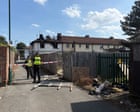
Midnight in Middlesbrough is rarely silent, but it is heavy. The air carries that specific, damp chill of an industrial autumn, clinging to brickwork and streetlamps alike. On nights like these, streets such as executor of quiet routines—rows of terraced houses breathing in tandem, windows fogged against the cold—usually sleep behind bolted doors.
Until they do not.
Consider what happens next: a sudden fracture in the dark. Sirens cut through the damp air, bouncing off narrow alleys, turning ordinary brick into jagged shadows of red and blue. By morning, the neighborhood is no longer just a place where people live. It is a scene. Yellow tape flutters in the draft. Investigators move with measured, heavy steps, looking for answers in ash.
Two lives ended inside a Middlesbrough house fire. That is the raw, unvarnished skeleton of the report. Two people, breathing and planning their tomorrows just hours prior, reduced to a headline in a morning briefing. But the fire department did not leave when the embers cooled. Neither did the detectives.
Because beneath the burnt timber and melted glass lies a darker, heavier question.
The Thread Across the Asphalt
Miles away, on the A66, a stretch of road known for its sweeping curves and relentless transit traffic, another kind of violence had already left its mark. A crash. Metal twisted into grotesque sculptures. Skid marks frozen in time.
At first glance, a house fire and a highway collision belong to different worlds. One is domestic, contained within four walls and fueled by misfortune or malice. The other is dynamic, a kinetic disaster born of speed, fatigue, or split-second human error. Investigators, however, live in the space between coincidences. They know that when two catastrophic events occur within proximity—geographically and temporally—the human mind desperately wants them to be separate.
Logic demands proof before panic. Yet intuition whispers caution.
Police are not ruling out links.
Those ten words carry a quiet weight. They are not an accusation. They are an admission of uncertainty. In moments like these, investigators become archetypes of doubt, sifting through digital footprints, CCTV feeds from petrol stations along the route, and mobile phone pings that trace invisible lines across the county.
Imagine standing in a room filled with fragments. A charred floorboard. A shattered windshield. A phone call made at 2:00 AM. To the untrained eye, they are unrelated debris. To a seasoned detective, they are pieces of a puzzle being forced together by invisible hands.
The Anatomy of a Suspicion
Why would a house fire connect to a highway crash?
To understand the investigators' hesitation, we have to look past the smoke and examine how modern chaos operates. Crimes and tragedies do not always happen in straight lines. They loop. They intersect.
When emergency services arrived at the Middlesbrough blaze, the scale of the devastation immediately elevated the response from standard firefighting to a criminal inquiry. Fire is a merciless eraser. It hides intent behind soot. It turns murder into an accident or an accident into a mystery. Forensic teams sift through the debris millimeter by millimeter, searching for accelerants, looking at burn patterns that tell stories of how the flames moved, where they started, and whether they were invited.
Simultaneously, the A66 crash investigation was yielding its own anomalies. Vehicles involved in high-stakes incidents often carry histories. Who was inside? Where were they coming from? What relationships, debts, or secrets tied the asphalt to the threshold of that residential door?
We want our tragedies to be neat. We want them to have single causes, clean boundaries, and easy closures. Life refuses to cooperate.
The Human Cost Behind the Tape
It is easy to get lost in the machinery of investigation—the forensics, the press releases, the speculative whispers bouncing across local social media groups. We talk about leads, timelines, and jurisdictional overlaps as if we are discussing a chessboard.
Step back. Look past the yellow tape.
In every neighborhood, residents stand on pavements in their slippers, arms crossed against the cold, watching strangers in white overalls comb through what used to be a home. They whisper to each other. They remember the sound of a door closing late at night, a car idling too long at the curb, an argument muffled by plaster and lath. They realize how fragile the boundary is between the ordinary rhythm of an evening and total catastrophe.
The two people who died in that house are not just statistics in a coroner's ledger. They were daughters, sons, friends, or neighbors. They had routines. They had unfinished cups of tea left on counters. Their absence now creates a vacuum in the community—a heavy, echoing silence that no official police statement can fill.
When authorities state they are keeping an open mind, they are acknowledging this human reality. They are saying: We see the grief, and we refuse to rush to a comforting conclusion until we have the hard, uncomfortable truth.
The Echoes That Remain
As the investigation grinds forward, the intersection of the Middlesbrough fire and the A66 collision remains shrouded in cautious speculation. Detectives work behind closed doors, matching forensic timelines with witness statements, building a timeline that stretches across miles and hours.
Maybe the connection is real. Maybe it is a ghost born of coincidence, a phantom link that will dissolve once the final forensic reports clear the air.
Regardless of the outcome, the impact lingers. The residents of that Middlesbrough street will look at their front doors differently tonight. Drivers navigating the dark stretches of the A66 will glance a little longer at the tarmac, mindful of how quickly a journey can turn sideways.
Some questions do not end with a period. They linger in the smoke, waiting for the wind to finally clear the view.