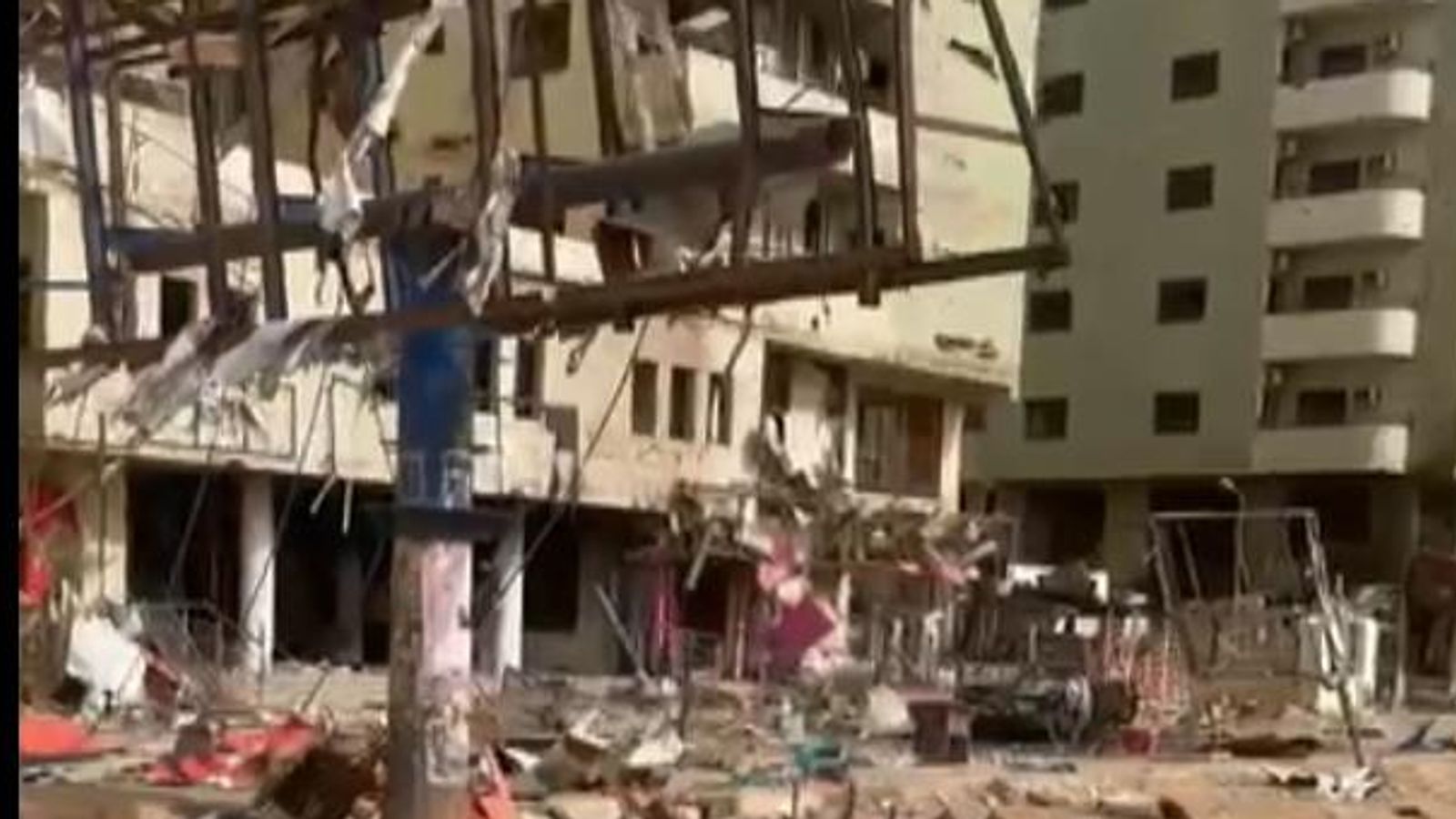
The coffee in the Jabra district used to taste like a promise. For nearly three months, the residents of Sudan’s capital had begun to reclaim the small, quiet rituals of survival. They walked a little slower. They looked at the horizon without squinting for the telltale glint of predatory wings. In the strange, fragile lull that had settled over Khartoum, the city was breathing again, however shallowly.
Then the humming started.
It is a sound that defies the majesty of aviation. It isn't the deep, chest-thumping roar of a fighter jet or the steady thrum of a cargo plane. It is a thin, mechanical whine, like a swarm of angry wasps trapped in a glass jar. It is the sound of a drone. When that sound returned to the skies above the Khartoum International Airport this week, it didn't just break the silence. It shattered the illusion that the war had moved on.
The Ghost in the Hangar
To understand why a few small aircraft hitting a runway matters, you have to understand the airport itself. In any other city, an airport is a gateway. In Khartoum, it is the heart of the ribcage. It sits in the center of the urban sprawl, a sprawling expanse of tarmac and hangars that has become the ultimate prize and the ultimate curse.
For months, the airport had been a graveyard of scorched fuselages and silent control towers. The "relative calm" the international media likes to cite wasn't peace. It was a stalemate. It was the exhaustion of two giants—the Sudanese Armed Forces (SAF) and the Rapid Support Forces (RSF)—catching their breath while the people underneath them tried to remember what it felt like to sleep through the night.
But drones are the weapons of the restless. They are cheap, they are cold, and they are terrifyingly precise. When the recent wave of suicide drones—loitering munitions, to use the antiseptic military term—slammed into the airport facilities, they weren't just targeting infrastructure. They were sending a message to every family in the surrounding neighborhoods: We can touch you whenever we want.
The Calculus of a Plastic Bird
Consider a hypothetical shopkeeper named Omar. For ninety days, Omar had stopped flinching at every motorcycle engine. He had started stocking more than just the bare essentials, thinking perhaps the supply lines from the north might hold. Then comes the strike.
From a tactical perspective, the drone is a marvel of efficiency. It costs a fraction of a missile. It requires no pilot to risk their life. It can hover, waiting for the perfect moment to dive. But for Omar, the drone is a psychological scalpel. It removes the one thing a human being needs to endure a siege: the ability to predict the next five minutes.
The strike on the airport represents a shift from traditional territorial warfare to a digitized, remote-control nightmare. The SAF and RSF are no longer just fighting for streets; they are fighting for the frequency. The sky, once a source of shade and rain, has been weaponized into a 24-hour surveillance feed.
Why the Silence Failed
The world often views African conflicts through the lens of "ancient animosities" or "tribal friction." This is a lie. What is happening in Khartoum is a high-tech proxy war played out in one of the most ancient settings on earth. The three-month lull wasn't a move toward diplomacy. It was a logistical pause.
Both sides have spent that time scouring the global market for the very tech that just lit up the Khartoum skyline. We are seeing the "Ukrainization" of African warfare. Small, consumer-grade drones modified with 3D-printed release hooks and mortar shells. Long-range Iranian and Turkish models that can stay aloft for a day, watching, waiting, and eventually, screaming toward the earth.
The tragedy of the "relative calm" is that it gave the world an excuse to look away. When the bombs aren't falling every hour, the news cycle moves to the next shiny disaster. But while the cameras were off, the hangars were being filled. The batteries were being charged.
The Invisible Stakes of a Tarmac
You might wonder why anyone would bother bombing an airport that hasn't seen a commercial flight in over a year. The answer lies in the grim logic of the siege. If the airport is operational, it is a lifeline for heavy weapons and foreign "advisors." If it is a cratered mess, it is a wall.
By hitting the airport now, the attackers—widely believed to be the RSF using advanced drone tech—are signaling a new offensive. They are cutting the strings of the SAF’s aerial advantage. They are blinding the giants.
But look closer at the smoke rising from the runway. It isn't just jet fuel burning. It is the hope of the humanitarian corridors. Every time a drone finds its mark on that tarmac, the distance between a starving child in Omdurman and a bag of grain grows by another hundred miles. The airport is the only place large enough to coordinate the scale of aid needed to stop a famine that is currently stalking the country like a shadow.
The Sound of the Future
There is a specific kind of horror in being hunted by a machine. A soldier can be reasoned with, or feared, or outmaneuvered. A drone is a line of code with a payload. It doesn't get tired. It doesn't feel the heat of the Sudanese sun. It just executes a command.
The residents of Khartoum are now living in a laboratory for 21st-century urban collapse. They are the first to experience what happens when the democratization of flight meets the total breakdown of the nation-state. It is a world where a teenager with a controller can paralyze a capital city.
The calm was never real. It was just the sound of the world holding its breath before the plunge. As the drones continue to circle, the people of Jabra and beyond are retreating back into the windowless rooms, back into the basements, back into the dark.
The humming has returned, and it is louder than it was before. It is the sound of a city being told that its temporary peace was merely a clerical error.
A single drone hovers over the Nile, its camera lens reflecting the sunset, watching a lone fisherman pull his net. The machine doesn't blink. It doesn't move. It simply waits for the next set of coordinates to arrive from a hundred miles away. The fisherman doesn't look up. He already knows what is there. He has learned that in the new Khartoum, the sky is no longer part of the natural world. It is a ceiling made of glass, and someone, somewhere, is holding the hammer.