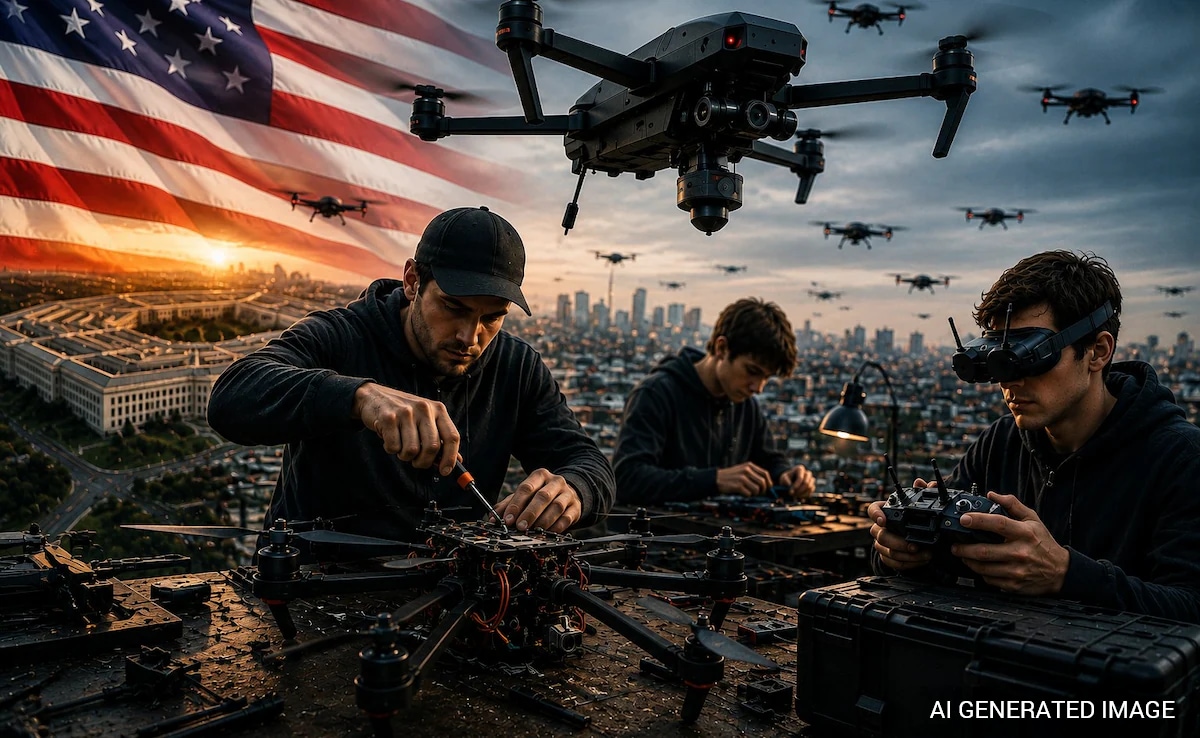
A standard windowless room in Virginia holds a screen showing a gray, digital map of an unnamed coastline. A young technician clicks a mouse. On the other side of the world, a shipping container mimics a sigh, its hydraulic lid swinging open to the sky.
Nothing happens for three seconds. Then, a high-pitched whine begins, like a million angry hornets trapped in a jar.
One by one, small, identical shapes rise into the air. They do not fly with the majestic, sweeping arcs of traditional fighter jets. They buzz. They hover. They communicate with each other in a language of pure data, shifting into a tight, fluid formation that looks less like military aviation and more like a starling murmuration over an autumn field.
This is Replicator. It is the Pentagon’s $54 billion gamble to fundamentally rewrite the physics of human conflict.
For decades, modern warfare relied on a simple premise: build the biggest, most expensive, most technologically advanced machine possible, and use it to dominate the battlefield. We built billion-dollar stealth bombers and multi-billion-dollar aircraft carriers. We treated these machines like crown jewels.
But a quiet shift in Ukraine and Taiwan changed the math. Cheap, off-the-shelf drones carrying taped-on explosives began destroying armored vehicles worth millions. The realization hit global military capitals like a physical blow. The era of the solitary, exquisite weapon system is drawing to a close.
The new strategy does not rely on a single, indestructible shield. It relies on a flood.
The Math of Mass
To understand why the military is pivoting toward thousands of expendable flying machines, you have to look at the cold math of a saturation attack.
Imagine a state-of-the-art naval destroyer. It is equipped with the finest radar systems on earth and a magazine full of surface-to-air missiles, each costing upwards of a million dollars. It is an apex predator of the seas.
Now, imagine that destroyer is targeted by a swarm of five hundred low-cost drones.
The ship’s radar tracks them instantly. The crew fires. A million-dollar missile obliterates a drone that cost less than a used car. Another missile fires. Another drone vanishes. The system works perfectly.
Until the ship runs out of missiles.
That is the terrifying simplicity of the swarm. It forces an adversary into an impossible economic and logistical corner. You cannot shoot down a thousand targets when you only carry a hundred interceptors. The swarm wins not through superior firepower, but through sheer, overwhelming numbers. It is attrition accelerated to the speed of silicon.
The Department of Defense calls this "attritable" tech. In plain terms, it means the military expects these machines to die. They are built to be used once and destroyed, acting as kinetic weapons—flying bombs—that can hunt in packs.
The scale of the investment is staggering. The Pentagon is funneling billions into manufacturing these systems at a pace the Western defense industrial base hasn't seen since World War II. The goal is to produce thousands of these autonomous systems within short, eighteen-to-twenty-four-month windows.
The Ghost in the Machine
But the real problem lies elsewhere. It is not a challenge of manufacturing plastic wings or electric motors. The true friction point of a fifty-four-billion-dollar drone swarm is the human mind.
Consider what happens next when a single human operator tries to control a swarm.
In traditional drone warfare, a pilot and a sensor operator sit in a trailer, controlling one single aircraft. They monitor its fuel, its cameras, its weapons. Now, scale that up. How does one human being pilot five hundred drones simultaneously?
They cannot. The human brain is a bottleneck.
To make a swarm work, the military must hand over the reins of flight and coordination to artificial intelligence. The drones must be able to talk to each other, distribute tasks, and adjust their flight paths in real-time without waiting for a human to click a button. If drone twenty-two gets shot down, drone twenty-three must automatically alter its trajectory to fill the gap in the line.
This shifts the role of the human from a pilot to something resembling a digital sheepdog. The operator sets the intent—"scour this valley" or "protect this perimeter"—and the swarm figures out how to execute the command.
This is where the psychological comfort of traditional command structures begins to fracture. For centuries, military hierarchy was built on absolute accountability. A commander orders a captain, who orders a squad. Everyone has a name. Everyone has a rank.
When an autonomous swarm disperses over hundreds of square miles, making micro-decisions every millisecond based on algorithms that even their creators cannot fully map out in real time, accountability becomes a ghost.
We find ourselves entering an era where the weapons themselves are calculating the tactics.
The Weight of the Unseen
Walking through the tech corridors where these systems are dreamed up, you quickly notice a strange contrast. The engineers are young, enthusiastic, and fueled by caffeine. They talk about "swarming logic," "mesh networks," and "distributed lethality." They view the problem through the clean, elegant lens of geometry and computer science.
But if you speak to veterans who have watched the evolution of drone warfare over the last two decades, the tone shifts. They remember when drones were slow, clunky eyes in the sky used purely for surveillance. They watched those eyes get teeth. Now, they are watching those teeth multiply by the thousands.
There is an eerie detachment to it all. A swarm does not possess malice. It does not possess courage. It operates with the terrifying neutrality of an Excel spreadsheet.
For a soldier on the ground, the psychological toll of this weapon is entirely different from artillery or traditional airstrikes. You cannot hide from a swarm in a trench. It can split apart, enter buildings, hunt through forests, and wait patiently on a hillside until its sensors detect heat or motion. It turns the very air around you into a persistent, malignant threat.
The strategic gamble is that this horror will act as the ultimate deterrent. The Pentagon’s explicit focus for Replicator is the Indo-Pacific. The goal is to make a cross-strait invasion so logistically nightmarish, so costly in assets and momentum, that an adversary will look at the sky and decide the attempt isn't worth the price. We are building an automated wall of denial.
The Horizon of the Autonomous Age
The money is already moving. Contracts are being signed. Small, agile tech startups are beating out traditional defense giants because they can code faster and iterate in weeks rather than fiscal quarters. The American military apparatus is trying to behave like a Silicon Valley software company, shedding its slow, bureaucratic skin to survive a fast, cheap future.
Yet, we are left standing on a profoundly uncertain shoreline.
History shows us that every time a nation invents a revolutionary way to wage war, the rest of the world does not simply sit by and watch. Technology democratizes faster than policy can adapt. The components that make up these swarms—small lithium batteries, commercial GPS chips, carbon fiber, open-source AI models—are available to anyone with an internet connection and a credit card.
The tools we are designing to flood the skies of our adversaries will inevitably find their way into the skies above us.
The Virginal technician closes the laptop program. On the screen, the gray coastline returns to a peaceful, empty grid. But the air outside the window feels different now. It feels heavy with the realization that the sky above our heads will never be truly empty again, filled instead with the quiet, persistent hum of choices we can no longer take back.