Inside the hull, it smells of scorched hydraulic fluid, wet canvas, and the sharp, metallic tang of ozone. It is a smell that hasn't changed since the autumn of 1916, when British tracks first churned the mud of the Somme.
But outside, the world has altered entirely.
A modern battlefield is a hyper-visible nightmare. Above the treeline, a three-hundred-dollar drone, buzzing with the cheap persistence of a backyard hornet, can spot a thermal signature from miles away. It relays those coordinates to automated artillery in less than sixty seconds. For thirty years, military theorists sat in air-conditioned auditoriums and declared that the age of the heavy tank was over. They called it an anachronism. A massive, expensive target. A rolling coffin.
Then Europe woke up to the sound of heavy artillery on its doorstep, and the theorists fell silent.
Deep within the gray, rain-lashed expanses of Salisbury Plain, Britain’s defense establishment is currently trying to answer a terrifyingly simple question: How do you make sixty tons of steel survive in an era where everyone can see everything?
The answer is rolling through the heather right now. It is called the Challenger 3.
The Weight of the Invisible
To understand what is happening in the current live-fire trials in Southwest England, you have to understand the mind of a tank crew.
Consider a hypothetical loader—let’s call him Corporal Miller. In the older Challenger 2, Miller’s job was a frantic, physical rhythm. Lift the shell. Ram the shell. Charge the breech. It was a dance performed in a vibrating steel box while the world exploded outside. If a drone spotted Miller’s tank, the crew relied on thick plates of Chobham armor to absorb the blow. It was a philosophy of passive endurance.
But endurance isn't enough anymore. Top-attack missiles and loitering munitions don't strike where the armor is thickest; they strike from above, piercing the thin roof of the turret.
The Challenger 3 changes the philosophy from endurance to active defiance. During the recent battlefield drills, observers didn't just watch a tank shoot at targets; they watched an integrated digital node operating within a massive, invisible web.
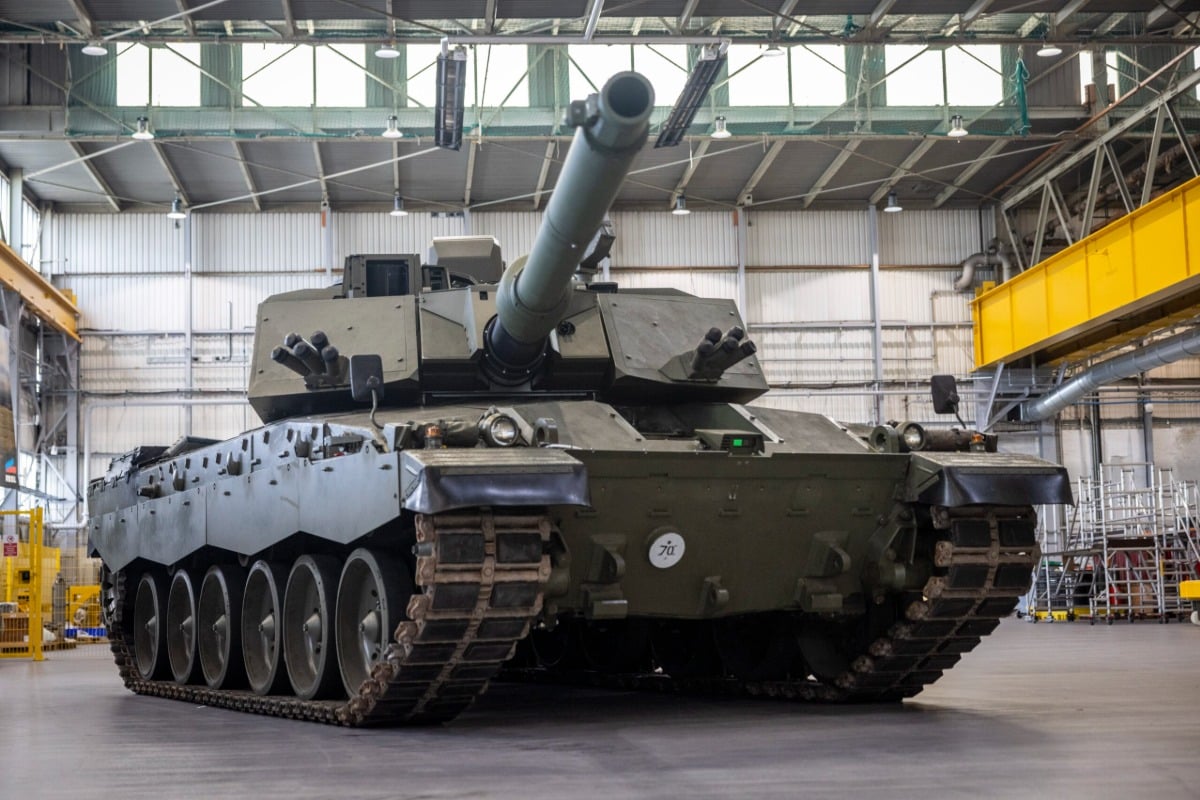
The new vehicle, built by Rheinmetall BAE Systems Land (RBSL), is essentially a completely new machine wearing the heavy boots of its predecessor. The hull has been stiffened and overhauled, but the turret is an entirely fresh creation. It features a smoothbore 120mm gun, replacing the traditional rifled barrel that Britain stubbornly clung to for decades.
This change sounds dry on paper. It isn't.
A smoothbore gun means the Challenger 3 can finally fire the same advanced, programmable ammunition used by NATO allies. Imagine a shell that doesn't just explode on impact, but can be told exactly when to detonate—whether that is a microsecond after punching through a concrete wall, or directly above a trench line.
But the real evolution isn't the gun. It is the skin of the beast.
The Digital Shell
The trials on Salisbury Plain have been testing more than just driving and shooting. They are testing the limits of human situational awareness.
In older armor, looking outside meant peering through narrow, bulletproof glass periscopes or sticking your head out of a hatch—a great way to get killed by shrapnel. The Challenger 3 wraps its crew in a digital cocoon. High-resolution day and thermal cameras feed 360-degree imagery directly to screens inside the hull.
But human eyes can only track so much. When three drones are descending from different angles, two anti-tank teams are creeping through a tree line, and an enemy tank is masking its heat signature behind a burning building, the human brain short-circuits.
This is where the new architecture steps in. The tank's internal systems automatically flag threats, prioritizing them by lethality. It tells the commander which target to destroy first, which to blind with smoke, and which to leave to escort vehicles.
Then there is the active protection system. During these drills, the military has been refining the integration of the Trophy system—a mechanism that detects incoming missiles using miniature radar panels. When a missile flies toward the tank, the system fires a tight cloud of small pellets to shred the threat in mid-air, yards away from the steel skin.
It is a terrifying concept to witness. The tank effectively shoots down bullets with its own bullets, inches from its own crew.
The Cold Reality of the Ledger
We must be honest about the anxiety underlying this project. The British Army has shrunk to its smallest size since the Napoleonic era. Money is tight, inflation has eaten away at procurement budgets, and the decision to upgrade only 148 of these vehicles has drawn fierce criticism from defense analysts.
Is 148 enough?
If a large-scale conflict breaks out, a hundred and forty-eight tanks can disappear in a few weeks of high-intensity attrition. The Ministry of Defence is gambling on quality over sheer mass. They are betting that one Challenger 3, linked digitally to infantry drones, artillery batteries, and F-35 fighter jets, can hold a line that used to require a whole regiment.
It is a fragile assumption. Technology fails. Mud gets into optical sensors. Power grids collapse. When the digital web goes dark, the crew is left with nothing but their training, their guts, and the thickness of their steel plates.
But watching the pre-production models tear through the chalky dirt of the British countryside, it becomes clear that this isn't just an incremental update. It is a frantic race to keep pace with a style of warfare that changes every six months on the battlefields of Eastern Europe.
The crews operating these prototypes know the stakes. They know that the lessons learned during these current drills will dictate whether they survive the opening hours of a future conflict, or whether they become another charred statistic on a satellite feed.
The engines roar, a deep, earth-shaking rumble that vibrates through the soles of your boots long before the vehicle appears over the ridge. The barrel stabilizes, tracking an invisible point on the horizon with the eerie, smooth precision of a predatory bird.
Sixty tons of computing power and armor plate plunge into a ditch, kicking up a wall of black mud, before surging upward toward the crest of the hill, chasing a future where survival is measured in milliseconds.