The quietest place on earth is a pediatric surgical theater right before the first incision.
Outside the doors of King Abdullah Specialist Children’s Hospital in Riyadh, the world moves with its usual chaotic momentum. Traffic hums. Phones beep. People rush toward ordinary destinations. But inside Operating Room number four, time operates on a completely different scale. It slows down. It stretches. Every breath taken by the surgical team is deliberate, muffled by sterile masks, because they are about to attempt something that defies the regular order of human nature.
They are about to separate two lives that were never supposed to be distinct.
We often take our individuality for granted. We wake up, move our limbs, and walk away from others without a second thought. Our bodies belong entirely to us. But for a pair of conjoined twins, identity is a shared estate. Every heartbeat, every shift in weight, and every breath is a negotiation. To separate them is not just a medical procedure; it is a profound philosophical intervention. It is the act of giving two human beings their own independent horizons.
The clock on the wall reads exactly 07:30. The countdown begins.
The Weight of the First Minute
To understand the immense gravity of a six-hour separation surgery, you have to look past the steel instruments and the blinking monitors. You have to look at the parents.
Imagine standing in a sterile corridor, holding everything you love in a single, tangled bundle. You are handing them over to a team of people in green scrubs, knowing that the next time you see them, they will either be two separate individuals or they might not be there at all. The vulnerability of that moment is staggering. It is a terrifying, dizzying leap of faith. As a parent, you are asking a team of strangers to rewrite the anatomy of your children.
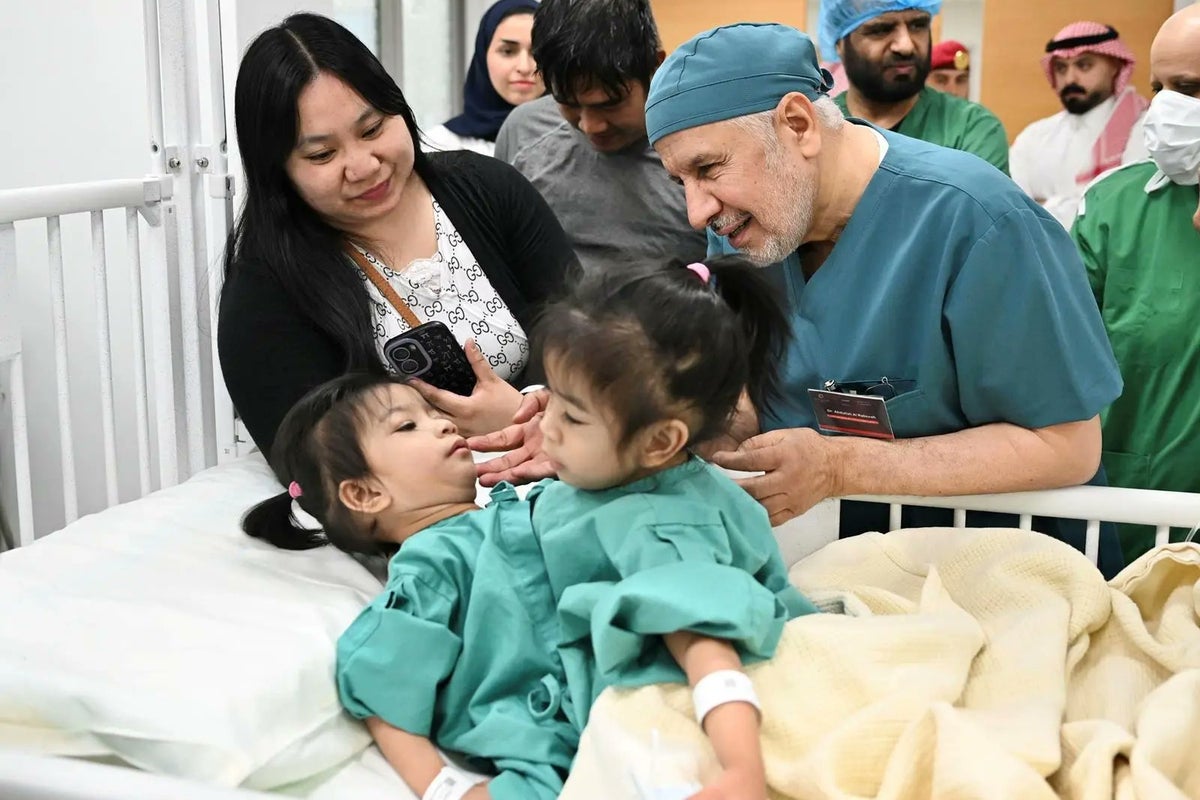
Dr. Abdullah Al-Rabeeah, leading a specialized team of Saudi surgeons, consultants, and nursing staff, knows this weight intimately. He has stood in this exact spot dozens of times before. Yet, familiarity does not breed comfort in a field where a single millimeter dictates the boundary between survival and tragedy.
The twins are joined at the lower abdomen and pelvis. They share vital tissue, a complex web of blood vessels, and an intricate map of nerves that must be meticulously traced, isolated, and divided. The human body does not come with a blueprint for anomalies. The team cannot rely solely on textbooks. They must rely on their collective intuition, sharpened by years of looking at what makes us whole.
The anesthesia takes hold. The room settles into a rhythmic, mechanical hum.
The Anatomy of Isolation
Medical separation is a drama played out in phases. It is a slow, methodical dismantling of a shared existence.
Consider the sheer logistics of the operation. You cannot simply cut. If you sever a single blood vessel too early, one twin’s blood pressure spikes while the other’s plummets. The team must act like two separate orchestras playing the exact same symphony in perfect synchronization. One group of doctors monitors Twin A; another watches Twin B. They must communicate without speaking over one another, balancing two lives on the tip of a single scalpel.
By the second hour, the surgery enters its most critical phase: the separation of the shared organs and the pelvic bone.
This is where the true mastery of the surgical team reveals itself. They are not just cutting away; they are reconstructing. They must ensure that once the physical bond is severed, each child has enough skin, muscle, and tissue to cover the newly exposed vulnerabilities. It is an intricate puzzle where the pieces must be created out of what already exists. The surgeons use microscopic sutures, finer than a strand of human hair, to re-route blood vessels, ensuring that each independent circulatory system can sustain itself.
The tension in the room is palpable, thick enough to cut. Minutes bleed into hours. The monitors continue their steady, reassuring beep, but everyone knows how quickly a flatline can replace that rhythm.
The Moment of Disconnection
Then comes the moment that everyone has been working toward. It is the fourth hour.
With a final, precise movement, the last physical connection is dissolved. For the first time since their conception, the twins are no longer one entity. They are two.
An extraordinary shift happens in the operating room the exact instant the separation is complete. The single surgical table is parted. The team divides cleanly into two distinct units. Suddenly, there are two tables, two sets of monitors, two independent lives requiring undivided attention. The space between the two tables is only a few centimeters wide, but it represents an entire universe of independence.
But the work is far from over. The void left behind must be closed.
The plastic surgery team steps forward. This is the art within the science. They must reshape the contours of the children’s bodies, closing the wounds and creating a new physical reality for each child. They work with a quiet urgency. Every minute the children remain under anesthesia increases the risk of complications, yet haste is the enemy of healing. They sew, layer by layer, muscle by muscle, skin by skin.
Beyond the Steel and Gauze
When the final stitch is tied and the clock marks the end of the sixth hour, a collective exhalation ripples through the room. The surgery is a success. The twins are stable. They are moved to the pediatric intensive care unit, where a new kind of vigil begins.
This achievement is not just a victory for a single hospital or a specific group of doctors. It is a testament to what happens when human ingenuity is backed by immense institutional will. Saudi Arabia’s humanitarian program for conjoined twins has become a global beacon for these rare, complex cases, drawing families from every corner of the earth who are searching for a miracle that feels entirely out of reach.
But the real story does not end when the surgical lights are turned off.
The true climax of this journey happens days later, in a quiet recovery room. The anesthesia has faded. The swelling has gone down. The parents are permitted to enter the room, their hearts in their throats. They walk past the monitors and the IV stands, approaching the two separate cribs that have replaced the single one they used to know.
They look down at their children. For the very first time, they can hold one child in their arms while the other rests peacefully nearby. They can look into one face without seeing the immediate reflection of the other's struggle.
The two children lie side by side, independent, breathing on their own, separate at last. Their hands reach out instinctively into the open air, searching for the familiar presence they have known since before they were born, finding only space, freedom, and the quiet promise of a future that belongs entirely to each of them.