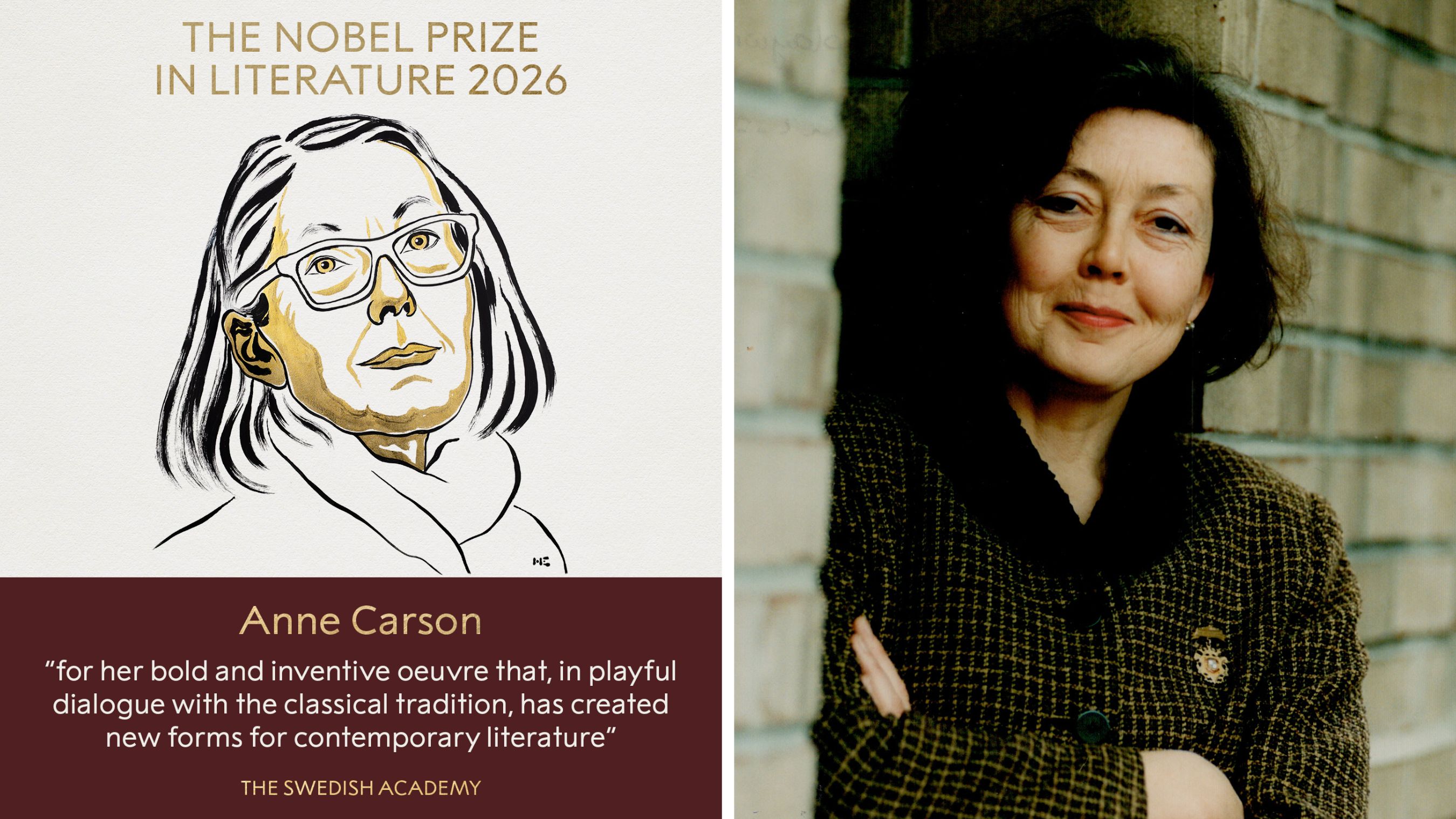
There is a specific kind of quiet that lives in the margins of a page. It is not the silence of an empty room, but the pregnant pause before a confession, the space where words have exhausted themselves and something older, heavier, takes over. Most writers build fortresses out of language. They stack adjectives like sandbags, mortar every sentence with cleverness, and dare the reader to find a way through the barricade.
Anne Carson does the opposite. She hands you a chisel.
When the Swedish Academy announced that Carson had won the 2026 Nobel Prize in Literature, the literary world did not erupt in the predictable, polite applause of a gala ballroom. Instead, there was a collective, breathless intake of breath, the kind of quiet that settles over a theater when the house lights go down and the stage remains bare. For decades, Carson has written from the borderlands where poetry, scholarship, translation, and grief collide. She does not write books you read on a commute; she writes artifacts you survive.
Consider what it means to translate ancient Greek in the middle of a modern grocery store or an airport terminal. You are standing among fluorescent lights and plastic packaging, holding words that were carved into stone or inked onto crumbling papyrus three millennia ago. You are listening to voices that have been dead so long their bones have turned to chalk. Carson has spent her life doing precisely this—not as a dusty academic locked in a university tower, but as an archeologist of the human heart who knows that Sappho's broken fragments are closer to our current loneliness than yesterday’s news headlines.
We live in an era addicted to noise. Every screen is a screaming billboard; every notification is a demand for obedience. We are drowning in content, yet starving for sense. Into this digital cacophony steps a woman who translated Euripides while working as a classical scholar, a poet who once published a novel in the form of an ancient Greek verse autobiography complete with photographs, drawings, and essays. She treats the page not as a flat surface for conveyance, but as a room you can enter, furniture you can break, windows you can shatter.
Think about Autobiography of Red. When it arrived in 1998, it did not just disrupt poetry; it detonated the boundary between what we call story and what we call song. It took a mythical creature—Geryon, the red monster slain by Hercules—and gave him a vintage camera, a complicated heart, and the agonizing vulnerability of modern heartbreak. Geryon is not a monster from a distant myth. He is the person sitting three rows ahead of you on the subway, staring out a rain-streaked window, wondering why love always feels like a slow dismantling of the self.
Carson makes the ancient immediate because she understands a fundamental truth about human suffering: we haven't evolved past it. The grief that wept through the Trojan War is the same grief that wakes you up at three in the morning when a relationship ends. The jealousy, the sudden flashes of grace, the terror of mortality—these are not historical artifacts. They are the operating system of being alive.
Yet, to read Carson is to encounter an intellect that intimidates even as it liberates. She holds a doctorate in comparative literature. She reads ancient Greek as fluently as most people read their morning emails. But she wears her erudition like a loose sweater, comfortable and worn at the elbows. She is suspicious of easy conclusions. When she writes about desire, she calls it sweetbitter—a translation of Sappho’s glykypikros—because she knows that nothing truly transformative ever arrives unmixed with pain.
The Nobel Prize is often treated as a coronation, a gold watch handed to an aging artist at the end of a long career. But with Carson, it feels different. It feels like an admission by the establishment that the traditional categories of literature—fiction, poetry, essay, criticism—are little more than administrative fictions. Carson has spent her entire writing life ignoring those boundaries. Her books refuse to sit neatly on a shelf. Is it poetry? Is it philosophy? Is it visual art? Yes. All of it. None of it.
Imagine walking into a gallery where the paintings are made entirely of silence. You step up close, squinting against the white space, and suddenly you realize the canvas is breathing. That is the experience of reading Carson’s translation of the Oresteia, Agamemnon. She strips away the Victorian pomp that usually clings to classical tragedy and leaves raw bone. There are lines in her translations that hit you in the solar plexus so hard you have to put the book down and walk across the room. Not because the words are complex, but because they are terrifyingly, blindingly simple.
She teaches us that clarity is not the absence of mystery; it is the courage to look directly at it without blinking.
For years, readers who found their way to her work felt like members of a secret society. You didn't lend your copy of Eros the Bittersweet to just anyone; you handed it to someone only when you trusted them enough to see your own bruises. It was a book that mapped the anatomy of longing so precisely that it felt less like reading and more like being x-rayed.
Now, with the highest literary honor in the world resting on her shoulders, that secret is out. The Swedish Academy has pointed a massive, international spotlight at a writer who has spent her life cultivating shadows and quiet corners. One wonders how she feels about it. Carson has always guarded her privacy with the fierce dedication of a medieval knight defending a breached gate. She does not do social media. She does not court the spotlight. She writes. She thinks. She translates the dead back into our language.
And perhaps that is the real lesson of her victory. In a world that rewards volume, speed, and constant self-presentation, Anne Carson has won by remaining entirely, stubbornly unlocatable. She does not care about your algorithm. She does not care about your content calendar or your personal brand. She cares about the exact weight of a Greek vowel, the way light hits an old stone in the Peloponnese, and the terrifying, beautiful frequency of human desire.
When you close one of her books, the silence returns. But it is no longer empty. It is populated by ghosts and possibilities, by ancient kings and modern loners, all whispering in a language that suddenly makes sense of the dark. The noise outside your window will return, of course. The notifications will light up; the traffic will roar. But something inside the room has shifted. You have looked into the margin, and for a brief, blinding second, you saw the shape of your own soul staring back.