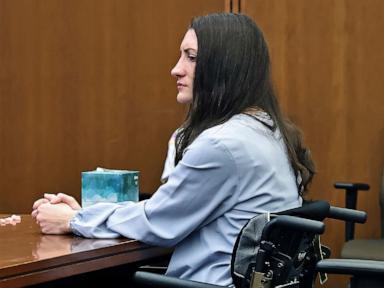
The fluorescent hum of a courthouse hallway at five o'clock in the evening has a distinct frequency. It is a dry, thin sound that hums against the base of the skull, vibrating through cheap linoleum and the worn wooden benches where families wait to hear the arithmetic of human tragedy. Behind a heavy, soundproofed oak door, twelve people are sitting in a room that smells faintly of old paper, cold coffee, and nervous sweat. They are arguing over the boundaries of a human mind pushed past its breaking point.
Then, the buzzer sounds.
The jurors file back into the courtroom, their eyes fixed on the floor, shoulders tight with the heavy ballast of an impossible choice. They have not reached a verdict. Not today. The judge thanks them, offers a brief caution about the night ahead, and sends them home to restless beds and quiet houses. Outside, the news vans idle against the curb, their satellite dishes pointing toward the dark sky like mechanical ears straining for a whisper from the void.
To read the headlines, it is a simple procedural stall. A day without a resolution. But behind that dry dispatch lies an agonizing human calculus that refuses to fit neatly inside the statutory boxes of the criminal code.
Consider what happens in a quiet kitchen when the world stops making sense.
We try to draw a sharp line between sanity and madness because it keeps us safe. It allows us to believe that the terrible things that happen in the shadows belong to a different species of human altogether. If a mother commits an unspeakable act, our instinct demands a simple narrative. Monster or victim. Evil or insane. Deliberate malice or tragic accident. We want the scales of justice to tip decisively, rewarding us with certainty.
Yet the human brain is not a precision instrument. It is a fragile organ vulnerable to biochemical storms, invisible fractures, and the terrifying abyss of postpartum psychosis.
In the courtroom, expert witnesses lean over mahogany stands and speak in clinical syllables. They parse the gray matter of medical records, prescription histories, and psychiatric evaluations. They talk about neurotransmitters and reality testing as if a mind in freefall can be charted like a weather pattern. But down in the pews, where the families sit with their hands clenched in their laps, the clinical terms dissolve into raw grief. There are no winners here. There is only a catastrophic collision between severe mental illness and the unyielding machinery of the law.
The jury is tasked with answering a question that defies easy measurement: Where does the disease end and the person begin?
When the panel was sent home for the day, they were carrying that exact paradox. They were wrestling with the terrifying realization that profound suffering can coexist with catastrophic outcomes. Every juror knows the stakes. They hold a life in their collective hands, balancing the demands of public accountability against the devastating reality of a fractured mind. It is a burden that lingers long after the courtroom lights go dark.
We check our phones for updates. We refresh the browser, hoping for a definitive headline that will restore order to the universe. Verdict reached. Guilty. Not guilty by reason of insanity. Closure.
Instead, we find the quiet pause of an unfinished deliberation.
That pause is uncomfortable because it forces us to look directly into the unmapped corners of human vulnerability. It reminds us that society’s safety nets are often gossamer thin, and that the distance between a normal Tuesday afternoon and an irrecoverable tragedy is terrifyingly short. The jurors are lingering in that uncomfortable space right now, wading through the debris of shattered lives, trying to find justice where perhaps only mercy and sorrow remain.
The hallway outside the deliberation room is empty now. The reporters have packed their cameras, and the footsteps have faded down the stairs. But inside the collective consciousness of a community watching from afar, the questions remain suspended in the air, waiting for a dawn that will demand an answer.