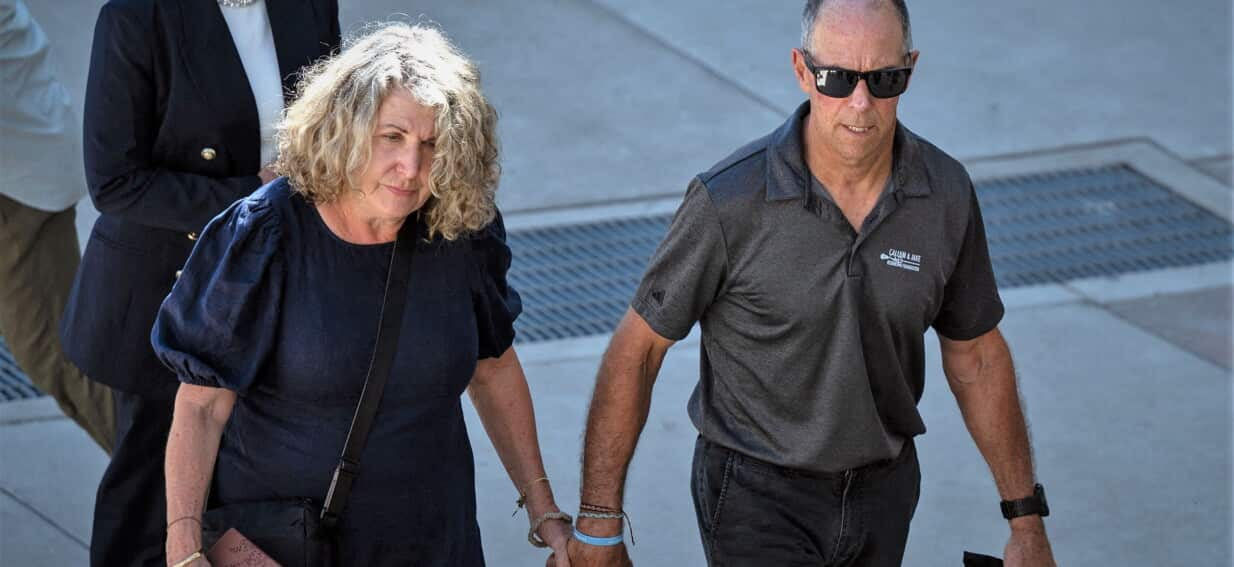
The courtroom air was thin, heavy with the weight of an arithmetic that never balances. Outside, the Australian sun beat down with its usual indifferent brightness, casting sharp shadows across concrete that felt entirely too ordinary for the tragedy attached to it. Inside, the parents sat shoulder to shoulder. They did not slump, exactly, but they leaned into one another like trees that had weathered a storm so fierce their roots had shifted permanently beneath the soil.
Callum Robinson, Jake Robinson, and Jack Carter. Three names. Three lives pruned back to memories before their seasons had even fully turned.
When the verdict finally dropped into the quiet room—guilty, the word flat and final—there were no cheers. There was no theatrical release of breath or slamming of fists. Instead, there was a collective tightening of jaws, a quiet folding of hands, and an immediate, deliberate choice.
They refused to speak the names of the men who had stolen their sons.
This is a story about that refusal. It is about what happens when justice is served by a court of law, yet the human heart finds itself utterly unmoored, drifting in an ocean of permanence. We tend to treat criminal trials as closures. We treat a guilty verdict like the final period at the end of a sentence, a neat grammatical signifier that tells us we can turn the page. But grief does not read punctuation. Grief keeps going long after the ink has dried.
Consider the geography of absence.
To understand what happened in that Mexican courtroom, you have to picture the trip. Baja California. Turquoise water curling over white sand, surfboards strapped to the roof of a beat-up truck, the salt-crusted freedom of young men who believed the world was an invitation rather than a hazard. Callum, Jake, and Jack were living out the golden myth of the Australian surfer abroad. They were chasing swells, sharing cheap meals, laughing in the dusk as the campfire popped against the dark.
Then came the violence. Random, senseless, predatory. A truck stolen, tents abandoned, bodies thrown down a remote well to hide the evidence of a robbery gone wrong.
When news travels across oceans, it arrives not as a narrative, but as a bomb. It shatters the kitchen table, the morning commute, the quiet Tuesday afternoon. For Martin and Debra Robinson, and for the Carter family, the world instantly split into two eras: Before and After.
The trial itself was an exercise in bureaucratic endurance. Months bled into one another. Translators droned. Evidence bags were brought forward—tattered clothing, surf wax, keys, the grim inventory of a ruined holiday. Every single hearing forced the families to walk back down into the dark, reliving the hours when their boys stopped breathing, stopped laughing, stopped answering their phones.
Yet, throughout this grueling ordeal, a quiet philosophy took shape.
In a media landscape that routinely rewards monstrosity with fame, the families made a conscious, radical pivot. They realized that perpetrators of senseless violence often crave an afterlife in infamy. They want their names whispered in fear, splashed across headlines, analyzed by criminologists, and debated by strangers. They want to occupy space in the collective consciousness long after the crime has faded.
The parents denied them that currency.
"We don't speak their names," they said.
Let that sink in. In a moment when every human impulse screams for vengeance, for screaming matches on courthouse steps, for curses hurled across a crowded room, these parents chose erasure. They starved the darkness of oxygen.
Instead, they spoke of waves. They spoke of Callum’s infectious laugh, of Jake’s steady loyalty, of Jack’s quiet kindness. They resurrected their boys not as victims of a gruesome crime, but as vibrant, breathing entities who had loved the ocean more than most people ever love anything.
This is the hidden cost of tragedy that statistics never capture. We tally the homicides. We log the conviction rates. We measure prison sentences in decades. But we rarely measure the quiet erosion of domestic spaces. We don't track the coffee cups left in the sink that nobody washes for a week because washing them feels like an admission that the person is gone. We don't quantify the heavy, suffocating silence that fills a hallway at three in the morning when the wind rattles the windowpane.
Martin Robinson stood outside the courthouse doors after the legal battle had concluded. The microphones were thrust forward, bristling like metal teeth. Reporters leaned in, hungry for venom, hungry for a soundbite that would sizzle on the evening news.
He didn't give it to them.
He spoke of grace. He spoke of gratitude for the friends who had searched the desolate cliffs when the police had stalled. He spoke of the enduring spirit of his sons. And then, he stepped back into the shadow of his wife, shielding her from the flashing lights not with his hands, but with his presence.
It is a strange thing to watch a human being endure the unendurable. We watch from the safety of our screens, scrolling through updates over morning coffee, feeling a momentary prick of horror before moving on to the weather or the stock market. We consume grief as entertainment, a fleeting narrative arc that resolves in ninety minutes or a three-part series.
Real life does not resolve.
The men convicted for the murders of the three surfers will spend decades behind thick walls of concrete and steel. That is the mechanical function of the state. Scales balanced, debts recorded. But the scales in the parents' kitchen will never level out. There will always be three plates too many on holidays. There will always be an empty passenger seat in the truck.
And yet, by refusing to speak the names of the killers, the families achieved something remarkable. They reclaimed ownership of the story.
In the calculus of trauma, you are often given a choice: let the worst thing that happened to you define the entirety of your remaining days, or find a way to honor what was good in the ashes. It is a brutal choice. It is unfair that anyone should have to make it. But grace, when it appears in the real world, rarely arrives wrapped in gold. It arrives bruised, bleeding, and standing upright because sitting down would mean giving up.
The sun went down over the courthouse that afternoon, painting the Baja sky in shades of bruised purple and amber—colors that looked remarkably like the ocean at dusk half a world away.
Across the globe, surfers paddled out into the lineup, waiting for the set to roll in. They checked the wind. They watched the horizon. They felt the cold rush of water against their skin, entirely unaware, for a brief, suspended moment, of how fragile the boundary is between a Tuesday afternoon and eternity.
In Perth, a mother folded three shirts and placed them gently back into a drawer. She did not cry. She did not scream at the walls. She simply closed the wooden drawer, walked to the window, and looked out at a sky that stretched endlessly across the Pacific, carrying the quiet, unbroken weight of a love that death could not quite reach.