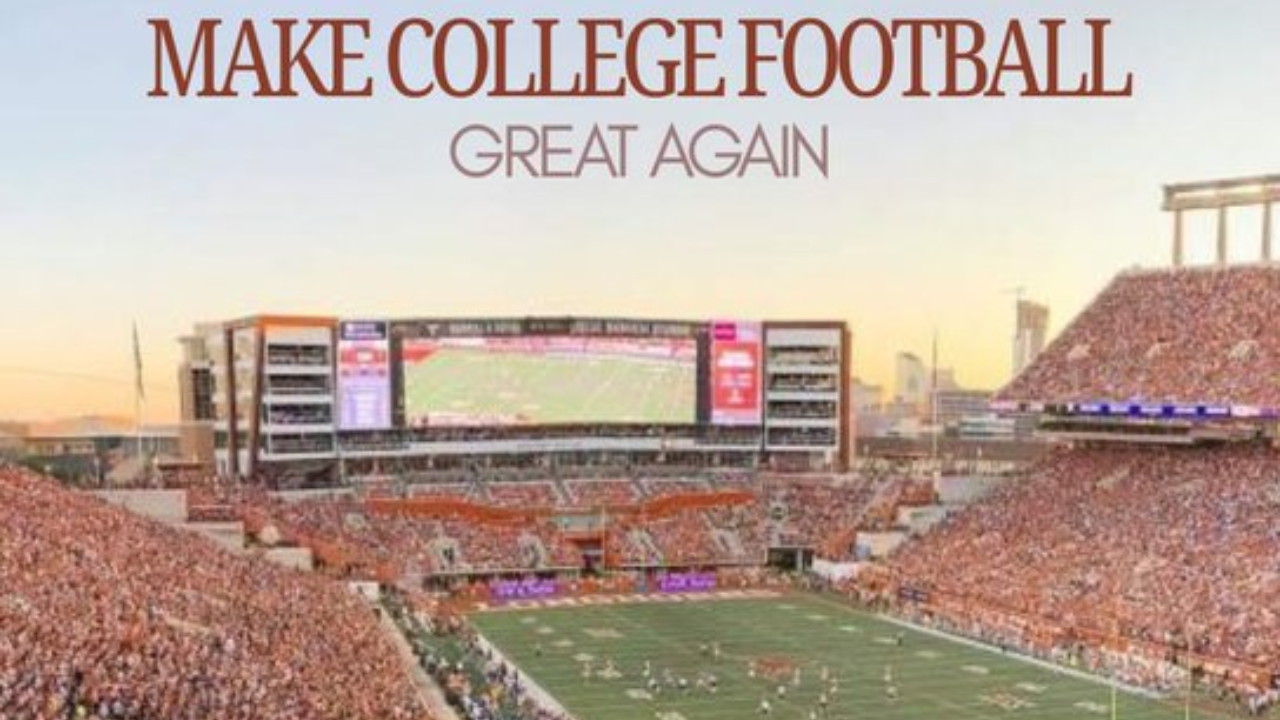
The lines separating public policy, social media provocation, and collegiate athletics have officially dissolved. When the United States Department of Education deployed a public social media graphic featuring the slogan "Make College Football Great Again" closely following a racially charged controversy ignited by Texas political figure Bo French, it was more than an tone-deaf comms blunder. It marked a symptom of a deeper decay. State apparatuses, political operatives, and cultural crusaders are weaponizing America's favorite Saturday obsession for partisan warfare.
To understand how a federal agency managed to entangle itself in a localized culture war over a University of Texas football game crowd, you have to look at the structural incentive system of modern American politics. Outrage is currency. Nuance is dead. And collegiate athletics, long viewed as the final secular religion holding fragmented communities together, makes for an exceptionally potent billboard.
The Anatomy of a Manufactured Firestorm
The sequence of events was swift, predictable, and engineered for maximum digital friction. Following a dramatic Texas Longhorns victory, Bo French, a Republican candidate for the Texas Railroad Commissioner, posted an image of students celebrating in the stands, accompanied by commentary targeting the demographic makeup of the student body. The resulting backlash was immediate, drawing condemnation across the political spectrum for targeting South Asian American students exercising their right to cheer for their university.
Days later, the official account for the United States Department of Education pushed out its "Make College Football Great Again" graphic. To any media literate observer, the dog whistle was deafening. Congressional leaders like Representative Raja Krishnamoorthi quickly stepped forward to denounce the department, pointing out the dangerous normalization of exclusionary rhetoric coming from federal platforms meant to serve all students.
Yet, the department's institutional reflex was not contrition; it was silence or deflection. This avoidance highlights a chilling reality. The people occupying positions of public trust are no longer trying to govern objectively. They are auditioning for algorithmic engagement.
The Commodification of Saturday Tradition
College football has always possessed an undercurrent of parochial tribalism. That is its charm. The pageantry, the bands, the tailgates, and the localized regional pride give millions of Americans a harmless outlet for belonging.
Politicians know this. For decades, governors have milked state universities for photo ops, walking onto turf fields in customized jerseys to bask in reflected glory. But what we are witnessing now goes far beyond standard glad-handing. It is a systematic attempt to retrofit college sports into a cultural battlefield.
When political figures scrutinize who is sitting in student sections based on ethnicity or background, they are signaling to their base that institutional spaces—even public universities—belong exclusively to a favored demographic. When a federal education agency echoes politically charged slogans right on the heels of such an incident, it crosses the line from tone-deaf meme usage to active participation in exclusion.
Institutions that are supposed to protect educational equity are instead winking at the peanut gallery.
The Hollow Core of Institutional Neutrality
Public agencies are bound by norms of neutrality. At least, they used to be. The erosion of these guardrails means that communication shops inside major federal bureaus are increasingly staffed or influenced by culture-war operatives who treat public communications like a burner account on X.
The defense is always the same. It was a joke. It was a pop-culture reference. It was misinterpreted.
Nobody is buying it anymore. We have reached a saturation point where the public recognizes a dog whistle even when wrapped in pigskin. When the agency responsible for overseeing federal civil rights in schools appears to validate partisan anxiety over the demographic evolution of college campuses, the betrayal of public trust is complete.
University campuses have changed. They reflect a changing America, whether certain political candidates like it or not. The students in those stadium seats at Austin or any other major research institution are paying tuition, studying organic chemistry, stressing over finals, and yes, rushing the field after a win. They are not political props. They are citizens.
Where the Ball Drops Next
The real tragedy here isn't just a clumsy graphic or a politician's offensive tweet. It's the relentless poisoning of communal spaces. Sports used to be the one place where you could stand next to a stranger, scream until your voice cracked, and high-five someone whose voting record you knew nothing about and cared even less about.
By dragging the culture wars onto the 50-yard line, political actors are systematically destroying the last neutral zones left in American life. If every public gathering, every student section, and every federal agency is co-opted into a purity test for who belongs, we lose the capacity to function as a shared society.
The Department of Education should be focused on reading scores, chronic absenteeism, and the staggering debt crushing a generation of graduates. Instead, it is playing footsie with internet trolls.
The scoreboard is flashing, but nobody is keeping track of what actually matters.
Bo French doubles down on racially charged post
This video provides additional context regarding the initial controversy surrounding Bo French's remarks on University of Texas students and the subsequent political fallout.