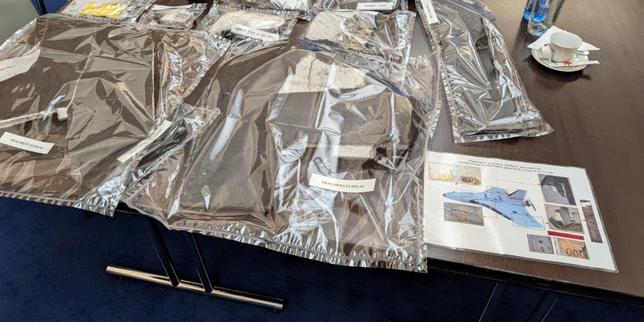
The border between the North Atlantic Treaty Organization and the ongoing conflict in Ukraine has blurred. It is no longer marked by high-altitude spy planes or satellite imagery alone. Instead, the boundary is defined by the low, buzzing whine of Iranian-designed Shahed loitering munitions crossing into Romanian and Moldovan airspace. For Bucharest and Chișinău, these incursions represent a dangerous shift in the mechanics of modern regional security. These nations are finding that their legal frameworks and physical defense systems were never designed for the granular, persistent threat posed by wayward or intentionally testing unmanned aerial vehicles.
The reality is that Russia is probing the threshold of NATO's patience. Every drone that drifts over the Danube or crosses the border into Moldova acts as a stress test for international alliances. These are not necessarily acts of full-scale aggression intended to start a kinetic war, but rather calculated demonstrations of weakness. They exploit the gaps between international law, which demands a clear act of war to trigger a response, and the reality on the ground, where a falling drone is simply a catastrophe waiting to happen.
The Geography of Vulnerability
The geography of the region is a tactical nightmare. The Danube Delta is a vast, marshy maze that provides excellent cover for low-flying objects seeking to evade traditional radar detection. When Russian forces target Ukrainian port infrastructure at Izmail or Reni, they are literally firing into the blind spots of the alliance. A drone traveling at low speed and low altitude over these waters becomes difficult to track with precision. If it deviates by a few hundred meters, it enters Romanian sovereign territory.
For Romania, the challenge is twofold. First, there is the technical requirement of detection. NATO air defense systems are built to stop jets and cruise missiles, not necessarily small, propeller-driven drones that barely register on traditional systems. Second, there is the political requirement. Downing a drone over a populated area could cause more damage than the drone itself. The debris field alone is a hazard, and the diplomatic implications of shooting down a Russian aircraft—even an unmanned one—force a level of deliberation that consumes precious seconds.
Moldova faces a different, arguably more acute, set of pressures. Without the protective umbrella of NATO membership, Chișinău is forced to balance its western aspirations with the reality of its limited air defense capabilities. For Moldova, these drone incursions are a psychological weapon. They serve to remind the population that their sovereignty remains conditional. It is a slow-burn intimidation campaign designed to prevent the country from integrating too deeply into European security structures.
Why Current Defense Strategies Falter
The current strategy for dealing with these incursions leans heavily on surveillance and protest. Governments track the flight paths, issue alerts to local populations, and lodge diplomatic complaints. However, this is a reactive posture in a theater that demands proactive engagement.
Consider a hypothetical scenario where an intelligence analyst tracks a swarm of drones approaching the border. The systems detect the flight path with 90 percent accuracy. Yet, the final 10 percent of flight trajectory remains opaque due to electronic interference or terrain masking. By the time the command structure confirms the drone has crossed the border, it has already passed over the critical zone. Attempting to intercept such a target requires a rapid decision-making cycle that current bureaucratic chains simply cannot sustain.
The failure here is one of imagination. We are applying cold war models to a conflict dominated by off-the-shelf technology. Russia utilizes a mix of high-end military drones and cheap, mass-produced systems that effectively saturate the radar environment. When a radar screen is cluttered with dozens of potential contacts, the risk of misidentification rises exponentially. This is exactly what the operators intended. They want to force the air defense command to choose between inaction or an accidental escalation.
The Technological Arms Race
The answer is not found in more expensive missile batteries, which are too costly to use against inexpensive drones. It lies in distributed sensor networks and directed energy solutions. Romania has begun moves to modernize its air defense, but hardware procurement is a slow, multi-year process. In the meantime, the threat is evolving at the speed of software updates.
There is also the matter of electronic warfare. The ability to jam the communication links of these drones before they reach the border is the most effective deterrent available. Yet, this requires an active, persistent electronic presence that can be seen as an act of escalation in its own right. If a neighbor begins jamming frequencies across the border, they are essentially interfering with the operations of a nuclear-armed power. The calculus is precarious.
Moldova has requested assistance from European partners, seeking radar systems that can detect these smaller signatures. But buying the equipment is only half the battle. They require the trained personnel to interpret the data in real-time and the legal authority to act. Currently, the legislative process in many of these states is ill-equipped for a scenario that unfolds in under five minutes.
The Political Cost of Inaction
Silence is interpreted as consent. When incursions are documented but met with nothing more than rhetoric, the threshold for future incursions lowers. This is the danger of the current trajectory. It normalizes the violation of sovereign airspace.
Furthermore, the domestic populations in both Romania and Moldova are growing restless. Living under the constant buzz of military hardware, even if it is just a stray drone, creates a palpable sense of unease. It disrupts local economies, complicates agricultural activities along the border, and feeds the narrative of a government that cannot secure its own territory. This internal pressure limits the maneuvering room for political leaders. They must appear strong without inviting a direct confrontation that their military might not be prepared to handle.
The integration of these nations into the European air defense shield is now a requirement rather than a goal. This means creating a unified data stream where a radar ping in the Danube Delta is instantly visible to a command center in Brussels. It removes the human delay of relaying information between national governments and international headquarters. It turns the entire eastern flank into a single, cohesive observation point.
Beyond the Horizon
The history of border conflicts is littered with states that waited too long to address the subtle intrusions of their neighbors. Once the precedent is established that a border is porous, it becomes almost impossible to harden it later without triggering the very conflict one sought to avoid.
Moving forward, the focus must shift to localized, autonomous response mechanisms. These systems would utilize machine learning to distinguish between a commercial drone, a bird, and a military-grade loitering munition. They would operate on a semi-autonomous basis, allowing for a defensive reaction within seconds, far faster than any human operator could authorize. It is a controversial path, raising ethical questions about automated warfare, but it is likely the only realistic solution to the persistent drone problem.
There is no simple fix for the skies over the Black Sea. The conflict in Ukraine has fundamentally altered the security equation for its neighbors. They are currently the frontline of an invisible war where the primary weapon is the drone, and the primary objective is to maintain control of the narrative. As the technology continues to proliferate, the challenge will only grow more intense. The question is no longer whether another drone will cross the border, but how long it will take before one of these incidents creates a reality that cannot be managed through diplomacy alone.