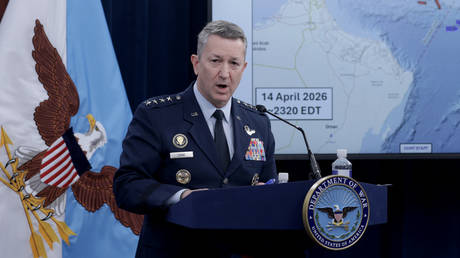
The United States has officially shifted from a regional blockade to a global maritime dragnet. General Dan Caine, Chairman of the Joint Chiefs of Staff, confirmed this week that American naval assets are now authorized to pursue and seize Iran-linked vessels anywhere on the high seas. This isn't just about patrolling the Persian Gulf anymore. From the Malacca Strait to the South China Sea, the Pentagon is hunting the "Shadow Fleet"—a ghostly armada of aging tankers that has kept Tehran’s economy on life support for years. By targeting these ships worldwide, Washington is betting it can choke off Iran’s remaining revenue before a fragile ceasefire expires.
The Ghost in the Machine
For a decade, Iran has refined the art of the "dark transit." It is a sophisticated game of cat and mouse involving AIS (Automatic Identification System) spoofing, where a ship’s transponder broadcasts a false location while the vessel is actually loading crude at Kharg Island. These ships often fly "flags of convenience" from nations like Panama, Liberia, or the Cook Islands, making legal interdiction a jurisdictional nightmare.
The new US strategy ignores the paperwork. By declaring a global pursuit of "material support" to Iran, the US is effectively asserting that the cargo—not the flag—dictates the target. This moves the conflict out of the legal gray zones of sanctions and into the black-and-white reality of a kinetic blockade.
Risking a Great Power Collision
The primary destination for this oil isn't a secret. It is China. For years, "teapot" refineries in China’s Shandong province have been the primary sink for Iranian crude, often rebranded as Malaysian or Omani oil during ship-to-ship transfers in the Middle East or Southeast Asia.
By expanding the hunt to the Pacific, the US is putting its destroyers on a collision course with Chinese interests. If a US boarding party climbs the rails of a Chinese-owned tanker in international waters, the "ceasefire" between Washington and Tehran becomes the least of the world’s worries. Beijing has already voiced concern, and while they rarely seek open conflict at sea, they view energy security as a core national interest. This global expansion isn't just a pressure tactic against Iran; it is a direct test of China’s patience.
The Fragility of the Shadow Fleet
There is a technical reason these ships are being targeted now. Most vessels in the Iranian shadow fleet are decades old, poorly maintained, and uninsured. They are environmental disasters waiting to happen.
- Average Age: Many of these tankers are over 20 years old, well past the point where reputable shippers would scrap them.
- Insurance Gaps: Because they operate outside the "P&I" (Protection and Indemnity) clubs, they lack the multi-billion dollar coverage required for major spills.
- Safety Standards: Crewed by sailors willing to work in legal limbo, these ships often bypass standard maintenance cycles to stay at sea.
Washington is using this lack of legitimacy as a lever. By framing the crackdown as an enforcement of "maritime safety" and "international norms," they are attempting to peel away the neutral nations that allow these ships to dock. However, the brute force of a naval blockade is a blunt instrument. When you threaten to fire on a tanker, the risk of a catastrophic oil spill in a sensitive waterway like the Malacca Strait becomes a very real possibility.
Economic Aftershocks
The immediate result of the blockade has been a spike in Brent Crude prices. While the US claims the Strait of Hormuz remains "open" for non-Iranian traffic, the reality on the water is different. Insurance premiums for any vessel entering the Gulf have skyrocketed. Shipping companies are faced with a brutal choice: risk a $2 million "toll" demanded by Iran’s Revolutionary Guard to pass through the Strait, or risk being boarded and seized by the US Navy if their cargo is even tangentially linked to Tehran.
This "compliance by fear" is working in the short term. According to CENTCOM, at least 14 vessels turned around in the first 72 hours of the blockade rather than face a boarding party. But the global economy cannot sustain a permanent state of maritime high noon. The longer this dragnet stays in place, the more it disrupts the "just-in-time" logistics of global energy.
The Legal Brinkmanship
International law is being stretched to its breaking point. Traditionally, a blockade is an act of war. By calling this a "maritime interdiction" or an "enforcement of contraband," the US is trying to avoid the "W-word" while reaping the benefits of total control.
General Caine was blunt: "If you do not comply with this blockade, we will use force." That is not the language of a regulatory body. It is the language of a combatant. The US is banking on the idea that Iran is too degraded to retaliate effectively. With its command and control reportedly at its "worst ever" according to Defense Secretary Pete Hegseth, Tehran may indeed be cornered. But a cornered regime often looks for the most asymmetric, painful way to strike back.
No Way Out
The end game remains opaque. If the goal is to force Iran back to the negotiating table in Pakistan, the global ship hunt might be the final turn of the screw. If the goal is regime collapse, the US may find that sinking the shadow fleet only forces the conflict into more dangerous, unconventional territory.
The sea has always been a place where rules are negotiated by the side with the biggest guns. Right now, those guns are American. But as the hunt moves into the Pacific and beyond, the definition of "Iranian-linked" will become the most contested phrase in the world. The US has the power to stop the ships, but it has yet to prove it can do so without setting the global order on fire.
The dragnet is out. The ships are being tracked. The next move belongs to the captains of the shadow fleet—and the patrons in Beijing who keep them afloat.



