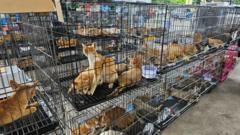
Police in Vietnam recently intercepted a major smuggling operation, rescuing hundreds of stolen cats crammed into a vehicle bound for slaughterhouses. While animal welfare organizations celebrated the immediate intervention, the bust highlights a systemic, highly lucrative black market that operates largely in the shadows. The illegal trade of cat meat, known locally as "little tiger," continues to thrive despite shifting public attitudes and sporadic law enforcement crackdowns.
To truly understand why this trade persists, one must look beyond the surface-level shock value of police raids and examine the economic, cultural, and logistical networks that keep the supply chains running.
The Economics of a Stolen Supply Chain
The trade does not rely on commercial farming. Breeding cats for meat is financially non-viable due to their carnivorous diet, slow growth rates, and territorial nature. Instead, the entire industry relies almost exclusively on theft.
Sourcing networks operate with calculated efficiency. Professional thieves target residential neighborhoods at night, utilizing wire snares, poisoned bait, and specialized nets to capture roaming pets and stray animals. For these thieves, the financial incentive outweighs the legal risks. A single cat can fetch a significant payout when sold to a local consolidator, making it a highly profitable enterprise in rural or low-income areas.
These local consolidators act as the middle tier of the supply chain. They collect animals from dozens of individual thieves, storing them in hidden holding facilities until they have enough volume to fill a transport truck. This is the point where the operation becomes highly vulnerable to law enforcement, as large vehicles must move across provincial lines to reach major urban demand centers, particularly in northern Vietnam.
Regulatory Blind Spots and Enforcement Gaps
Vietnam has enacted various regulations over the years to curb the trade, yet enforcement remains inconsistent. At one point, a directive aimed at preventing plague outbreaks banned the consumption and trade of cat meat entirely. However, that specific regulation was later repealed, leaving a fragmented legal framework that local authorities struggle to apply uniformly.
The primary legal tool currently available involves anti-smuggling and sanitation laws. Transporting live animals across provinces without proper health certification, vaccination records, or proof of origin is illegal. When police intercept a shipment, it is typically on these grounds rather than specific animal cruelty statutes.
For a provincial police officer, managing an intercepted truck presents a logistical nightmare.
Seizing hundreds of live, potentially diseased animals requires immediate veterinary care, secure housing, and food. Local police departments rarely possess the budget or infrastructure to handle this burden. Without immediate assistance from domestic or international animal welfare non-governmental organizations (NGOs), authorities often find themselves ill-equipped to process the seizure effectively. This logistical bottleneck creates a natural deterrent against aggressive enforcement.
The Myth of Tradition versus Modern Consumption
The consumption of cat meat is frequently mischaracterized as an ancient, uninterrupted cultural tradition. Historical data suggests otherwise. While the consumption of various meats occurred during periods of severe famine and war, the widespread commercialization of "little tiger" as a leisure food is a relatively modern phenomenon, gaining traction in the late 20th century alongside rising disposable incomes.
Today, consumption is heavily tied to specific social rituals and superstitious beliefs.
Many consumers believe that eating cat meat at the start of the lunar month brings good fortune, boosts vitality, or wards off bad luck. It is primarily consumed in specialized restaurants, often accompanied by rice wine, serving as a status symbol or a bonding ritual among specific demographics.
This demand exists in direct opposition to a rapidly growing counter-trend within the country. Vietnam's urban middle class is experiencing a massive surge in pet ownership. For millions of younger Vietnamese citizens, cats are viewed strictly as companion animals and family members. This demographic shift has turned pet theft into a deeply emotional and volatile flashpoint, sparking intense online campaigns and community-led night watches to protect neighborhoods from thieves.
Public Health Risks Beyond the Slaughterhouse
The unregulated movement of thousands of stressed, injured, and unvaccinated animals poses a severe public health threat. The conditions within transport trucks and holding cages are optimal for the transmission of zoonotic diseases.
Cats are packed tightly into cramped bamboo or wire crates, frequently suffering from dehydration, broken limbs, and open wounds. Under these extreme stress levels, their immune systems fail, allowing viruses and bacteria to shed rapidly.
While rabies is most commonly associated with dogs, cats are equally capable of transmitting the virus to humans through bites, scratches, or exposure to fluids during the slaughtering process.
Because the entire supply chain operates outside the purview of the Ministry of Agriculture and Rural Development, there is zero veterinary inspection. Meat enters the kitchen without any screening for salmonella, E. coli, or parasites. The workers handling these animals—often without gloves or protective gear—serve as the primary vector for potential outbreaks, carrying pathogens back to their families and communities.
The Roadblocks to a Permanent Resolution
Eradicating the underground trade requires addressing the root economic drivers rather than relying solely on sporadic highway intercepts. As long as the profit margins remain high and the penalties for pet theft remain low, new smuggling rings will inevitably emerge to replace those disrupted by police.
Currently, pet theft is often treated as a minor property crime rather than a serious offense, provided the monetary value of the stolen animal falls below a specific legal threshold. Without stricter penal codes that recognize the societal harm of pet theft and the public health risks of unregulated meat distribution, the judicial system lacks the teeth to deter offenders.
Furthermore, a sustainable solution demands a permanent infrastructure for rescued animals. NGOs can only absorb a fraction of the animals seized in major busts. Long-term progress hinges on the establishment of government-backed animal shelters, nationwide rabies vaccination initiatives, and comprehensive public education campaigns targeting the superstitions that drive demand. Until the market for "little tiger" faces both legal consequences and a total loss of social acceptability, the quiet war on Vietnam's streets will continue.