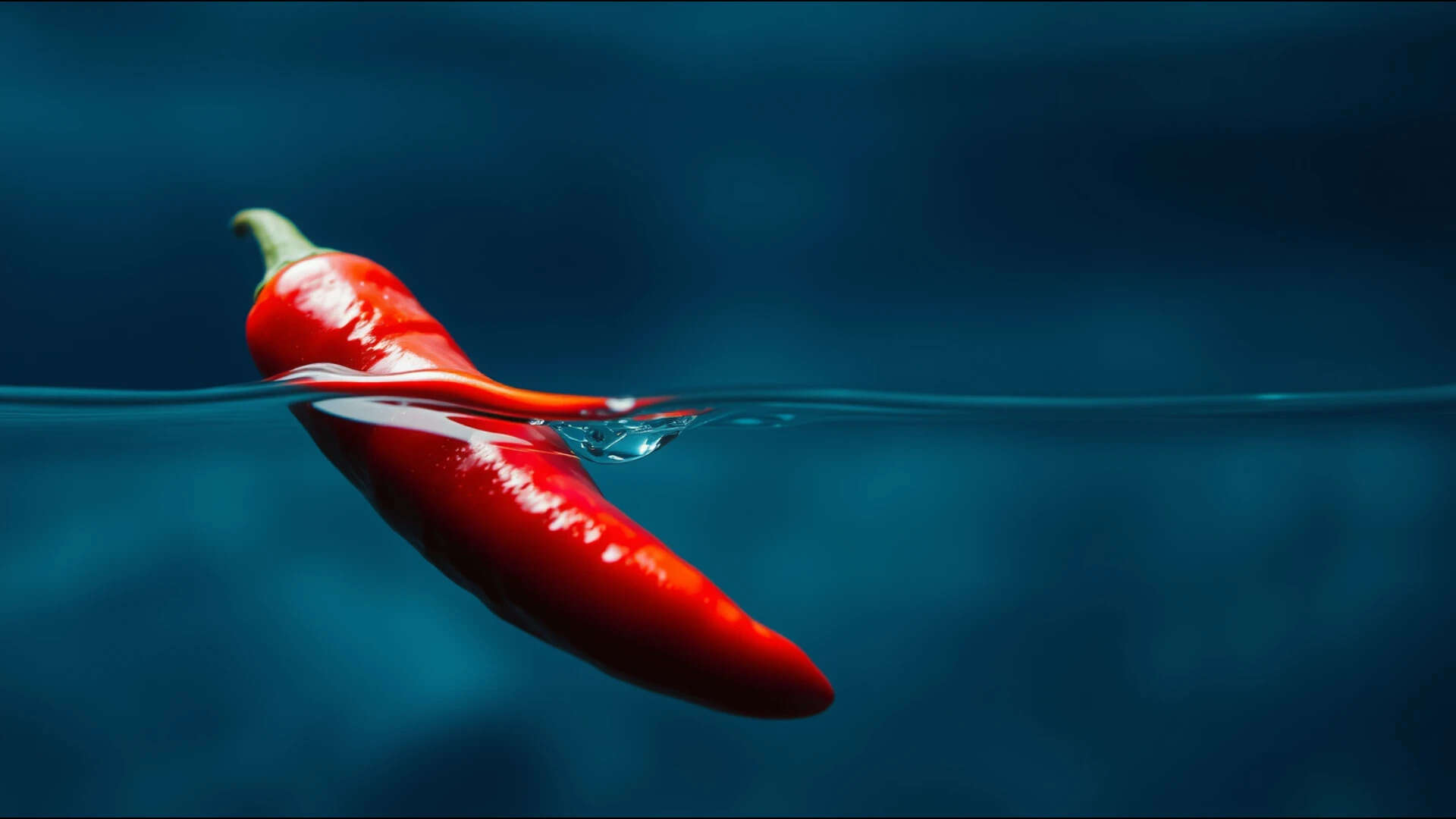
The water in the deep bay off the coast of Southern Myanmar is not blue. It is a thick, churning green, heavy with silt from the delta and dark with the shadows of underwater trenches. If you drop a stone here, it vanishes within seconds. If you dive down seven fathoms—about forty-two feet into the crushing, sunless cold—the pressure builds against your eardrums until the silence itself feels loud.
Up on the wooden deck of the fishing trawler, the midday heat is oppressive. The air smells of salt, drying nets, and the sharp, unmistakable sting of crushed bird’s eye chillies from a shared lunch bowl.
An old maritime proverb in this part of the world speaks directly to this contrast. A real chilli, seven fathoms under water, will still taste hot.
It sounds like a bit of folklore, a colorful exaggeration told by sailors to pass the time. But it is actually a profound psychological truth wrapped in an agricultural metaphor. It is a statement about what cannot be broken.
We live in a culture obsessed with surface presentation. We polish our public profiles, rehearse our reactions, and construct elaborate personas designed to withstand the mild breezes of daily scrutiny. We mistake this public-facing armor for strength. But true character has nothing to do with how we perform when the sun is shining and the audience is clapping. Character is about what survives when you are dragged into the deep.
The Anatomy of the Deep
Consider a hypothetical woman named Thiri.
Thiri runs a small, independent textile workshop in Yangon. For a decade, her business survived on predictable rhythms: steady local orders, reliable suppliers, and a tightly-knit team of weavers who knew each other’s families. To the outside world, Thiri was a success because her ledger balanced. She was kind because it was easy to be kind when the orders arrived on time. She was patient because there was very little to be impatient about.
Then, the economy shifted. A major international contract defaulted without warning. The workshop’s bank account emptied within forty-eight hours. Suddenly, Thiri was not just a business owner; she was a woman responsible for the livelihoods of twenty families with no money to pay them.
This is the first fathom.
Pressure changes things. In materials science, engineers talk about the "yield point"—the precise moment of stress where a material ceases to behave elastically and plastically deforms, permanently changing its shape. Humans have a yield point too. When the pressure hits, the polite, cultivated layers of personality begin to peel away like cheap paint.
Under the weight of that first financial crisis, Thiri faced a choice that thousands face daily in anonymity. She could cut her losses, quietly dissolve the company, and protect her personal savings while leaving her weavers to fend for themselves. Or she could carry the weight.
The proverb does not say the chilli stays dry. It does not say the chilli remains untouched by the ocean. The salt water invades every crevice. The cold numbs the skin. The darkness isolates.
But the heat remains.
The Illusion of Environment
We often blame our failures of character on our circumstances. If only I weren’t so stressed, I wouldn’t have snapped. If only the system weren’t corrupt, I wouldn’t have cut that corner. We treat character like a liquid, assuming it must take the shape of whatever container it is poured into. If the container is hostile, we believe we have a license to be hostile. If the environment is dark, we allow ourselves to go dim.
But the biology of a chilli pepper defies this logic. The heat of a chilli does not come from the sun, the soil, or the rain, though it needs those things to grow. The heat comes from a chemical compound called capsaicin, concentrated heavily in the white placental tissue that holds the seeds. Capsaicin is an evolutionary defense mechanism. It exists to protect the plant’s future from fungi and predators.
The heat is intrinsic. It is manufactured from within.
When you submerge that pepper under forty feet of ocean water, the surrounding environment is entirely antithetical to fire. The ocean is wet; fire is dry. The ocean is freezing; fire is hot. Yet, if a diver were to pluck that pepper from the mud at the bottom of the sea, crush it between their fingers, and bring it to their tongue, the chemical reality remains unchanged. The capsaicin still binds to the pain receptors. The brain still registers a burn.
This is not a metaphor for stubbornness. It is an illustration of core identity.
When Thiri decided to look her weavers in the eye, admit the money was gone, and promise them she would find a way to pay them even if it meant selling her own family jewelry, she was not reacting to her environment. She was reacting to her internal composition. The external world was telling her to hoard, to hide, to survive individually. The internal heat dictated otherwise.
The Modern Submersion
It is easy to look at historical figures—dissidents, martyrs, pioneers—and see the seven-fathom rule in action. We read about people who endured solitary confinement without betraying their comrades, or leaders who stood against mobs to defend an unpopular truth.
But the deep water of the modern world is rarely that dramatic. It is slower. More corrosive.
Consider what happens next in the quiet crises of everyday life:
- The middle manager who discovers a financial discrepancy and chooses to report it, knowing it will derail their career progression.
- The caregiver who spends years tending to an ailing parent in an empty house, long after the friends have stopped calling and the compliments have dried up.
- The student who refuses to join in the casual, devastating mockery of an outsider on a group chat, choosing social isolation over compliance.
These individuals are underwater. They are operating in environments where their integrity yields no immediate reward, where their kindness is invisible, and where their honesty looks like foolishness.
The danger of the deep water is not just the pressure; it is the temptation to adapt. The human mind is incredibly adept at rationalization. When we are surrounded by cold, dark water, we tell ourselves that becoming cold and dark is simply a matter of survival. We dilute ourselves to match the ocean.
But dilution is a choice, not an inevitability.
Testing the Chemistry
How do you know what your own chemical composition is before the storm hits?
You don’t. Not completely.
We can guess. We can write personal mission statements and take personality quizzes. We can sit in comfortable rooms and pledge our allegiance to high ideals. But until the environment turns hostile, those ideals are just theories. They are dry chillies sitting in a jar on a kitchen shelf, looking pretty but untested.
The true test requires pressure. It requires the absence of an audience.
I remember watching a small carpentry business dismantle itself during a regional timber shortage years ago. The owner, a quiet man who never talked about his values, spent his final liquid assets ensuring that his apprentices were placed with other masters before he closed his doors permanently. He didn't post about it. He didn't write an inspiring essay on LinkedIn. When asked why he didn't just file for bankruptcy and walk away with his house intact, he looked genuinely confused by the question.
"If I don't look after the boys," he said, "then who am I?"
He wasn't trying to be a hero. He was simply incapable of being anything else. The heat was too deeply embedded in his tissue to be washed away by a bad market.
The Undiluted Self
The Burmese proverb does not promise that the chilli will change the ocean. The seven fathoms of water will remain cold, dark, and immense long after the pepper is gone. The world does not automatically become a kinder place just because you choose to maintain your integrity in the dark.
But the point was never to change the ocean. The point is to prevent the ocean from changing you.
There is a distinct, quiet terrifying beauty in watching someone who knows exactly who they are when everything else has been stripped away. They do not shout. They do not demand attention. They simply exist in their true state, burning quietly in the deep, maintaining their temperature against the weight of the world.
Imagine the diver reaching the bottom of the bay. The light from above is gone. The air is mechanical, pumped through a rubber hose. Everything is gray, uniform, and cold. And there, tucked into the silt, is a small, fierce spark of red. You bite into it, and for a second, the cold disappears. The darkness vanishes. There is only the heat.