History has a weird habit of recycling itself. Sometimes that recycling takes the literal form of nineteenth-century battleship plating ending up inside a modern medical scanner. You've probably heard wild stories about low-background steel salvaged from sunken wrecks. Most people assume it's just maritime lore or a treasure hunter's fever dream. The truth is much stranger, involving a massive act of defiance at Scapa Flow more than a century ago.
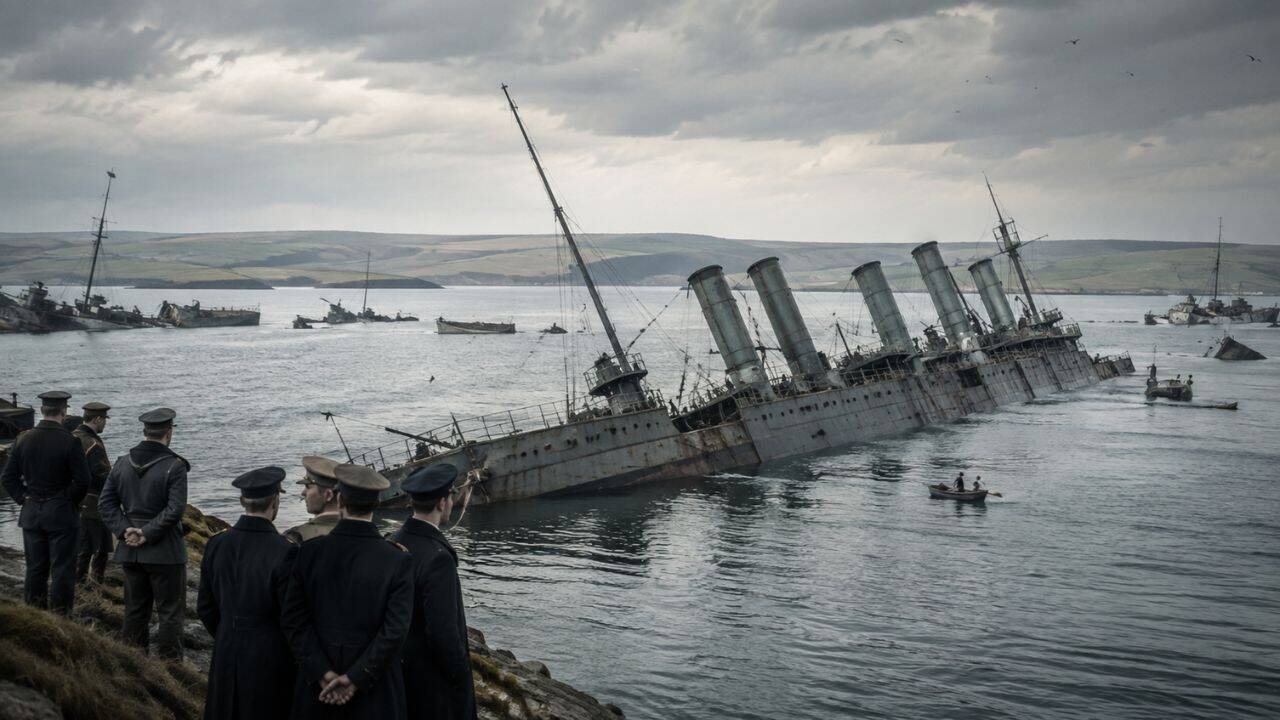
Picture June 21, 1919. World War I ended months earlier, but the peace treaty negotiations were still crawling along in Paris. The Imperial German High Seas Fleet sat interned at the British naval base of Scapa Flow in Orkney, Scotland. Rear Admiral Ludwig von Reuter knew the victorious Allies planned to carve up his ships among themselves. He decided to deny them the satisfaction. He ordered his crews to scuttle the entire fleet. Fifty-two warships went down in the chilly Scottish waters in a single afternoon.
It was the greatest loss of warships in history outside of actual combat. For decades, those massive iron and steel hulls sat on the muddy seafloor. They became a forgotten graveyard of a bygone military empire. Then, the atomic age changed everything about how we look at metal.
The Nuclear Age Changed Everything About Steel
You can't make sensitive radiation-detection equipment out of ordinary modern steel anymore. That sounds counterintuitive until you understand how the twentieth century polluted our atmosphere.
When the United States and the Soviet Union started detonating atomic bombs in the atmosphere during the 1940s and 1950s, they blanketed the globe in fallout. Every blast spewed radioactive isotopes into the air. Industrial steel production requires massive amounts of atmospheric air blown into blast furnaces. Because of this, every ton of steel manufactured after 1945 carries a faint radioactive signature.
Cobalt-60 and other isotopes embed themselves directly into the crystalline structure of the metal. If you build a Geiger counter, a whole-body particle counter, or a sensitive medical mass spectrometer using post-war steel, the casing itself emits background radiation. That radiation ruins the accuracy of devices designed to measure minute traces of decay.
Scientists hit a wall. They needed steel manufactured before the trinity test in July 1945. They needed pristine, uncontaminated metal forged in a world that had never split an atom.
How Scapa Flow Became a Deep Sea Mine
Enter the salvage divers and scrap metal entrepreneurs. The Scapa Flow wrecks were massive steel mountains resting in relatively shallow water. They weren't just historic artifacts. They were literal vaults of pre-atomic steel.
Salvage operations began almost immediately after the scuttling, though for entirely economic reasons rather than scientific ones. Between the wars, companies like Cox and Danks used ingenious methods to raise massive dreadnoughts, patching holes and pumping compressed air into inverted hulls. They dragged hulls like the SMS Kaiser to the surface, towed them to Rosyth, and chopped them up for scrap.
Scrap metal yards fed hungry post-war industrial booms with salvaged dreadnought steel. By the time physicists realized they needed low-background steel for sensitive physics experiments and medical instruments, a huge portion of the Scapa Flow fleet had already been melted down.
People assume all the steel was gone. That's a myth. Several massive capital ships proved too difficult or too deep to raise during the early twentieth-century attempts. Heavy cruisers, destroyers, and battleship fragments stayed put.
Where Low Background Steel Actually Goes Today
Physicists don't just use salvaged warship steel for fun. They need it for shielding equipment that measures weak radioactive signals from space or from rare particle interactions.
Think about dark matter detectors buried deep underground in former mines. Think about sensitive medical equipment used to monitor patients for radiation exposure. If the shield surrounding the sensor is radioactive, the instrument detects its own enclosure instead of the target signal.
Low-background steel acts as a quiet room. It blocks stray environmental gamma rays without adding its own noise to the mix.
Aside from Scapa Flow, salvagers have targeted other pre-1945 shipwrecks. The ships scuttled at Operation Crossroads or historical wrecks from World War I naval engagements all share the same superpower. They were sealed off from the atomic atmosphere.
The Reality Check on Salvaged Warship Metal
Let's clear up a major misconception. Not every piece of sunken steel from 1919 is a goldmine. The market has changed dramatically.
Modern technology has caught up in unexpected ways. Particle detectors have grown so sensitive that researchers can sometimes compensate digitally for modern steel's background radiation. Meanwhile, alternative materials like ancient lead recovered from Roman shipwrecks have sometimes filled similar shielding roles, though lead brings its own toxicity and structural challenges.
Furthermore, diving on protected war graves is heavily restricted. You can't just rent a chainsaw, swim down to a protected British heritage site in Scotland, and hack off a chunk of a battleship. Scapa Flow is a designated Scheduled Ancient Monument. The remaining wrecks are protected under the Ancient Monuments and Archaeological Areas Act.
The days of commercial enterprises blasting open dreadnoughts for scrap are long gone. The steel that was recovered decades ago is the primary source for existing ultra-low background applications. When a laboratory needs this material today, they rely on stockpiles harvested during those early twentieth-century salvage operations.
Why This Forgotten History Still Matters
We live in a world obsessed with the new. We throw away materials the second they outlive their immediate utility.
The story of the Scapa Flow scuttling flips that dynamic on its head. A desperate military maneuver designed to spite a rival navy accidentally preserved a pristine environmental time capsule. Admiral von Reuter wanted to deny his enemies trophies. He ended up handing future nuclear physicists an irreplaceable resource.
Next time you hear about high-tech physics laboratories probing the deepest mysteries of the universe, remember what holds them together. Sometimes it is not cutting-edge synthetic polymers or space-age alloys. Sometimes it is the melted-down hull of a German dreadnought, rusting quietly on a Scottish seabed until humanity finally caught up to its potential.
Check your assumptions about waste and history. What we discard today might be the exact resource our descendants need to solve problems we haven't even invented yet.